
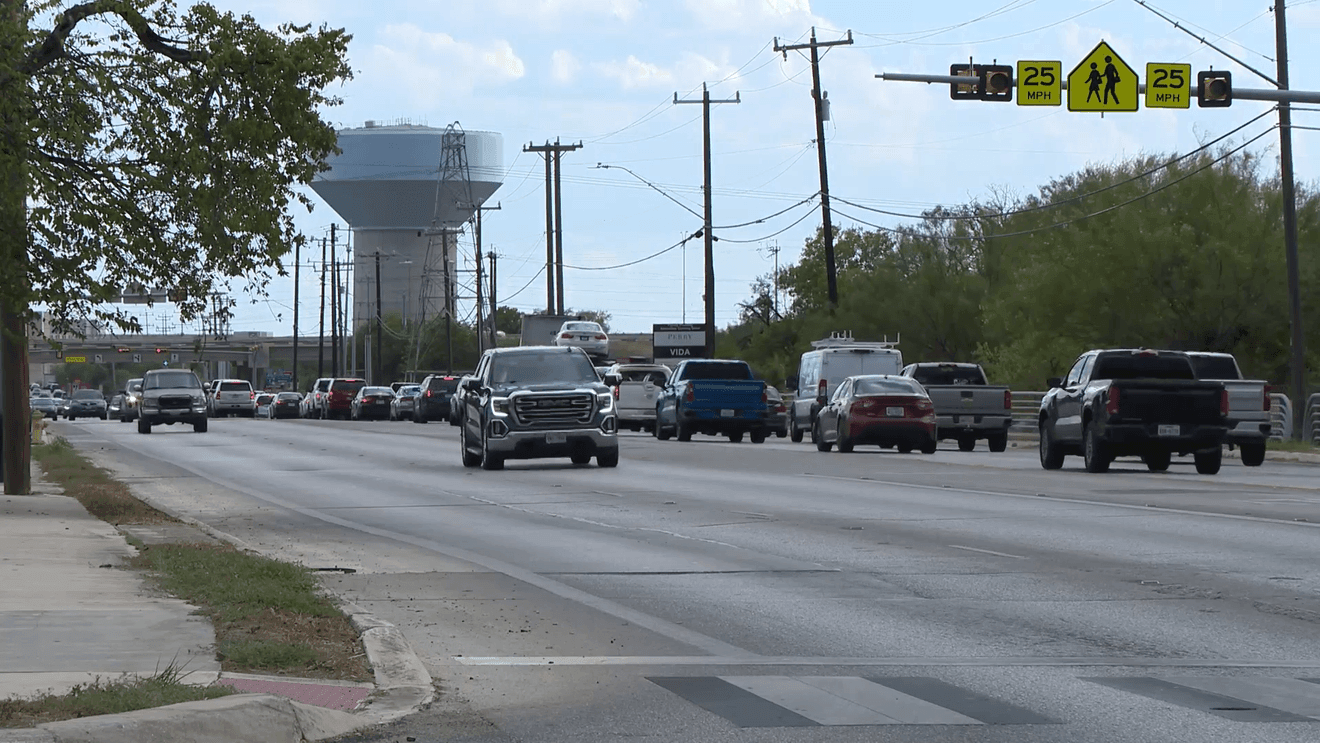
SAN ANTONIO — As development continues across San Antonio’s South Side, some longtime residents say infrastructure along South Zarzamora Street is struggling to keep pace with the area’s growth.
Edward Mata has lived just off South Zarzamora for nearly 50 years. He said traffic is particularly heavy from about 6:30 to 8:30 a.m. and again from roughly 2:30 or 3 p.m. until 6 or 7 p.m.
During those busy periods, Mata said he sometimes avoids the closest exit from his neighborhood altogether.
“During that time, for me to go out onto South Zarzamora, I have to travel down about a block and a half, two blocks, because there’s a traffic light there,” Mata said. “That’s where I go in and out of this neighborhood.”
Mata said he has watched the area change significantly since moving into his home in 1976.
“This is the worst,” Mata said of the traffic. “Of course, this is the most development that has been going on with the hospital, A&M and Toyota and all that.”
Mata said he welcomes development but believes infrastructure improvements need to accompany it.
“I’m glad the hospital is going up and things of this nature, and the improvements that they’ve done in that area are great, but we need greater improvements on this end of South Zarzamora Street,” Mata said.
Among the changes Mata would like to see are additional traffic signals to create breaks in traffic, more turning capacity near Interstate 35 and safer crossings for pedestrians.
“We need more traffic lights to create gaps in the traffic so the traffic going into the neighborhoods can get in and out,” Mata said.
District 4 Councilman Edward Mungia said his office has heard concerns about the corridor from other residents as well.
“We know that Zarzamora from 35 all the way down Applewhite Road is highly trafficked every day,” Mungia said. “Some of it, the street is not great. We’ve had some patchwork done, but we really need a holistic vision on Zarzamora to make it better for the future.”
Mungia said his office has held three input meetings as it looks toward potentially including improvements in the city’s 2027 bond program.
When asked whether development is moving faster than infrastructure, Mungia responded, “Absolutely. A hundred percent.”
Mungia said officials are considering options including turn lanes, roadway expansion and additional traffic signals. He said projects involving access roads would also require coordination with the Texas Department of Transportation.
However, no specific improvements are funded yet.
“Our biggest opportunity will be the 2027 bond package with the city,” Mungia said.
Mungia cautioned that improvements to the entire corridor would not happen through a single bond project, saying work from Interstate 35 to Applewhite Road would likely require multiple bond cycles.
He said his office is also hearing calls for a traffic signal along Zarzamora south of Loop 410 near Jaguar Parkway and is looking at ways improved VIA Metropolitan Transit service could help reduce congestion.
For Mata, the issue comes down to making sure infrastructure keeps pace with a part of San Antonio that looks much different than it did when he first moved there.
“Back in my days, there was hardly any traffic here,” Mata said. “But now the traffic is getting bad.”