
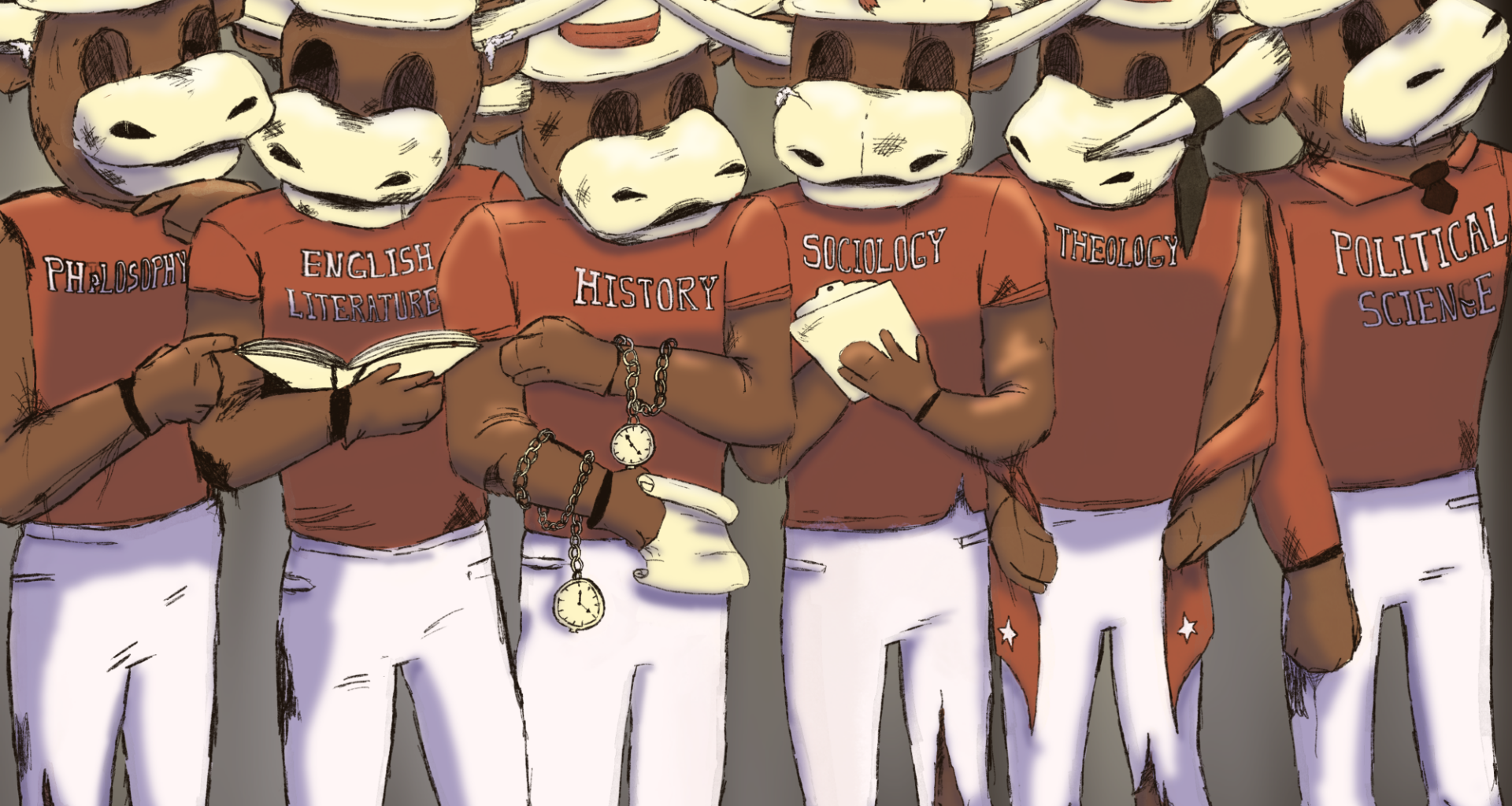
Bachelor’s degrees in humanities were awarded at a significantly lower level compared to the past decade in 2025, according to a Sept. 8 report from the American Academy of Arts and Sciences’ Humanities Indicators project. UT’s numbers over the same period dipped even further, according to University data.
The humanities are defined as the “knowledge, skills, and activities that help people interpret and engage with language, culture, history, and the ongoing search for meaning and connection in human life,” according to the organization behind the report. Examples of humanities degrees offered at UT include cultural, ethnic & gender studies, history, philosophy and religion.
Colleges and universities across the United States awarded about 164,000 bachelor’s degrees in the humanities in 2025, down 30.4% from about 236,000 degrees awarded in 2012, according to the report. At UT, students were awarded over 300 degrees in English, history, philosophy, linguistics and classical studies, and languages other than English in 2025, compared to over 800 in 2012, according to data from the National Center for Science and Engineering Statistics.
The drop does not suggest that humanities do not teach transferable skills, but is part of a larger problem, said Robert Townsend, the report’s author and program director for humanities, arts and culture programs at the American Academy of Arts and Sciences.
“With a humanities degree, you’ve developed a lot of really great skills that can take you pretty much anywhere in today’s world,” Townsend said. “It’s not always clear to a lot of students what skills they’ve developed out of a humanities class. … We just need to do a better job of helping students figure out how to say that (and) put it in a cover letter.”
Daniel Shea, a philosophy graduate student and assistant instructor at the University, said the skills students gain in a philosophy class have proven to be transferable for him.
“The ability to formulate an argument, the ability to evaluate an argument, the ability to read a bit of text and extract an argument from that text; I think these are really skills that … are going to come in handy,” Shea said.
Zoe Lynch, a classical languages and Plan II sophomore, and Rileigh Buttle, a philosophy and Plan II freshman, said they both intend to go to law school and that they know what skills will transfer over from their degree toward their career path.
Buttle said that in college, she has let herself study what seems interesting, like humanities, rather than focus exclusively on what degree will earn the most in her future.
“Humans gravitate more towards the artistic and humanities degrees because that’s what humans are,” Buttle said. “That’s what we are designed to want to study. It’s not really supposed to be about constantly making money.”
Townsend said the earnings of humanities degree recipients are close to the average for all college graduates, excluding STEM, according to data released by Georgetown University’s Center on Education and the Workforce.
“Engineers are the outliers for everybody else, and so why our earnings keep getting compared to engineers is kind of stupid to me because we’re pretty much close to the average for all other college graduates,” Townsend said. “There’s plenty to be said that over a lifetime, a humanities graduate is going to do just fine.”