
“I reached my hand down and picked it up; it made my heart thump, for I was certain it was gold.”
Within a year of James Marshall discovering gold in a sawmill outside of Sacramento, thousands of restless Americans were flooding west into the Sierra Nevada Range, borrowing money, mortgaging their homes and risking their savings for a chance at prosperity.
This single discovery, and the frenzy caused by the news, changed everything about California: the landscape, the economy and its demographics.
But the now-dubbed Golden State wasn’t the only place that drew crowds. Those who didn’t make it to the gold rush found themselves trickling throughout the Midwest, and hardly a decade later, went to Texas following the result of the Mexican-American War.
Sign up for the Food & Drink newsletter to get the latest stories delivered to your inbox
THANK YOU!
You’re all set.
CLOSE
These days, expansion isn’t because of one single discovery like gold, but of something else entirely being discovered over and over again: opportunity.
Texans are no strangers to our own gold we’ve been sitting on for centuries, but it’s no longer our little secret. For a while now, the word has been out, and Dallas, as it seems, is in the middle of its own culinary renaissance in the name of gold.
While Dallasites love new sparkly things, staying power isn’t a commodity. Will multi-million-dollar build-outs ensure restaurants endure the great Dallas gold rush? And what long-term effect are they having on the city’s dining scene?
The new edible gold rush
Trickles of imports started in Dallas as early as 2005, when Nobu opened inside The Crescent. Then came Ocean Prime, Carbone and CATCH, considered the early crowd, before “don’t California my Texas” became a statewide slogan.
Joseph Palladino, who cofounded Nick & Sams and recently expanded his eponymous steakhouse from New York City to Dallas this year, has watched the fabric of Dallas dining change from the inside over the last 30 years, and he knows why these big names were a whisper until now.
“Up until the early 2000s, many different types of food, and the level they’re being served at today, weren’t possible,” Palladino explained. “The demographic density to support them wasn’t there, but I believe that’s changed.”
Now, openings in the city alternate between our own talent and those expanding from the coast: Dallas, New York; Dallas, Los Angeles; Dallas, Scottsdale; Dallas, Miami.
“I think people come here because we’re centrally located,” Palladino explained. “Dallas has a steady stream of business travelers coming from both coasts, which gives a lot of these imports free market research and brand awareness. It gives them a barometer on the brand to see if it’s something that has legs to it that can be successful here and in other states.”
Then factor in ledgers like payroll, hourly wages and taxes, where it runs cheaper in Texas than it does in Los Angeles or New York, and the expansion makes sense. “To do business in Texas is a lot easier than it is on the East and West Coast,” Palladino said. “All those things kind of come into play for lots of reasons.”
Every detail from dining rooms to matchbooks
Celebrity magnet Delilah opened early this year, bringing the glitzy A-list experience to Dallas. This supper club-style restaurant debuted in LA and has seen the likes of Justin Bieber, Beyoncé, Post Malone, Blake Lively and Leonardo DiCaprio dining in its Titanic-level dining room (before it sank).
John Sofio, Delilah’s longtime design partner and founder of Built Inc., worked with a $1.5 million budget to set it up as a series of reveals, rather than giving diners all the design elements at once.
He shared with us that the idea was to always have another detail to discover from one visit to the next. Like a lipstick kiss on a cocktail napkin or a hidden message if diners are curious enough to turn over a plate. The matchbooks alone are collector’s items.
$100K wallpaper
“Building a restaurant today has quadrupled in price between millwork, finish-outs, all the kitchen equipment, the millwork, the steel work and all the point-of-sale system,” Palladino explained. “Everything has gone up so much from years ago that if you’re going to build something from scratch and it’s not a second-generation restaurant, it’s going to be extremely costly to open it.”
When Nuri Steakhouse opened in 2024 as a one-of-one $20 million concept, it put an invisible ceiling on what we thought a dining room could be. Owner Wan Kim hung $100,000 wallpaper, knowing full well he’d never see a return on that investment, but that wasn’t the point. The Smoothie King CEO had his own financial backing. But now restaurants eyeing Dallas for expansion are following in steakhouses’ footsteps, with build-outs costing as much as $6 to $9 million.
Take Sant Ambroeus, a Milanese concept from Italy. It’s spending $9 million on its exclusive Dallas location in a new Knox-Henderson development, according to the Texas Department of Licensing and Regulation (TDLR). Its 7,800-square-foot space anchors the base of a luxury high-rise residence called The Lora, and is famously known in both the Upper East Side and West Village for its cream-toned opulence.
Scilla, from Dallas’ own Duro Hospitality, doesn’t need a number to put a price on its dining room. It opened as one of the prettiest places to eat in Dallas and was created to be an immersive escape hidden within the city.
These new restaurants all begin with one question: How should a guest feel the moment they walk through the door? And the answer to that is by being transportive. Which costs a lot of money.
Great steaks
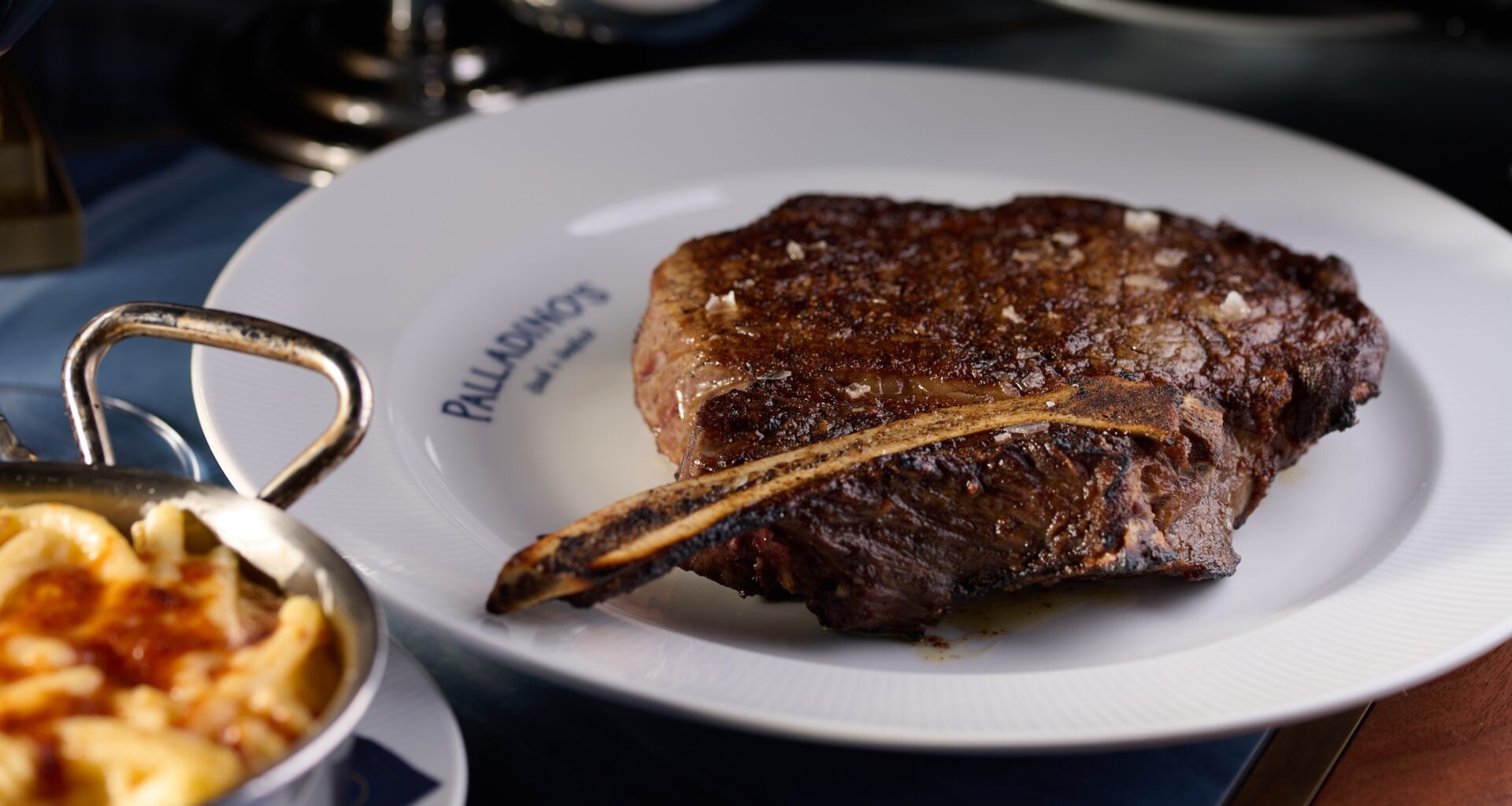
Punk Noir, which is looking to shake up fine-dining in Dallas, and Palladino’s both spent around half a million on renovations to open their restaurants this year, according to TDLR. Even one of Dallas’ largest hospitality groups, Harwood, closed four of its more casual concepts this year to reevaluate in response to all the new eye candy in Uptown. It’s about to open, you guessed it, a glitzy new steakhouse.
Docent Steak has been in the works for over two years, and the team at Harwood ensures it will be one of one when it opens at the end of the month. Inside, guests will find one of the largest collections of samurai art in the world and exclusive cuts of steak from its own cattle program.
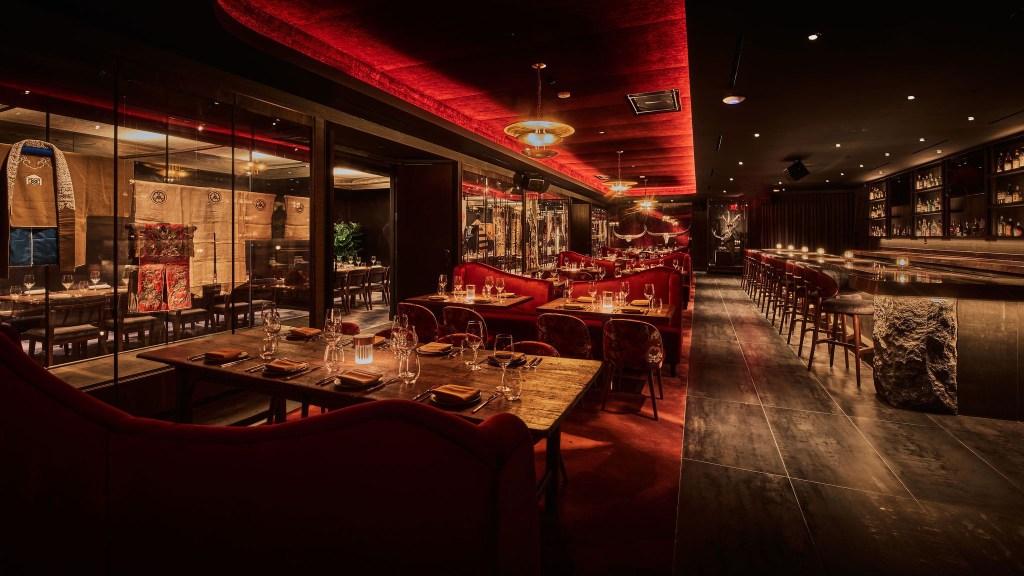 Docent’s lower dining room. This new steakhouse will open on Oct. 1.
Courtesy of Harwood Hospitality
Most restaurant spending goes toward making a place feel singular, but as new concepts multiply, openings start to feel homogeneous. Especially when three different coastal Mexican restaurants open within the same quarter, followed by two new coastal Italian concepts and what now feels like a dozen more on the way.
From what we’ve seen with previous concepts that invested millions only to come in with a bang and fizzle in less than two years (see La Neta and Komodo), putting all your advertising and budget into virality and gold-flaked dumplings is not what will make Dallas diners, who can be both fickle and loyal, keep coming back to your restaurant.
After all, we’re a steak city
If these new restaurants can’t escape looking alike, or shake the illusion that they’re all following the same blueprint, there’s one thing where sameness might be working in their favor: steak on the menu. Palladino explains why:
“People who live in New York eat Italian food. People who travel to New York eat Italian food. People who come from other parts of the country go to New York and eat Italian food. I think the same reflects Texas,” Palladino says. “People who live in Texas eat steaks; people who come to Texas want steaks. It’s a safe pick to pretty much hit everyone’s palate.”
Even two new concepts, Scilla and Élephante, both rooted in coastal Italian cuisine, have steaks on their menus.
“You look at this as a mathematical equation where you do the numbers and steakhouses,” Palladino explained, “the best steaks are a high-cost item and the margins are very, very tight, but a steakhouse guarantees you a certain amount of sales per month. Those sales allow you to stay in business. When do you see a steakhouse close? Very rarely.”
Westward expansion gave many who rushed towards The Golden State a stake in a promising future, but many who dipped their pans for gold never found what they came searching for.
Whether Dallas has room for a dozen renditions of spicy vodka sauce and whipped ricotta is up to us, but also largely up to everyone coming to Dallas with a company card.
And what that will boil down to is not who spent the most on wallpaper and custom furnishings, but who was able to stick around long enough to find out what exactly it is that makes a restaurant in Dallas thrive.
And does it happen to take the shape of a steak?