
El Paso, Texas (KFOX14) — Some stories begin with the person on the cover. This one begins with the writer because the person on the cover would rather talk about everyone else.
The City Magazine’s September cover profile centers on Tony Rancich, the owner and founder of Sonic Ranch in Tornillo. For our Daytime conversation, however, we welcomed Glenn Garza, known to Borderland radio listeners as “Dubba G” of 95.5 FM KLAQ. Glenn wrote the cover feature, “Tony Rancich of Sonic Ranch: Building an Oasis of Sound in the Desert.”
It is an important distinction because viewers may reasonably wonder why Glenn was sitting with us instead of Tony. The answer is part of Tony’s story. Glenn had written the profile and could put decades of work into context. Tony, meanwhile, has little interest in explaining his own importance or making himself the public face of what he created.
“He’s touched millions and millions, and you could walk past him in the street and nobody knows his name,” Glenn told us. “But he likes it that way. That’s how he wants it.”
That contrast gave us the real starting point for our conversation. Sonic Ranch has earned an international reputation among musicians, yet the man responsible for building it remains largely unknown outside the recording industry. Tony’s name may not be familiar to the average listener, but there is a good chance that some of the music created on his property has reached them.
The origin of Sonic Ranch is not a conventional studio startup story. According to Glenn’s profile, Tony inherited the ranch after losing his mother and grandparents while he was still a child, around 11 years old. As a teenager, he bought a tape recorder so he could record himself playing guitar. Larger recording equipment and more instruments followed, and friends gradually began coming to the property to use what he had collected.
What started with one young musician trying to capture his own playing eventually grew into a place built around the needs of other artists.
Glenn’s profile describes Sonic Ranch as a 3,200-acre oasis in the Chihuahuan Desert, surrounded by a working pecan orchard beyond El Paso’s eastern edge. The official Sonic Ranch website presents it as a residential recording destination, with multiple studio spaces, bedrooms, bungalows, dining areas and places for artists to spend time away from the control room.
That residential part matters. Artists are not simply arriving for a few hours, watching the clock and leaving when the session ends. They can stay on the property, eat together, step outside, return to a song and continue working without separating the creative process from the rest of the day. Sonic Ranch was built to give the work room to breathe.
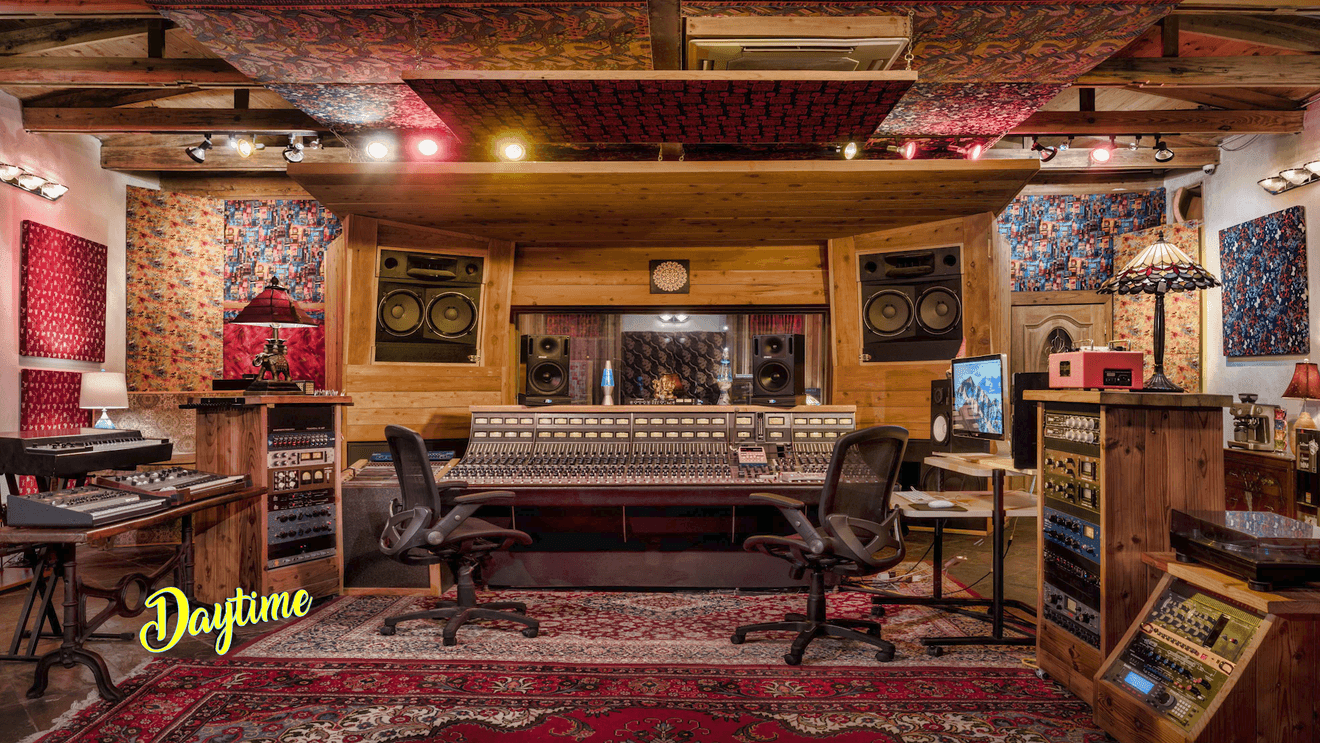
The property’s earlier life is still visible inside the studios. One building that became a recording space originally served as a blacksmith shop more than a century ago. The first studio Tony built occupies a subterranean room that, according to Glenn’s profile, was once used to raise chinchillas in the 1940s. Rather than erase that history, Tony incorporated it into the spaces musicians use today.
Then there are the details that make Sonic Ranch feel less like a commercial facility and more like the physical expression of one person’s imagination.
The studios contain vintage consoles, microphones, amplifiers, guitars, keyboards and pianos, but the technical equipment is only one layer. The official Sonic Ranch site describes a 1927 Steinway in Studio A, lithographs by artists including Salvador Dalí, Marc Chagall and Joan Miró, and centuries-old pillars from India inside Big Blue. Antique furnishings, rugs and fabrics appear throughout the property, sometimes serving an acoustic purpose while also changing how the rooms feel.
The choices are deliberate. Glenn’s profile explains that Tony believes art inspires art, so the environment surrounding a musician deserves as much thought as the recording equipment. A painting, an old rug, a particular instrument or the quiet of the orchard may not appear in an album’s credits, but each can become part of the experience that produces the record.
Sonic Ranch’s reputation also grew in a way that feels consistent with Tony’s personality. Glenn told us that musicians recorded there, shared the experience with their friends and gradually brought more artists into the fold. National acts heard about the property from other national acts. The studio expanded its reach through the people who had worked there rather than through Tony placing himself at the center of the story.
The Yeah Yeah Yeahs are among the artists connected to Sonic Ranch in Glenn’s profile and our conversation, but the larger point is not a list of recognizable names. It is the distance a song can travel. A listener may never visit Tornillo, see the pecan trees or know where an album was recorded, yet the work created there can still become part of that person’s life.
That is what Glenn meant when he said Tony has touched millions. The influence is indirect. It moves outward through musicians and then through the people who hear their records, attend their concerts and carry those songs into their own memories.
Tony’s instinct, Glenn explained, is to return the credit to those artists.
“If you ask him about himself, he will say, ‘It’s the artists. It’s them. Look at them,’” Glenn said.
That sentence also explains why we were talking to Glenn.
Glenn was not there as a substitute for Tony or to speak over him. We were talking with the writer who had just taken on the difficult job of profiling a man who does not naturally seek recognition. Glenn could describe the history, the scale of the property and the creative culture Tony built while respecting Tony’s preference to keep the attention on the musicians.
By the end of our conversation, the absence of Tony from the interview no longer felt like a missing piece. It revealed something essential about him. The person responsible for Sonic Ranch seems comfortable staying at the edge of the frame while the artists, engineers and music occupy the center.
For us, that is what made Glenn the right person for this particular conversation. Tony is the subject of the story, but Glenn gives viewers a way into it. He helps explain how a private person turned a ranch outside El Paso into a home for creative work, then allowed the results to speak far more loudly than he ever would.
City Magazine September Issue Unveiling (Courtesy: KFOX14)