
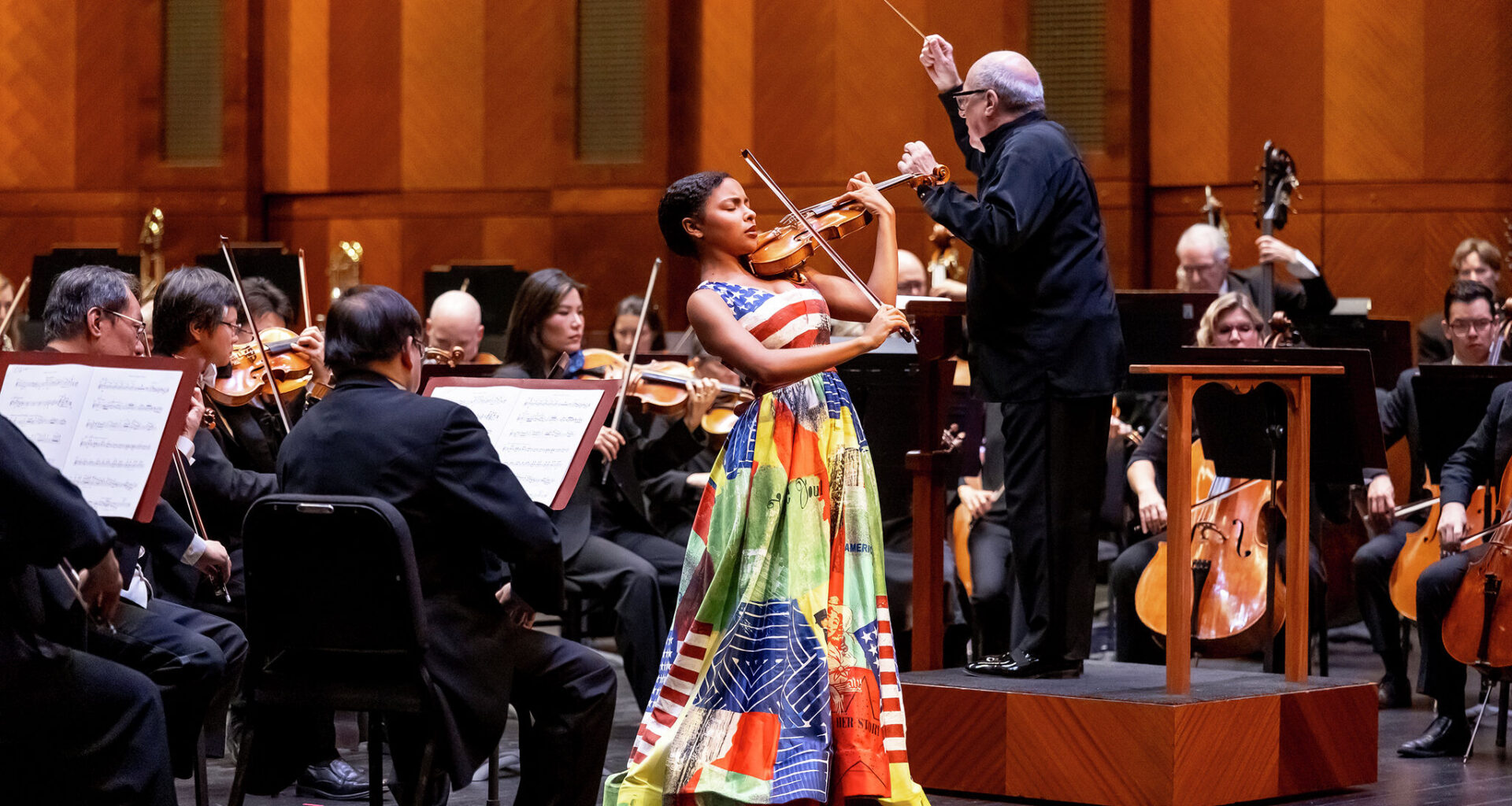
Violinist Amaryn Olmeda performs with the Fort Worth Symphony Orchestra, conducted by music director Robert Spano, in a Cliburn concert at Bass Performance Hall in Fort Worth on Sept. 22, 2026.
Brandon Wade
FORT WORTH — The Cliburn celebrated America’s 250th birthday by booking three soloists and the Fort Worth Symphony Orchestra for a concert of American music. With an enjoyable mix of works by Gershwin, Copland, Barber and Mason Bates, it happened Tuesday night at Bass Performance Hall, with FWSO music director Robert Spano conducting.

Best known for its quadrennial competition for up-and-coming young pianists, the Cliburn has been expanding its reach with additional competitions, concerts and educational activities. Tuesday’s concert fit right in.
Bates’ Cello Concerto, dating from 2014, was performed with the soloist, Joshua Roman, for whom it was composed. Twenty-six minutes long, nominally in the traditional fast-slow-fast concerto sequence, it actually blurred and blended pacings. Sometimes it sang, sometimes danced, sometimes both at once.
Article continues below this ad
The cello began by spinning out lyric, almost romantic, ruminations while various sections of the orchestra pulsed and chattered, gleamed and glowed. Elsewhere the roles were reversed. The central movement is marked “Serene,” but percussion both tuned and untuned added much color and rhythmic impulse. One patch even suggested Balinese gamelan patterns.
Concertos are often conceived to show off virtuosity. But while there were technical challenges along the way here, only the finale (marked “Léger,” French for “light”) had Roman skittering brilliantly — dazzlingly — over the fingerboard. One section even had him plucking and strumming with a guitar pick, heightening the rhythmic edge.
It’s hard to imagine a performance more assured, more natural, more compelling than Roman’s, with a gorgeous tone throughout. Spano and the orchestra made a persuasive case for their often complex duties. But on first hearing I thought the finale could have used some trimming.
For the Barber Violin Concerto, soloist Amaryn Olmeda savored the music’s sweetly soaring lyricism without ever overdoing it. Only 18 years old, she made the perpetual-motion finale seem effortless.
At least in my seat, though, her tone was a bit wiry for this glorious indulgence in late romanticism. Spano kept the orchestra carefully balanced, giving it just enough big bloom when needed. Principal oboist Jennifer Corning Lucio made magic of her instrument’s middle-movement solo.
Article continues below this ad
Angel Stanislav Wang, a finalist in the 2025 Van Cliburn International Piano Competition, brought plenty of digital dexterity and a huge personality to Gershwin’s Rhapsody in Blue. Judging from Gershwin’s own 1920s piano rolls, though, the music was intended for performances much more forthright, less extravagantly pushed and pulled, than Wang’s.
Is “historic performance practice” a consideration here? I don’t know, but the performance struck me as a bit self-indulgent — even Stas Chernyshev’s over-the-top opening clarinet glissando. But Spano fastidiously coordinated the proceedings, and the orchestra delivered the goods.
Copland was represented by An Outdoor Overture, which opened the concert. His all-American voice was everywhere evident, in music that by turns danced, marched and reminisced. The performance was ebullient, if not always ideally taut.