
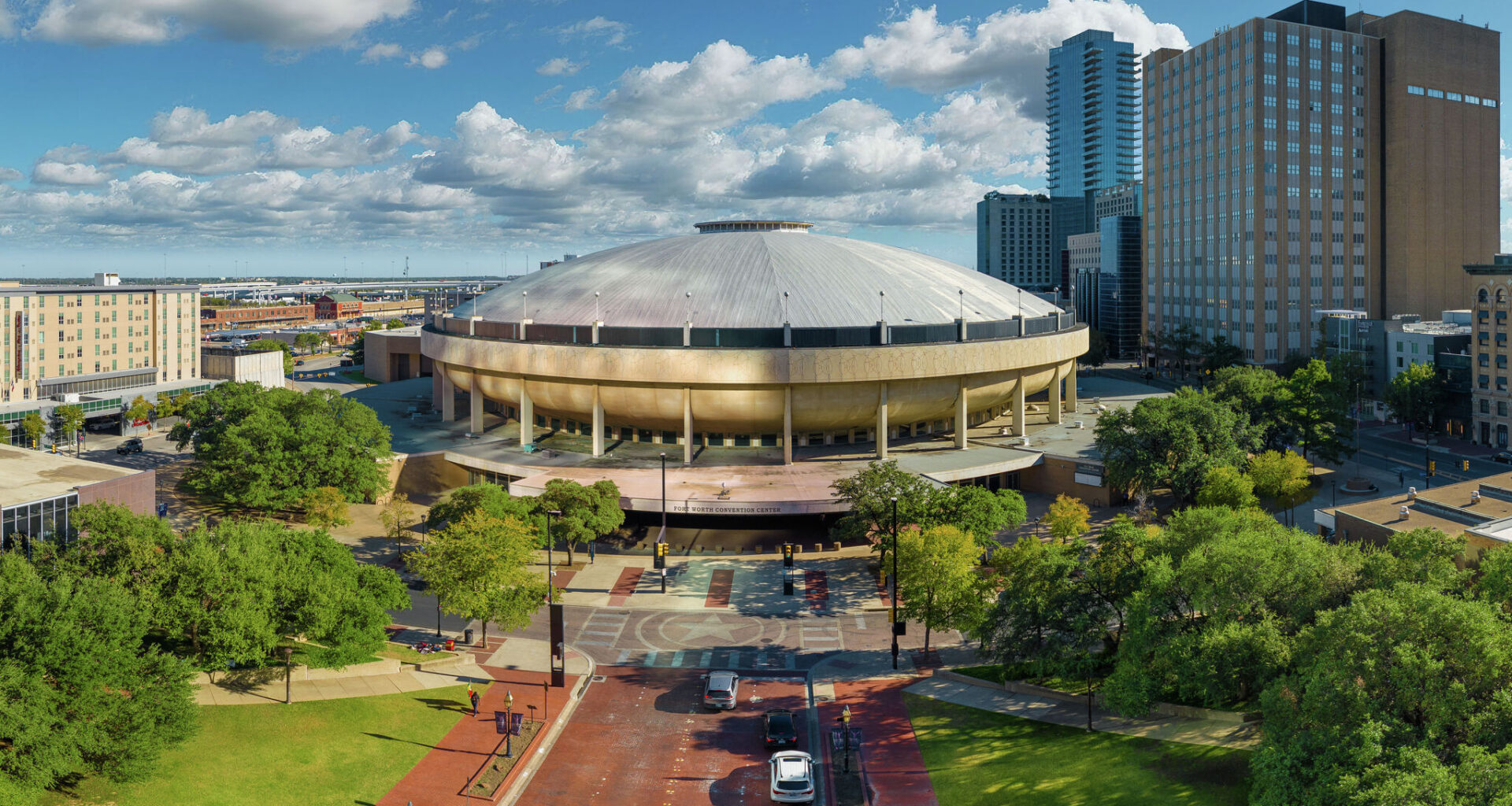
The Fort Worth Convention Center Arena is scheduled to be demolished in early 2027.
City of Fort Worth
What with the state of City Hall, the Kalita Humphreys Theater, Fair Park and other languishing landmarks, you would think Dallas has the Worst Steward of Texas Architecture title all locked up. Not quite. Fort Worth, which has long assumed an air of cultural superiority over Dallas, appears to be coming for our dunce-cap shaped crown.

This month, Cowtown celebrated — celebrated! — the coming demolition of the Fort Worth Convention Center Arena with a farewell event cheerily titled “It’s Goin’ Down.” Completed in 1968, the building appears like a giant flying saucer landed in the heart of the city’s downtown, its prominence augmented by its position on a ceremonial axis with Sundance Square and the Tarrant County Courthouse. The word iconic is floated around too loosely in the world of architecture, but in this case it is justified.
Over its life, the arena has been host to a myriad of notable figures, among them Elvis Presley, Bob Dylan, the Rolling Stones, Bob Marley, and more recently, K-Pop supergroup BTS. It was also the home of the Texas Chaparrals of the American Basketball Association, the precursor to today’s San Antonio Spurs.
Article continues below this ad
A sprouting tiled column at the Fort Worth Convention Center Arena.
Mark Lamster
The arena’s saucer form is just one of its architectural signatures. Also notable are the thick columns placed before its main entry that are covered in light-blue mosaic tile and flare out organically, like blooming plants. Its design was the product of a consortium of local architects, most prominent among them Preston M. Geren, who was to Fort Worth architecture what George Dahl was in Dallas — a prolific figure whose career spanned decades.
Demolition of the arena is scheduled to begin early next year to make way for an expansion of the linked convention center. In place of its distinctive architectural spaceship, Fort Worth will be getting a 4-story, glass-fronted extension designed by the firm TVS, a specialist in convention centers. Judging from renderings, it is neither especially good nor especially terrible — the architectural equivalent of oatmeal.
Fort Worth has also slated another Geren building for destruction, a handsome two-story office building completed in 1959 at 919 Summit Ave., which will be replaced by a new library.
The vacant Fort Worth Community Arts Center.
Mark Lamster
Those buildings will soon be gone, but the fate of the former Fort Worth Community Arts Center, a sprawling modern complex at the western end of the city’s cultural district, is an open question. The building has been shuttered for more than a year, having been abandoned after the city said it was in need of about $30 million in maintenance and repairs.
Article continues below this ad
The complex opened in 1954 as the home to the Fort Worth Art Center (precursor to the Modern Art Museum of Fort Worth) and was designed by Herbert Bayer, an Austrian–born design polymath who immigrated to the United States in 1938. Bayer never achieved the fame of some of his fellow Bauhaus master emigres (among them Mies van der Rohe, Walter Gropius and Marcel Breuer) but his influence was enormous, especially in the fields of graphic design and typography.
The arts center was one of his few completed architectural projects, a work of rigid geometry in the International Style that, in the words of a local architecture guide, “established the standard of excellence” that would define the buildings of Fort Worth’s cultural district. It was expanded in the 1970s, with the addition of a theater and porte cochere designed by the firm of O’Neil Ford, the renowned Texas modernist.
What will come of the building is unclear. A feasibility study that would look at possible uses was scheduled to begin this past summer and be completed by year’s end, but representatives for the city did not respond to a request for an update on its status.
View of the shuttered Heritage Park Plaza in Fort Worth.
Mark Lamster
And then there is the case of Heritage Park Plaza, a masterwork of modern design completed in 1980 by the revered landscape architect Lawrence Halprin. Situated roughly on the site of the former Army fort that gave Fort Worth its name, the park is composed of a series of concrete outdoor rooms and cascading water courses that overlook the Trinity River. Sadly, this American treasure (it was added to the National Register of Historic Places in 2010) has been shut off from public access for nearly two decades.
Article continues below this ad
The park’s 2007 closure was driven by a number of factors, among them concerns for safety (amplified after the 2004 drowning deaths of four tourists at the nearby Fort Worth Water Gardens), ADA compatibility, homeless occupation and various maintenance issues. A restoration has been long promised by city officials, but has yet to happen.
There is at least some hope this may change. Downtown Fort Worth Inc., the nonprofit charged with restoring the park, has raised roughly $45 million of a needed $50 million for a project that would rehabilitate not just Heritage Park Plaza but the adjacent Paddock Park and create a shaded, ADA-compatible path from them to the Trinity.
“It’s a really important project to us,” says Melissa Konur, the longtime director of the project for Downtown Fort Worth. “It is closer than it has ever been.”
That’s encouraging, but there is no definitive start date and it is hard to imagine a project of this scale taking less than two years once ground is broken. After years of promises, it is hard to have faith that it will begin soon.
Article continues below this ad
All of which is to say, it’s time for all of North Texas to start treating its historic buildings and landscapes with the respect they deserve.