
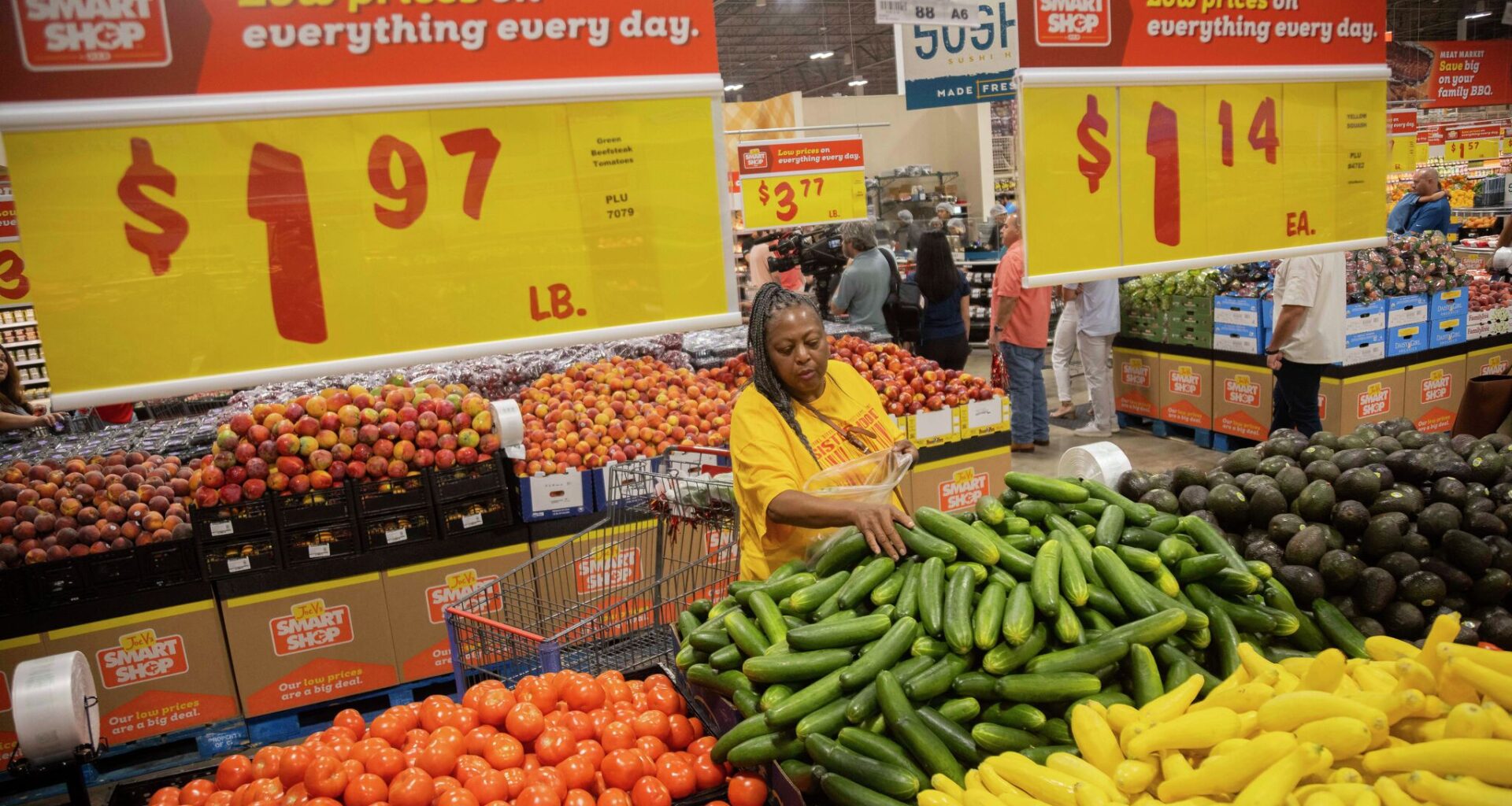
Linda Green Coleman of Oak Cliff shops the cucumber selection during the grand opening of Joe V’s Smart Shop on Wednesday, June 12, 2024, in southern Dallas and near neighborhoods in Duncanville and DeSoto. This is Joe V’s Smart Shop first North Texas location. Coleman, who normally travels to the H-E-B in Waxahachie, said she is so thankful for the store opening.
Juan Figueroa/Dallas Morning News
In Dallas, when it comes to getting groceries, you’ll have more options shopping above Interstate 30.

It’s an imbalance advocates have been working to address for years. Southern Dallas is home to roughly 45% of residents, a majority of them Black and Hispanic, but less than a third of grocery stores sit below I-30, according to 2024 data from the city.
Grocery stores, including supermarkets, are concentrated north of the highway. In southern areas, the bulk of shops selling food — over 85% — are gas stations, pharmacies or dollar stores.
Article continues below this ad
Access to food options has long been a point of dissatisfaction for residents who complain of traveling outside their neighborhoods, or the city itself, to go shopping.
The grocery landscape has changed since 2024, when Dallas took stock of its options, but here’s what the data shows:
Dallas counted more than 850 stores selling groceries across the city
Of those, more than 480 were in northern areas, which includes downtown
About 370 stores were in southern areas
Citywide, convenience stores made up the majority of shops
An overall look at Dallas grocers
The city’s data does not only include big grocery stores, which are categorized as retailers offering a variety of fresh food products. It also lists convenience stores, dollar stores and other options like pharmacies.
Article continues below this ad
In the 2024 database, there are 858 stores listed across Dallas. Of these, nearly 60% are convenience stores that accept SNAP, and 21% are general stores stocking some grocery or food items.
Citywide, grocery stores make up just 19% of the total.
A closer look at that category, which includes stores such as Aldi, Kroger and Walmart, reveals a greater disparity in food access for Dallas residents.
Only 30% of grocery stores were located south of I-30, in council districts 1, 3, 4, 5, 7 and 8. About 70% remain concentrated in the north.
When it comes to wholesale clubs such as Costco and Sam’s Club, seven of nine were in the north.
Article continues below this ad
Mill City resident Linda Belt prepares food for another costumer while Robert Walker eats French fries at the Fair Park Grocery on Lagow Street near Metropolitan Avenue on Nov. 14, 2025, in Dallas.
Angela Piazza/Dallas Morning News
Convenience stores
More than 85% of the shops logged south of I-30 were convenience stores like 7-Eleven or Quiktrip, along with pharmacies like CVS or Walgreens, and dollar stores.
These places stock limited food and grocery items in their inventory. Anga Sanders, the founder of FEED Oak Cliff who has advocated for more than a decade to bring grocery options to southern Dallas, said there’s a big difference between these options and a large grocery store.
“You can go in there, and you can buy a bag of chips or some cookies or whatever, but that’s not the purpose of it,” Sanders said.
Article continues below this ad
Related: Southern Dallas grapples with health disparities in new Dallas County report with Parkland
Certain areas in southern Dallas could qualify as “food swamps” rather than “food deserts” — places where there are few grocers, but easy access to less-nutritious options at corner stores or fast-food restaurants, according to the American Journal of Public Health.
Sanders called the disparity in access “food apartheid,” with zoning issues and corporate choices over the years leading to grocery stores not showing up in areas with hundreds of thousands of people. Areas in southern Dallas have some of the greatest health vulnerabilities in Dallas County, including high rates of diabetes.
Food access
Advocates are pushing for change. Sanders is part of a group of dozens of organizations and collaborators looking to shore up Dallas’ vast food system through the Dallas-Dallas County Food Plan.
Whitney Strauss, who leads the food plan, is exploring ways Dallas could make it easier for grocers and small stores to stay open in underserved areas.
The city’s data, she said, could serve as a starting point. Solutions, however, must be tailored to communities, she added.
Article continues below this ad
“A map can’t tell you whether the food in that store is affordable,” Strauss said, “whether there’s produce that’s fresh, whether a family has a car … or whether what’s on the shelves is what a household actually eats.”
Related: Considering visiting a food pantry for the first time? Here’s how it works
The discussion around groceries is happening as many struggle with hunger. Texas leads the nation in the number of people facing food insecurity, according to a 2026 Feeding America report. The Dallas-Fort Worth area ranks fourth in the U.S. for the number of people experiencing food insecurity, with one in four children facing hunger.
Whether you live by five grocery stores, or none at all, Strauss said the food system is interconnected — tied to healthcare costs in communities and the expense of nutrition-related chronic diseases.
“When one system is weak, that ultimately impacts all of us,” she said.
How long does it take you to get to a grocery store in Dallas? 🛒
This reporting is part of the Future of North Texas, a community-funded journalism initiative supported by the Commit Partnership, Communities Foundation of Texas, The Dallas Foundation, the Dallas Mavericks, the Dallas Regional Chamber, Deedie Rose, Lisa and Charles Siegel, the McCune-Losinger Family Fund, The Meadows Foundation, the Perot Foundation, the United Way of Metropolitan Dallas and the University of Texas at Dallas. The News retains full editorial control of this coverage.
Article continues below this ad