
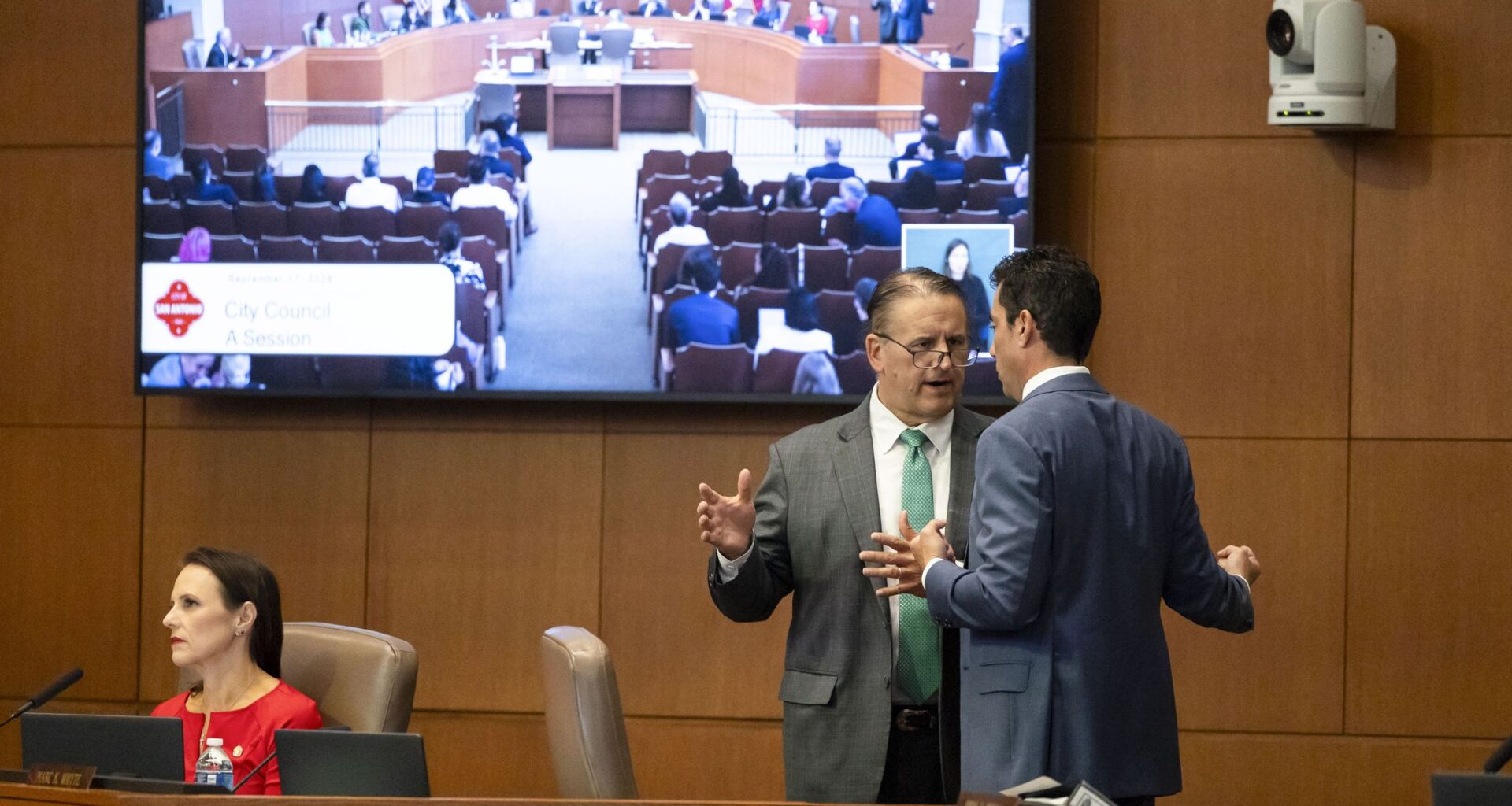
San Antonio City Council Member Marc Whyte, right, who opposed raising taxes to balance the budget, speaks with City Manager Erik Walsh during a recent meeting on the budget. The city still faces structural issues with its budget that will require reviewing how it spends.
Katina Zentz/San Antonio Express-News
To no one’s surprise, the San Antonio City Council and Bexar County Commissioners Court approved budgets this month that avoid tough decisions and fail to rein in spending.

Bexar County commissioners, by a 3-2 vote, passed a $2.6 billion budget by tapping $68 million in reserves. This is unsustainable as the county faces a two-year projected deficit of $145 million. Commissioners will either need to cut spending or raise the tax rate next year to make the math work.
Article continues below this ad
Meanwhile, in a 7-4 vote, the San Antonio City Council approved a $4.4 billion budget that makes some cuts and raises the property tax rate by 2 cents, pushing it to about 56 cents per $100 of taxable assessed property value.
Because the city’s general fund budget, which covers operating expenses, has grown significantly in recent years, and because people are feeling financially pinched, we argued against raising the tax rate.
We can see the need for utility rate increases to maintain critical infrastructure, and we can see the need to raise tax rates for school districts because we believe in investing in children and the state has starved schools of funding. But city officials never won us over on this rate increase.
The general fund for the upcoming fiscal year is set to hit $1.76 billion. Consider that just in 2025, the city’s general fund was $1.57 billion. It’s hard to imagine efficiencies could not have been found.
Article continues below this ad
Nevertheless, these budgets have been approved. Since the city and county’s budget challenges persist, it’s imperative officials begin the hard work to address them.
An easy place to start is to create a city-county budget working group that can review spending and identify areas for collaboration and savings. An obvious example of this is ending double magistration. The city spends at least $5 million a year on a duplicative lockup.
This needs to end for humanitarian and budgetary reasons. We are not interested in excuses that allow double magistration to persist. We are interested in leadership that finds solutions to end a practice that is a monument to bureaucratic indifference.
There is simply no excuse for putting people detained by law enforcement through booking and processing twice. The city needs to close its lockup on Frio Street on the West Side and find a way to work with the county.
Article continues below this ad
And, no, this cannot wait years until the county supposedly opens a new intake center for its jail. It needs to end now.
So much at City Hall — whether it’s the one in San Antonio or, say, Chicago — takes on larger symbolism. Votes aren’t merely won or lost on council. They are framed as political weakness or strength.
When we look at how the city spends millions of dollars to perpetuate double magistration, it becomes symbolic of wasteful spending and indifference. If the city can spend millions of dollars on this practice and then raise our taxes, we can’t help but wonder what else officials are spending millions of dollars on that might be questionable.
To answer that question, we strongly encourage the city and county to embark on zero-based budgeting for all departments.
Article continues below this ad
Raising property tax rates (the city) and tapping reserves (the county) should be last resorts. Before such measures are taken, taxpayers deserve to know that every expense has been reviewed and every possible efficiency has been identified.
We are not remotely convinced that has happened at the city or the county.