
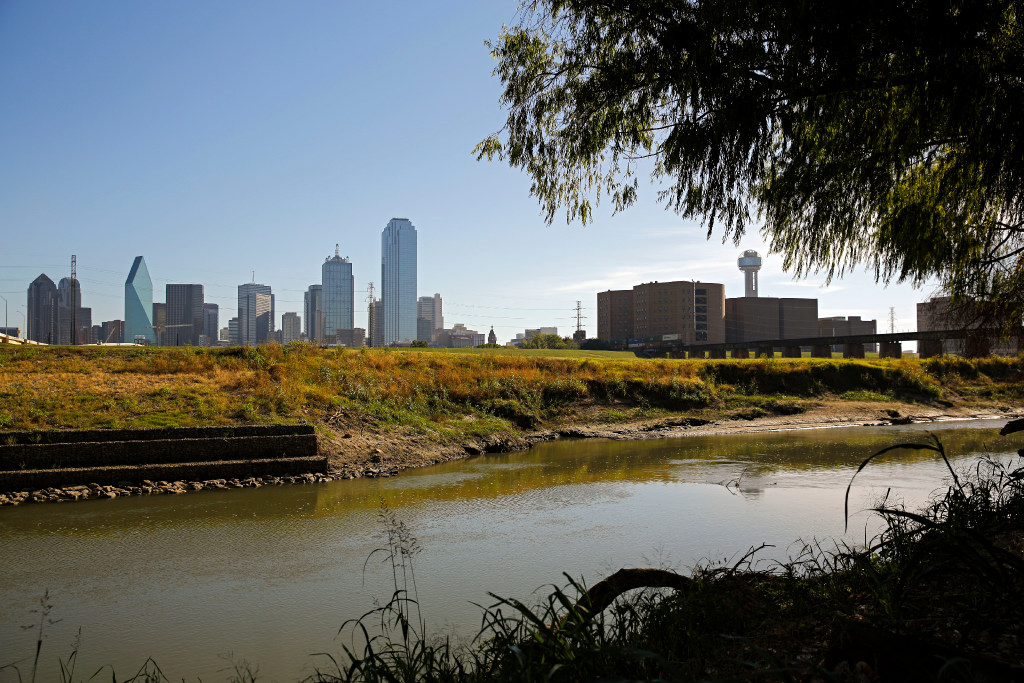
The Trinity River runs through parts of North Texas before continuing south toward the Trinity Bay on the Gulf Coast.
Staff Photographer
Long before Dallas became a permanent settlement, the Trinity River was winding its way through Texas.

Before being called the Trinity River, the body of water had other names that were given more than 300 years ago, including ones from the Caddo and a Spanish explorer. But how did the Texas river end up with the name it has today?
One reader asked Curious Texas, “Why is the Trinity River named the Trinity River?”
Article continues below this ad
Here’s what we found out.
Where is the Trinity River?
The Trinity River runs through parts of North Texas before continuing south toward the Trinity Bay on the Gulf Coast.
Today, the river has three principal branches, including the East Fork, Elm Fork and West Fork, according to the Texas State Historical Association. It also has a fourth headstream that is shorter and smaller, known as the Clear Fork.
It is the longest river with its entire course in Texas, according to the association.
Article continues below this ad
Related: Why doesn’t Dallas use the Trinity River as a port? Curious Texas investigates
Why is the Trinity River named the Trinity River?
Spanish explorer Alonso de León is credited as the person who named the Trinity River, according to Lola Norris, associate professor of Spanish and translation at Texas A&M International University.
De León led several expeditions into Texas in the late 1600s, including one in search of French settlers who had established a colony in territory claimed by Spain.
During his 1690 expedition, Norris said in an email that de León and his companions traveled northeast toward the territory of the Hasinai people, where they established the first Spanish mission San Francisco de los Tejas.
Article continues below this ad
Along the way, de León kept a detailed expedition diary, with daily entries describing the distance they had covered, the direction and what they saw. Norris translated de León’s diaries in a book, “General Alonso de León’s Expedition Diaries into Texas (1686-1690).”
“De León named all locations and valleys where the expedition party stopped and all the rivers they crossed,” Norris said.
Norris said de León named what is now called the Trinity River on May 19, 1690, the “Río de la Santísima Trinidad,” which translates to the River of the Most Holy Trinity.
The places and rivers de León encountered during the 1690 expedition were “almost exclusively,” Norris said, named for saints or other Catholic entities. The Trinity River was named by de León around the time of the Feast of the Holy Trinity, a religious holiday also known as Trinity Sunday.
Norris said other names given to landmarks on the 1690 expedition included Río de San Carlos and Río del Espíritu Santo.
Article continues below this ad
The 1690 expedition was different from de León’s 1689 expedition, Norris said, as many of the given landmark names were more descriptive than Catholic-inspired. For instance, de León named the Nueces River, the “Río de las Nueces,” because of the pecan trees growing along its banks, according to the Texas State Historical Association.
Related: Why does Dallas exist? Curious Texas answers what we’ve all been wondering
Did the Trinity River have other names?
The Trinity River has also been identified as the stream that the Caddo called the “Arkikosa” in Central Texas and “Daycoa” along the coast, according to the Texas State Historical Association.
Article continues below this ad
The naming of the Trinity River is also credited to French explorer Rene Robert Cavelier, Sieur de La Salle, according to the Trinity River Authority. In 1687, he named the Trinity the “River of the Canoes,” according to the historical association.
Maps from the early 19th century at the Dallas Public Library also show various spellings of the Trinity River, including the “Trinite” and the “Trinidad.” But eventually, a version of de León’s name stuck and became the Trinity River.
Related: Could Texas divide itself into five states? Curious Texas cracks open the history books
Ask Curious Texas: What questions do you have about our state?
Submit your question, and our journalists may investigate the answer in a future story.