
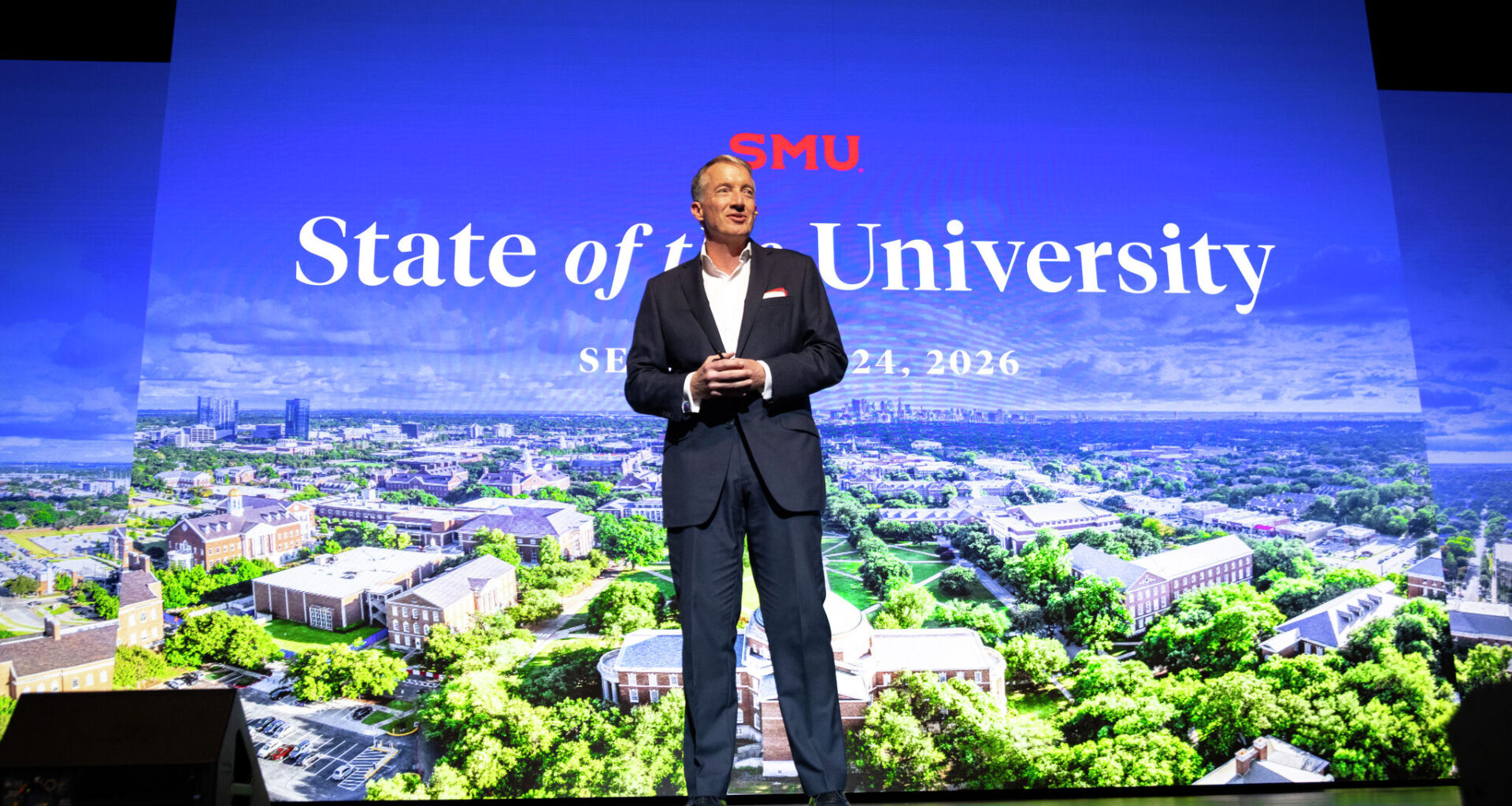
Southern Methodist University President Jay Hartzell outlined his vision for the school’s next decade in his “State of the University” address on Thursday afternoon at SMU’s McFarlin Memorial Auditorium.
Photo courtesy of Southern Methodist University, Kim Leeson
Silicon Valley has Stanford University. Southern Methodist University must be the equivalent for North Texas, said its president, Jay Hartzell, on Thursday.

During his first “State of the University” address, Hartzell revealed his strategic plan, which will guide the school through the next decade. He shared his vision to tap into the opportunities aflush in the region, invest in signature programs, and prepare students to be leaders in a changing world.
Related: Exclusive interview: Why did Jay Hartzell leave UT job to become SMU president?
Article continues below this ad
“Dallas needs us, or at least we can benefit Dallas,” he told a crowd at the McFarlin Memorial Auditorium.
Then comes the question: how can SMU help?
“We bring the scholars to the problem,” he said. “We also have a way to convene people from different sectors together in a way that I think is special.”
Eyes are on Hartzell to see how he will steer the region’s top university in the coming years. He came into the job last year, after R. Gerald Turner led the school for three decades. Before landing at the small private university, Hartzell served as president of the University of Texas at Austin.
Last school year, more than 12,500 students attended one of SMU’s eight degree-granting schools. The school employs about 1,740 staff members and administrators and boasts an endowment of $2.3 billion. Tuition is currently priced at more than $31,800 for a semester, which doesn’t include the costs for housing or meals.
Article continues below this ad
On Thursday, Hartzell acknowledged that the future holds unknowns. The advent of artificial intelligence poses a big question, he said, as anxieties about the job market have intensified.
Related: More universities want to be neutral. Will it work at SMU?
But he remains “optimistic.” SMU students can easily adapt to change, if they master the fundamental skills, like critical thinking. Amid the explosive growth of technology, liberal arts — which he analogized to the “bread and butter” of an education — will experience a “renaissance moment.”
“That kind of an education lets you have the flexibility to pursue something that today is unknown,” he said. “It gives you a chance to distinguish truth from falsehood. It gives you a chance to disentangle conviction from arrogance.”
But students still must be fluent in new technology, he said. That’s why the school is rolling out a campus-wide partnership with Anthropic, he announced. By next spring, Claude will be available to all students and faculty.
Article continues below this ad
SMU will also invest in interdisciplinary programs to provide the kind of specialized education that no other university can match, Hartzell said. School leaders are weighing which classes, fields and majors can be combined.
He pointed to the new energy studies program as an example. The program, funded by a $60 million donation, draws upon various disciplines to prepare students for careers in the energy industry. North Texas is uniquely positioned to offer it, school leaders previously said, because it’s home to automotive companies, oil and gas businesses and major financial institutions.
Related: SMU draws $60 million donation to launch energy studies, honors programs
Research is a cornerstone of the new framework. SMU is one of the 16 Texas institutions with an R1 designation. The coveted status that recognizes universities that spend significantly on research and produce a high number of research doctorates.
A crowd filled SMU’s McFarlin Memorial Auditorium on Thursday as Southern Methodist University President Jay Hartzell discussed how he will steer the region’s top university in the coming years. He came into the job last year, after R. Gerald Turner led the school for three decades.
Photo courtesy of Southern Methodist University, Jeffrey McWhorter
The school’s relationship with the city continued to be a throughline in his vision for the future. As part of the strategic plan, SMU started the Dallas Office, a “front-door” that can coordinate partnerships with local organizations.
Article continues below this ad
“Our goal is to have the students and the faculty not have to spend as much time opening the door,” he said, “and spend more time walking through it.”
In his opening remarks, James Kang Hoon Lee, a professor of early Christianity, said Hartzell moves quickly to implement big ideas. He thanked the president for seeking out input on the plan, which involved more than 9,000 stakeholders.
“Here we are, ready to roll out a robust strategic framework for SMU’s future,” Lee said. “It is a vision that honors our past, but pushes us toward a vibrant future.”
The DMN Education Lab deepens the coverage and conversation about urgent education issues critical to the future of North Texas.
Article continues below this ad
The DMN Education Lab is a community-funded journalism initiative, with support from Bobby and Lottye Lyle, Communities Foundation of Texas, The Dallas Foundation, Dallas Regional Chamber, Deedie Rose, Garrett and Cecilia Boone, Judy and Jim Gibbs, The Meadows Foundation, The Murrell Foundation, Ron Steinhart, Solutions Journalism Network, Southern Methodist University, Sydney Smith Hicks, and the University of Texas at Dallas. The Dallas Morning News retains full editorial control of the Education Lab’s journalism.