
On the evening of July 21, millions of Texans arrived home from work and flipped on their lights and air conditioning.
Quietly, they broke a record. The state’s energy grid eclipsed its previous peak demand of 85.5 gigawatts, set back in August 2023.
The grid shattered the old record again the next day, with a new top mark of 91.1 gigawatts, according to data from the Electric Reliability Council of Texas, a nonprofit that oversees the state’s grid. ERCOT estimates that one gigawatt can power approximately 250,000 households at the peak of summer.
As the summer continued, the grid repeatedly soared past its old demand record, for days and then weeks at a time. On Aug. 20, amid the first 100-degree day of the year in Houston, the grid ran above its 2023 benchmark from 2 p.m. to 9 p.m. – seven hours straight.
READ MORE: ERCOT breaks record for power demand during extreme Texas heat
By mid-September, as temperatures and demand began to cool, Texas’s grid had surpassed its 2023 usage peak on 45 separate days, including for three consecutive weeks in August.
In ERCOT’s Coast weather zone, which includes the Houston metro area, the grid also eclipsed its 2023 record twice, on July 22 and Aug. 26, with the latter reaching the region’s new demand record at 24.2 gigawatts.
“If you model the grid, we saw this coming, but it’s still pretty wild to see,” Joshua Rhodes, an energy research scientist at the University of Texas at Austin, said.

More striking than the record-setting numbers was how little changed for the state’s residents.
In 2023, historic heatwaves stretched the state’s energy infrastructure to its limit, setting grid records. That summer, ERCOT issued nearly a dozen warnings asking Texans to conserve electricity, and even declared a brief grid emergency for the first time since Winter Storm Uri devastated the state in 2021.
In 2026, none of that happened. Not a single conservation request was issued, and energy reserves comfortably exceeded demand.
2023 EMERGENCY: Texas power grid briefly enters level 2 emergency for the first time since 2021
Perhaps the most telling sign of the lack of stress was at the hour with the highest energy demand in the Texas grid’s 85-year history – 6 p.m. on July 22 – there was so much reserve generation that batteries connected to the grid were able to charge, instead of providing energy.
“Routinely, we are operating at demand levels that would have been exceptional just a few years ago,” Pablo Vegas, ERCOT’s CEO, told the nonprofit’s board last week. “For customers, the grid simply worked the way it was supposed to.”

President and CEO of ERCOT, Pablo Vegas, pictured here in 2023, described the energy demands placed on the ERCOT grid this summer as “exceptional.” (Melissa Phillip/Staff Photographer)
ERCOT CEO: ERCOT approves, then pauses, $6.4 million CEO contract after Dan Patrick objects
Amidst a record-setting and widespread concern about projections of skyrocketing energy demand driven by data centers, the Chronicle spoke to more than half a dozen grid experts – from top researchers to current and former grid officials and key figures in the energy market – to try to understand why Texas’s notoriously unreliable grid had a remarkably reliable summer.
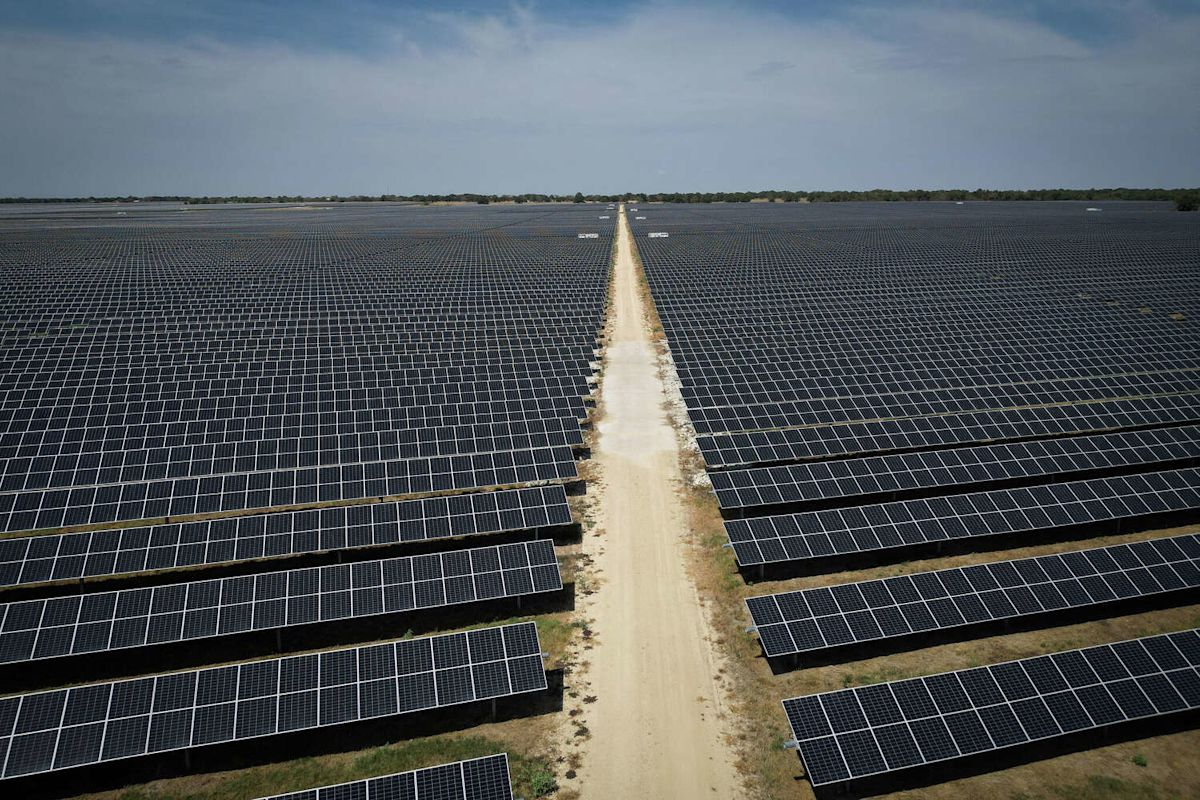
The answer was unanimous: solar panels and batteries.
Solar, battery boom fueled simple summer
The solar buildout in Texas isn’t new.

Jupiter Power’s battery storage, pictured here in 2024 in Houston. Experts attributed the strength of Texas’s grid in 2026 to growth in solar and battery facilities. (Jason Fochtman/Staff photographer)
But it has dramatically accelerated in Texas since about 2019, when it surpassed wind as the cheapest energy source to build en masse, according to Jay Zarnikau, a former Public Utility Commission official and retired energy researcher from UT Austin.
“The big story for the last few years has been solar energy and battery energy storage,” Zarnikau said. “I think the growth in supply has exceeded the growth in demand.”
SOLAR SURGE:
Solar supplied more power than coal to the ERCOT grid in 2025 for the first year ever
Since 2023, Texas has added 19.5 gigawatts of new solar arrays to its grid’s capacity, enough to power 4.8 million homes, according to ERCOT. Over that same time frame, wind has added 2.5 gigawatts, and natural gas has stayed virtually flat.

In the peak months of 2023, solar contributed roughly 7.5% of all energy generation. During the peak months of this summer, solar’s share of Texas energy had more than doubled, to just over 18%.
Battery storage, which grew by 16 gigawatts since 2023, more than quadrupling, also played a crucial role in the smooth summer, Zarnikau said.
That’s because batteries can charge themselves on the grid during the day, when the sun provides plenty of excess energy, and then be deployed in the evenings, when demand rises as the sun sets
READ MORE:
Why are battery storage projects coming to Houston? Behind the new technology’s rapid growth
That strategic deployment of battery reserves also helps consumers save on electricity costs, Tim Wells, the CEO of Houston-area utility CenterPoint Energy, observed during a panel at Houston’s annual Energy & Climate Week last Wednesday.
“This penetration of solar and batteries, it helps dampen the prices,” Wells said. “It’s a real success story.”

CenterPoint Energy president Jason Wells, pictured here at the Houston Chronicle offices in 2025. Wells said last week that increased solar and battery facilities had flattened consumer prices during a record-setting summer. (Sharon Steinmann / Staff photographer)
The batteries mean ERCOT has to bring fewer natural gas plants – which cost more than renewables or batteries – online during that crucial evening demand surge, Wells explained.
But batteries alone still aren’t enough. Most of the battery arrays deployed across Texas don’t hold more than two hours of storage, Rhodes said. Natural gas plants still generate more energy for the grid than renewables, and also offer around-the-clock dependability that solar and wind lack.
“Different stakeholders like to plant their flags for the different generation resources, but I say it’s everything.” Bill Flores, the chair of ERCOT’s board of directors, said. “Texas is an all-of-the-above state.”
A smooth summer gives way to a stormy future for the grid
While this summer was smooth, industry executives and academics agree there is no guarantee future summers will be as easy.
Major pressures are bearing down on the Texas energy grid; chief among those is the question of data centers, which experts project could add between 50 and several hundred gigawatts of new demand to the state’s grid by the end of the decade.

Men pictured here in 2023 working on transmission lines in the Montrose neighborhood in Houston. Texas’s grid repeatedly broke its power demand records from 2023 this summer. (Jon Shapley/Staff photographer)
In the Houston area alone, Wells said at his climate summit talk that roughly 14 gigawatts of new data centers were under construction and set to come online by 2030.
That’s up from the 10 gigawatts he projected in April 2025, though at that time Wells said that was a “conservative forecast.” If the planned 14 gigawatts of data-center capacity is built, it would amount to a nearly 60% increase in the Houston area’s current 24.2-gigawatt peak demand.
In his remarks to the ERCOT board last week, Vegas alluded to “challenges ahead” for the grid operator, as ERCOT attempts to navigate surging demand from data centers and other large projects.
DATA CENTERS:
Gov. Greg Abbott issues permit moratorium on new data centers
Under political pressure, Gov. Greg Abbott has also moved to curtail data center development in the state, calling for an audit of all data center projects last month, and issuing a moratorium on new permits this week.
“Simply put, Texans must come first,” Abbott said in a statement. “Data centers must pay their own way, protect our grid and water.”
Subscribe
There’s more to Houston with the Chronicle. Subscribe today for just 25¢.
This article originally published at Texas shattered energy demand records this summer. Here’s why the grid barely broke a sweat..