
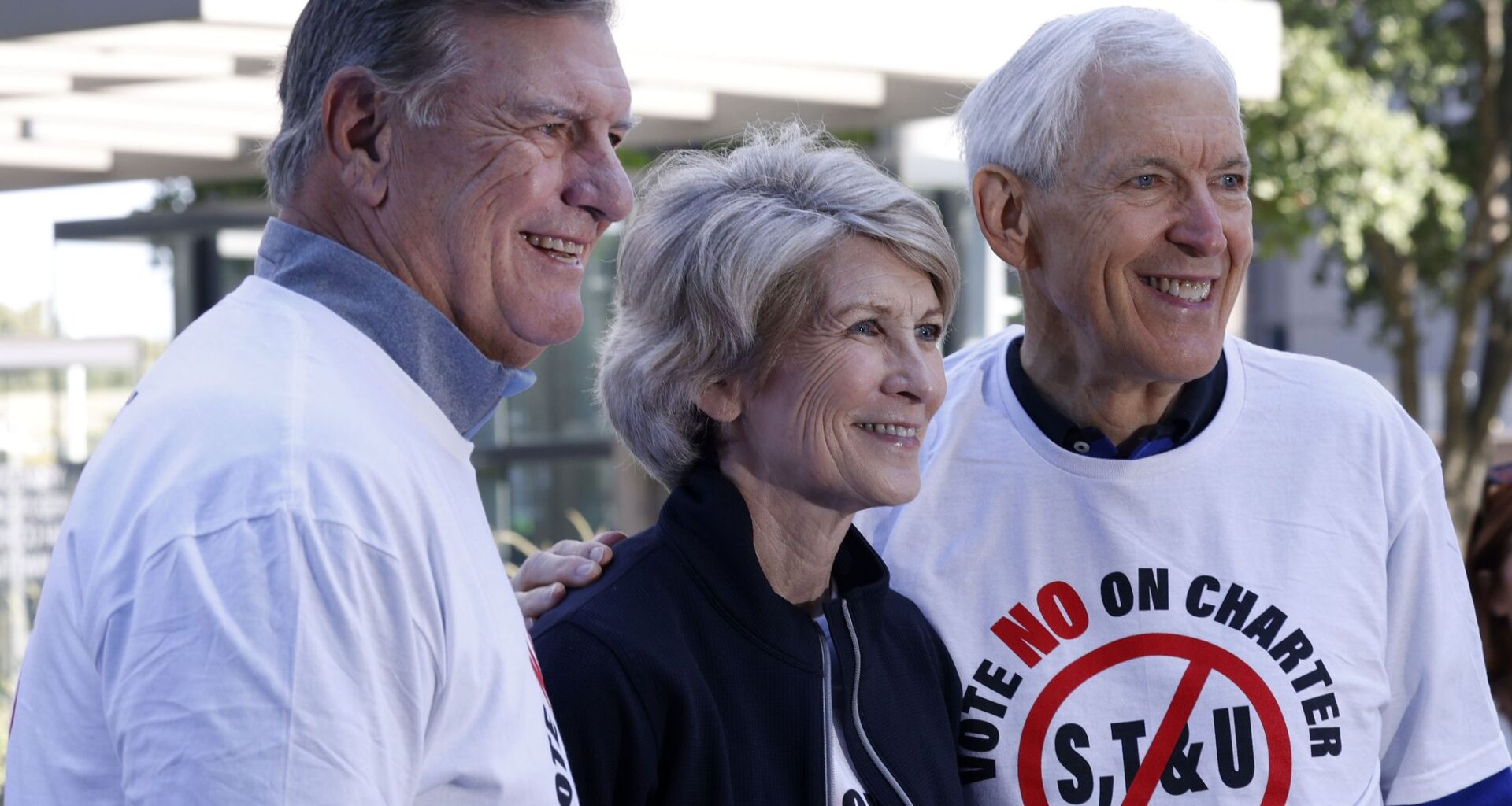
Former Dallas Mayors Mike Rawlings, Laura Miller and Tom Leppert after a news conference in November 2024 on city charter propositions.
Chitose Suzuki/Staff Photographer
Former Dallas mayors Laura Miller and Tom Leppert agree the next mayor needs more power at City Hall. On Friday, they sparred over whether City Hall itself should stick around.

At a Greater Dallas Planning Council event, a discussion about reviving downtown turned into a lively debate over the future of the I.M. Pei-designed building: Should the city keep operating there or move and open the site for redevelopment?
Miller said the city could keep City Hall and develop the land around it for “whatever entertainment complex, markets, basketball stadium, whatever you want to go there.”
Article continues below this ad
Leppert questioned whether anyone would invest in that plan. “At some point it’s not what we want, it’s what the market wants, and we ought to listen to that,” he said.
It was a preview of the political maneuvering Dallas residents could see as separate petition drives get underway to collect enough signatures to put City Hall’s future and the mayor’s powers on the May 2027 ballot.
Miller backs a ballot measure to require city operations to remain in the building. Leppert has joined former Mayors Ron Kirk and Mike Rawlings in a separate push to give the mayor more authority over the city manager and the budget. The next mayoral election is in November 2027.
Both Miller and Leppert said the mayor should have a greater say in City Hall’s direction, including how Dallas tackles vacant office towers, aging infrastructure and homelessness downtown. But they remain at odds on whether that work should happen inside the current building.
Miller: Build around City Hall
Miller said City Hall was built to last 100 years, not 30 or 40. She said the city could preserve it while developing roughly 47 acres of surrounding land.
Article continues below this ad
She challenged the city’s repair estimates and said the cost of demolishing City Hall also needed closer scrutiny. Miller suggested demolition could cost as much as $600 million, citing figures the University of Cincinnati examined for tearing down its tallest concrete building.
Miller, a former reporter at The Dallas Morning News who was mayor from 2002 to 2007, said elected leaders should take more responsibility for revitalizing downtown and attracting business.
Former Mayor Laura Miller speaks during a news conference Thursday on a petition drive being organized by the Save City Hall coalition.
Shafkat Anowar/The Dallas Morning News
She urged them to pursue developers, landowners and public funding more aggressively and to build stronger partnerships with private businesses.
“The leadership is not chasing every developer, every landowner, every state and county subsidies they can get their hands on to do that kind of transformative work,” she said.
Article continues below this ad
Related: Boilers, repair costs and the escalating fight over the future of Dallas City Hall
Leppert: Listen to the market
Leppert defended consultants’ estimates that City Hall repairs could exceed $1 billion. He said the cost could climb once workers opened the walls of the nearly 50-year-old building.
“So if anybody wants to do it, terrific. But please stand and be willing to guarantee the cost,” he said.
Former Dallas Mayor Tom Leppert at a 2024 event hosted by the Dallas Regional Chamber.
Steve Hamm/Special Contributor
Leppert, a businessman who served as mayor from 2007 to 2011, also questioned whether developing the surrounding land would be enough to draw a buyer or major tenant.
Article continues below this ad
No developer or franchise has expressed interest in that approach, he said. Redeveloping the entire site near the Kay Bailey Hutchison Convention Center would be more likely to draw a major project and the investment to support it, he said.
Leppert also pointed to the petition drive he is backing with Kirk and Rawlings for a ballot proposal that would give mayors more authority to appoint the city manager and city attorney and shape the budget.
“That provides accountability, which unfortunately there’s no accountability in the city government today,” he said.
Under Dallas’ current system, the mayor leads City Council meetings and has one vote, while the council chooses the city manager, who runs daily operations and proposes the budget.
A divided room
The audience at the Omni Dallas Hotel applauded arguments from both former mayors.
Article continues below this ad
Lynn McBee, a civic leader who moderated the discussion, repeatedly steered them back to the question they had gathered to address: how city leaders could help downtown grow.
Watching was Laura Cole, granddaughter of former Mayor J. Erik Jonsson, who led City Hall’s construction as Dallas sought to remake its image after President John F. Kennedy’s assassination.
She sat with her sister, Emily Corrigan. Both took part in the Miller-led petition drive announcement the day before outside City Hall.
On another issue, Miller and Leppert both praised Downtown Dallas Inc.’s support for more bike lanes and an extension of the Katy Trail past City Hall. The group is expected to unveil the plan next week, with the building’s future still unsettled.
The discussion came as downtown contends with AT&T’s departure to Plano and the closure of Neiman Marcus’ flagship store.
Article continues below this ad
For all their disagreement about the building, the former mayors found a moment to joke about working together.
“We have got to fix these problems, and if Tom and I could both be a charter amendment on the ballot next year to be co-mayors, we’d be really something,” Miller said.