
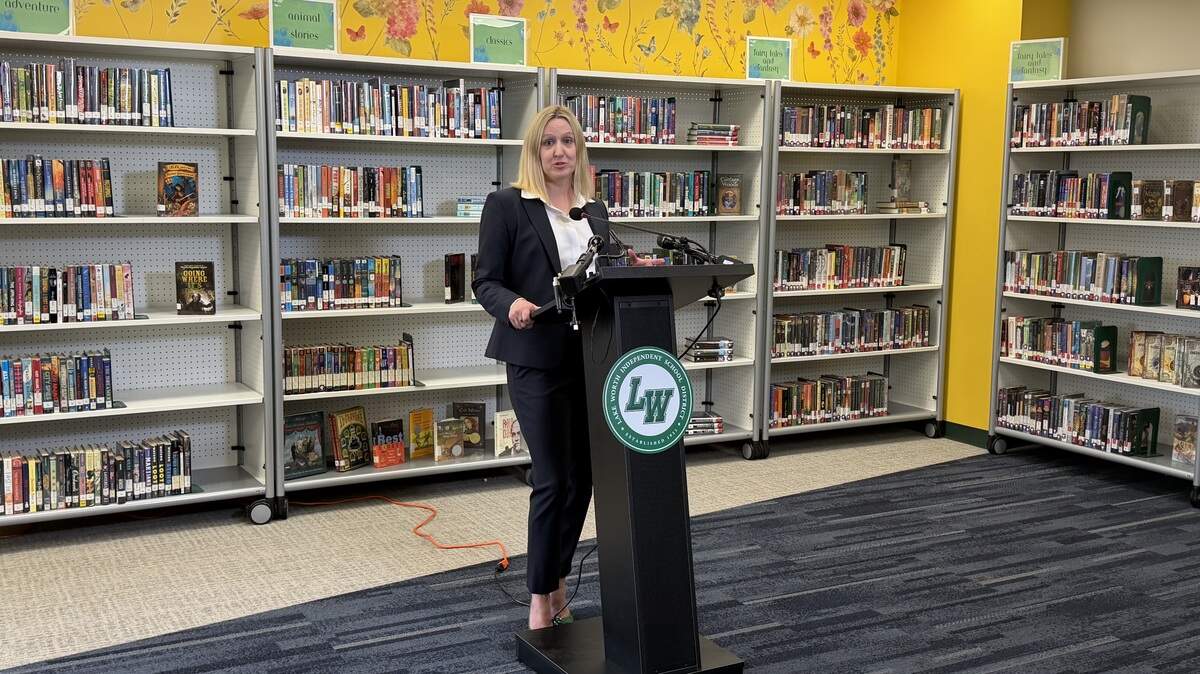
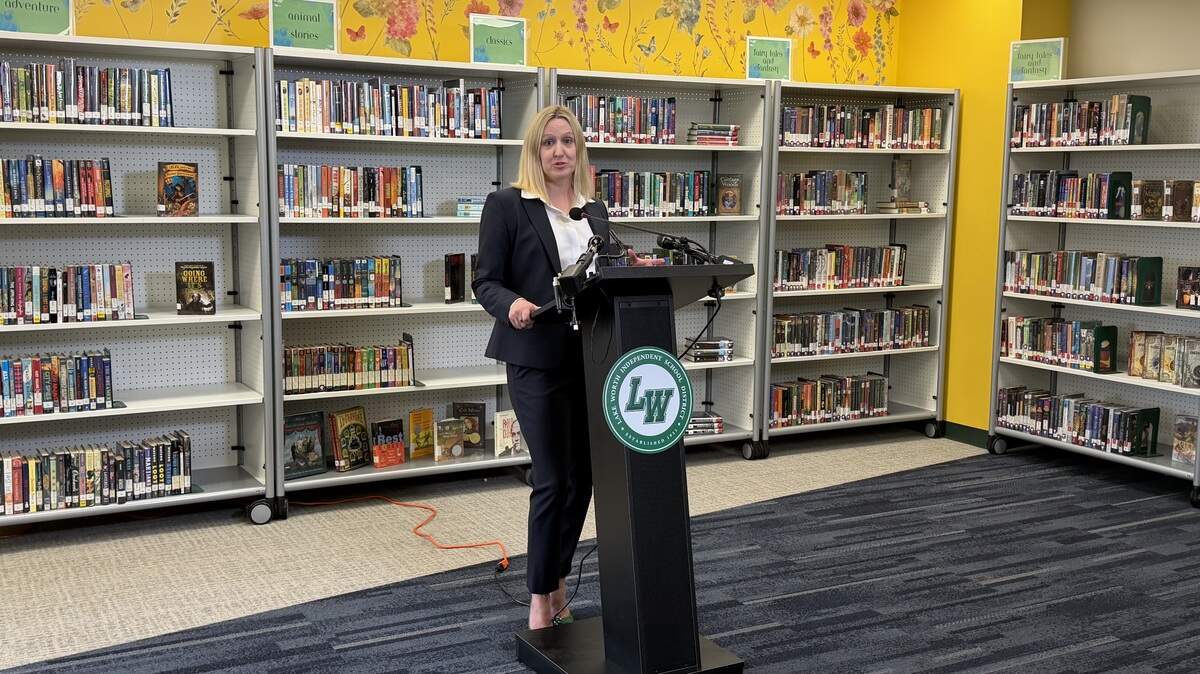
New state-appointed Lake Worth ISD Superintendent Ena Meyers held a press conference hours after assuming the role on in April.
Samuel O’Neal
soneal@star-telegram.com
Four months since Lake Worth ISD was taken over by the Texas Education Agency, state-appointed leaders have their sights set on improving reading and math scores through an overhauled curriculum and new instructional method.
Superintendent Ena Meyers, who was appointed by TEA in April following years of stagnant academic performance, and the new five-person Board of Managers worked with members of the curriculum department to reexamine how students were absorbing instruction.
Prior to state intervention, four of Lake Worth ISD’s five campuses were F-graded in TEA’s annual A-F accountability rating system. Just 30% of students in the district currently meet grade level, across all STAAR tested grades.
Meyers and the Board of Managers have developed a curriculum described as “loosely scripted,” but leaders still want “teachers to be teachers” and use their skills to teach their class the best way they know how.
Instructional materials given to teachers may include suggested script ideas on lesson notes for younger teachers, but there is no district-wide uniform script, Lake Worth ISD leaders said during a community event Wednesday.
When Meyers was appointed as the district’s leader in April, overhauling the curriculum was one of her first and biggest priorities, she said.
“We want to look at the curriculum,” Meyers said. “What is in front of our students, and what are they learning? And is that aligned to the work that we have to do, the work that is ahead of them? And do our teachers feel supported and able to deliver high-quality instruction?”
Lake Worth ISD’s semi-scripted method is a contrast from changes made in Fort Worth ISD, which is also currently under state control. Fort Worth leaders have adopted a strictly scripted curriculum model that has caused clashes between parents and district leaders.
Some things Lake Worth is doing that is similar to Fort Worth are first-teach methods and “demonstrations of learning” at the end of each instructional block to ensure students are absorbing the information taught to them. DOLs are short tests that ask questions related to the main points of that day’s lesson.
Lake Worth has already seen incremental gains over the summer in STAAR exam results. The district’s improvements from 2024-25 to 2025-26 were the largest in the Dallas-Fort Worth Metroplex, according to data from the Fort Worth Education Partnership.
Lake Worth’s grade 3-8 STAAR exam results grew by more than 9% in math and nearly 3% in reading from 2025 to 2026. The math score growth was more than any other district in Tarrant County. Both the math and reading results outpaced the Texas average for year-to-year growth.
But Lake Worth still lags significantly behind the state average STAAR exam results and is also behind most other districts in the Metroplex. Meyers said Wednesday that the district is focused on building on progress already established instead of tearing things down and starting over.
“We believe these improvements are the result of a focused commitment to high-quality instruction and meeting the needs of every student,” a district spokesperson wrote in a statement following the release of 2026 STAAR results. “While we are encouraged by the gains across multiple subjects and grade levels, we also recognize that there is important work ahead.”
Something Meyers acknowledged she has in her favor as she attempts to turn Lake Worth around is the ability to be accessible to everyone in the district, since it only includes five campuses. While a big district like Fort Worth requires so many levels of communication, Meyers can easily address problems with teachers on their campus if they need her to, she said Wednesday.
Wednesday’s community event was the second since Meyers took over as superintendent, and there will be a third in January. The first drew more than 60 attendees, a number leaders were proud of in a district that has long struggled with parent engagement. Wednesday’s session was not as well attended, but Meyers still believes families are becoming increasingly more engaged and she feels her team has the support of the community, she said.
When she was first appointed, Meyers made increasing parent engagement a goal, but something they were not going to force.
“I think when students enjoy being in school, and you have an entire community who is focused on student learning, kids are going to be going home and telling their families about the great day they had. You will see natural engagement increase. And I think you will see a natural connection that will happen.”
Lake Worth leaders are also working to implement smaller changes around the school day to enhance the academic experience for both students and families. Meyers announced Wednesday that the district has secured a Lowey 21st Century grant, which will provide no-cost after-school programs for students in the district. The program will include academic and school enrichment activities, Meyers said.
The district plans to create staffed positions to oversee the program and have those positions filled by November.
In-school changes this year have also included mandatory weekly social-emotional learning and character development lessons for Lake Worth students. Those lessons also include dedicated time built into the school day to develop leadership, communication and other essential life skills that go beyond just scoring well on STAAR exams.
The district is also planning to improve its partnerships with higher education, business and community organizations in the area.
“I’ve been in this role for four months and it really feels like forever, in the best way,” Meyers said. “I have seen some really, really strong things in our schools. Our teachers are the ones everyone should be bragging on. They are diving in, they are taking coaching, they are asking great questions. They want to work with our curriculum, they are asking our leaders to help them understand how to deliver that to our students. And it is just really encouraging and inspiring.”
Related Stories from Fort Worth Star-Telegram

Fort Worth Star-Telegram
Samuel O’Neal is the K-12 Education Reporter at the Fort Worth Star-Telegram, covering public schools and policy that impacts them. He previously worked as a staff writer at the Philadelphia Inquirer and is a graduate of Temple University.