
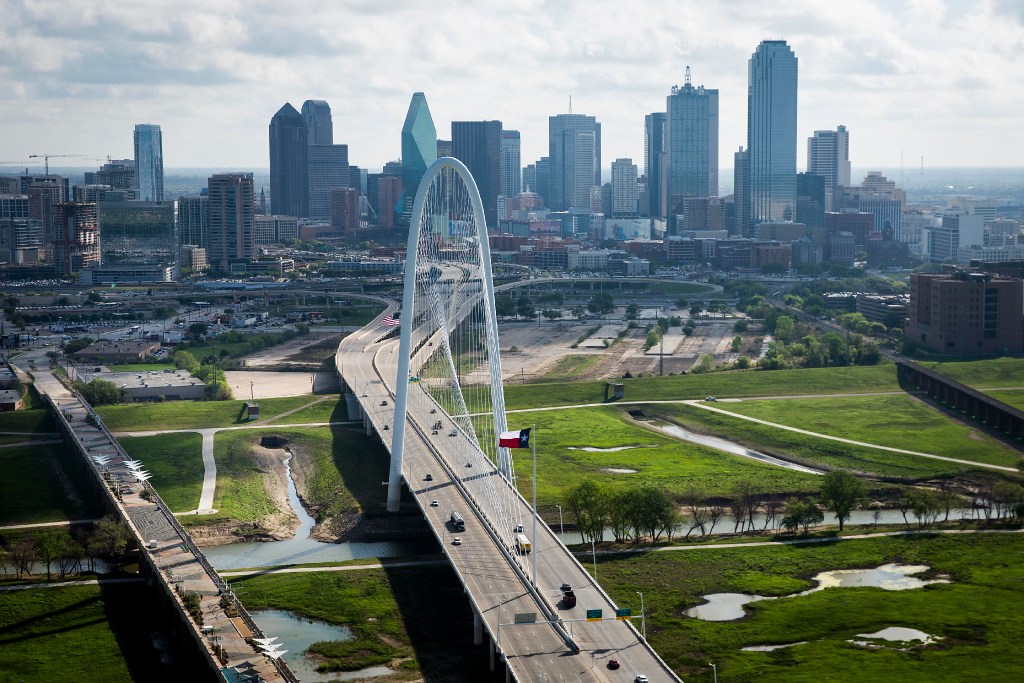
The Margaret Hunt Hill Bridge and downtown Dallas skyline
Smiley N. Pool/Staff Photographer
From its origins as a trading center along the Trinity River to its rise as one of America’s most dynamic metropolitan areas, Dallas has consistently reinvented itself through bold leadership, strategic investments and a willingness to think big. Downtown has long served as the region’s economic, cultural, governmental and transportation hub. Today, it stands at another pivotal moment.
An unprecedented wave of public and private investments is converging on downtown and central Dallas. The redevelopment of the Kay Bailey Hutchison Convention Center, a potential second convention center hotel, discussions surrounding renovated or new Dallas City Hall and a new Dallas Mavericks arena and entertainment district, the proposed Therme Dallas project, major transportation improvements, housing initiatives, public space investments and significant private-sector development are all moving forward at the same time.
This opportunity is extraordinary. Yet the central question is not whether these individual projects succeed. The question is whether Dallas can align them into something larger than the sum of their parts.
Article continues below this ad
History suggests that Dallas achieves its greatest successes when it chooses vision over fragmentation.
Nearly 60 years ago, civic leaders recognized that growth alone would not guarantee a thriving city. In 1968, the Greater Dallas Planning Council, AIA Dallas and the Dallas Design Committee launched Designs for Dallas, a groundbreaking effort that challenged residents to think beyond roads, buildings and utilities. It asked larger questions: What kind of city should Dallas become? How should neighborhoods connect? What role should parks, transit and public spaces play in shaping quality of life?
That same spirit was reflected in the notable short film, The Walls Are Rising, which presented two possible futures for Dallas. One was defined by car-centric infrastructure, congestion and disconnected growth. The other was built around thoughtful planning, pedestrian-focused design and livability. At the time, many of its ideas seemed visionary. Today, they feel remarkably prophetic.
Concepts such as regional transit systems, trail-oriented development and stronger connections between neighborhoods eventually became reality through investments like Dallas Area Rapid Transit and the Katy Trail. These transformative projects began not with construction, but with a shared vision and the commitment to see it through.
The tradition continued in the 1980s through Visions for Dallas, another collaborative effort involving key city, community and industry leaders. The initiative helped influence investments in downtown redevelopment, transportation infrastructure, civic facilities and public spaces that continue to benefit Dallas today.
Article continues below this ad
The lesson is clear: Many of the assets Dallas residents now take for granted began as ambitious ideas. Transformational change starts with a vision.
That lesson is especially relevant today because the scale of opportunity facing Dallas is unlike anything seen in decades.
Major transportation investments, including the planning and reconstruction of the Interstate 30 Canyon, Interstate 345, and the I-30 East corridor, will reshape mobility and create opportunities to reconnect neighborhoods long divided by highway infrastructure. Proposed streetcar expansions and continued discussions surrounding high-speed rail could further strengthen Dallas’ role as a regional transportation hub. At the same time, DART’s modernization efforts create opportunities to rethink how transit supports downtown growth, employment centers, housing and major destinations.
Public space investments offer equally transformative potential. Expansion plans for Klyde Warren Park, Harold Simmons Park, convention center deck parks, Loop Dallas connections and stronger links between downtown neighborhoods all contribute to a more walkable, connected and livable urban core.
Housing must also remain central to the discussion. Great downtowns do not thrive simply because people work there. They thrive because people live there. A successful downtown requires attainable housing, workforce housing, mixed-use neighborhoods and policies that support long-term residential growth. Initiatives such as HouseDTX and ongoing City of Dallas zoning reform efforts represent important steps toward creating a vibrant and inclusive downtown for future generations.
Article continues below this ad
Meanwhile, the private sector continues to make significant bets on Dallas’ future. Major financial institutions, investment firms, real estate developers and corporate employers are expanding their presence downtown. Combined with Dallas’ growing reputation as “Y’all Street,” these investments further reinforce the city’s emergence as one of the nation’s leading financial and business centers.
The challenge is ensuring that none of these projects operate in isolation.
Dallas has no shortage of plans. What has often been missing is the ability to connect those plans to a single, long-term vision that survives election cycles, leadership changes and shifting political priorities.
That responsibility belongs to all of us, but especially to civic leadership.
The mayor, City Council and city manager must work together to align transportation, housing, economic development, infrastructure, parks and civic investments around a common strategic framework. The goal should not simply be completing projects. It should be maximizing their collective impact and using them to unlock the full potential of Downtown Dallas.
Article continues below this ad
Professional planners, architects, engineers and urban designers also have a critical role to play. They bring technical expertise, innovative solutions and lessons learned from cities across the globe. Just as importantly, they can serve as an extension of city staff, helping transform ambitious ideas into achievable outcomes.
Developers, corporate leaders, public agencies, civic organizations and neighborhood groups must be equally engaged. Downtown Dallas belongs to every resident of this city, not just those who live or work in the urban core. Its success influences economic competitiveness, job creation, tax revenues, mobility, culture, tourism and quality of life throughout the region.
Most important, residents themselves must have a meaningful seat at the table.
Public engagement cannot be an afterthought. Communities trust plans when they are invited to help shape them. They become skeptical when they are asked to react to decisions that have already been made. Building consensus requires transparency, collaboration and a genuine commitment to listening.
As the Greater Dallas Planning Council celebrates its 80th year of service, its role remains as relevant as ever. For eight decades, GDPC has served as a forum where business leaders, public officials, planners, community organizations and residents come together to discuss the issues shaping Dallas’ future. Its greatest contribution has not been producing plans but creating conversations that lead to shared understanding and collective action.
Article continues below this ad
Dallas needs that spirit again.
The city has a once-in-a-generation opportunity before it. Billions of dollars in public and private investment are converging at the same moment. The decisions made over the next several years will shape downtown Dallas for decades to come.
The question is not whether Dallas will grow. Growth is inevitable.
The question is whether Dallas will seize this moment to create a bold, unified vision that connects these investments and positions the city for long-term success, or allow individual projects to proceed without a larger purpose tying them together.
History tells us what happens when Dallas thinks boldly. It builds the future.
Article continues below this ad
Now it must do so once again.
Ruben Landa is the president of the Greater Dallas Planning Council, and Gair Abbud is its managing director.