
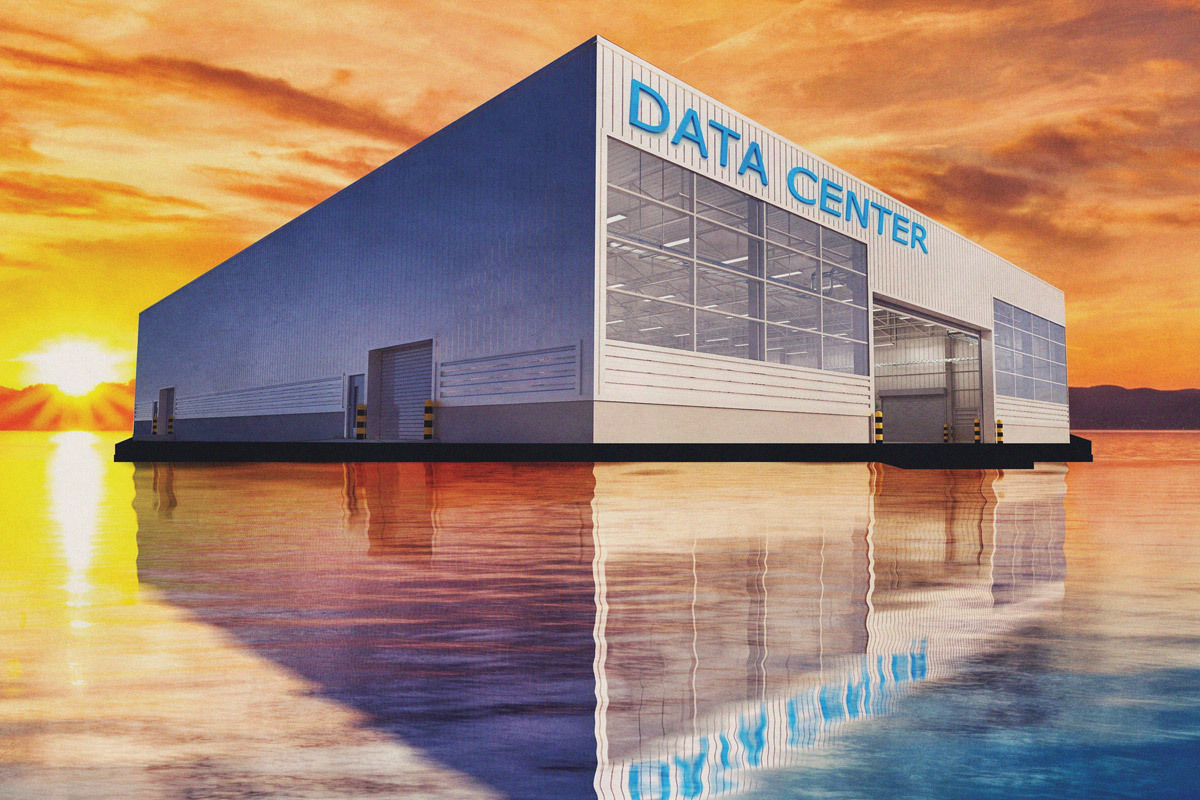
Dallas startup Mousterian is planning to put its data centers on water to help with cooling and water usage.
Photo illustration by Michael Hogue
Data centers are blamed for being loud, ugly and using massive amounts of electricity and water. They’ve also recently become politically toxic, leading to contentious public meetings in D-FW communities like Red Oak and Keller and a surprise moratorium from Gov. Greg Abbott.

But those data centers, which sometimes occupy hundreds of acres and use the resource equivalent of small cities, are located on land, often near people’s homes. A Dallas startup, called Mousterian, is taking a different approach: Developing data centers that float on water.
The unique design, said Min Suh, Mousterian’s CEO and cofounder, allows the floating data centers avoid municipal water supplies entirely, because they use the surrounding body of water as part of a closed-loop cooling system. The floating data centers also don’t make noise and are ideally located near power plants, so they can access energy easily and avoid bothering residents, because people generally aren’t living in such heavy industrial zones anyway.
Article continues below this ad
“We like to think, ‘If we are going to build a data center, we’re trying to do it in the most sustainable way possible,’ ” said Suh.
‘We’re killing ourselves’
Now several years into an AI-driven construction boom, the United States is home to over 4,000 data centers, including more than 1,000 hyperscalers, the largest facilities. Many of the biggest are in Texas, including Stargate, a potentially $500 billion joint venture in Abilene led by OpenAI, and Frontier, an incoming 1,200-acre project in Shackelford County. Numerous projects are also underway in data center-heavy D-FW, which was recently ranked by Cushman and Wakefield as the top primary data center market in the Americas.
The boom has created a rush of Texas construction jobs and been welcomed by many political and business leaders. “I think of [data centers] almost like the highways and the airports that are the fundamental infrastructure of the future,” Dallas Regional Chamber executive Mike Rosa told The News last year.
But the computing centers’ vast energy and water consumption — the biggest culprit is their cooling systems — has emerged as a persistent flashpoint, prompting community outrage and various local and state moratoriums.
Article continues below this ad
In Texas, Abbott’s new moratorium mandates an audit of pending data center projects that includes details on their cooling systems and impact on local water supplies, and politicians including Gina Hinojosa and James Talarico, the state’s Democratic gubernatorial and U.S. Senate candidates, are also loudly calling for tighter water regulations.
One controversial project — a planned data center about 60 miles southeast of Dallas that was expected to pull millions of gallons of water per day from Cedar Creek Lake, which also supplies drinking water for Fort Worth — was already scrapped.
“We’re killing ourselves letting the data centers in,” said Ashley Cook, a lawyer who led the fight against the project. “You’re basically turning a rural residential peaceful community into an industrial corridor.”
Some industry leaders have pushed back against the water-guzzling stigma, including OpenAI CEO Sam Altman, who has called the water issue “totally fake” even while pushing for more renewable energy use. Experts say the consumption issues are in fact relatively nuanced and localized. Each facility’s design and technology is also important.
By space, ocean or fjord
Yet as the world’s seemingly insatiable demand for computing power keeps rising, developers have also been exploring more novel solutions. Elon Musk and Jeff Bezos, among others, have unveiled plans for data centers in space. Earlier this year, a wind-powered, underwater data center began operating several miles off the coast of Shanghai. In Norway, a data center complex was built into an abandoned mine, with seawater-based cooling from an adjacent fjord.
Article continues below this ad
Several years ago, a California-based company called Nautilus Data Technologies developed the world’s first floating data center, which it built atop a refurbished, 700-ton barge in the San Joaquin River at the industrial Port of Stockton. The two-story operation, which resembles a white shipping container, began operating in 2021 with a cooling system that cycles around 4,500 gallons of river water per minute, with screens that serve as filters to keep fish and plants out of the intake system.
The site proved more ecologically sustainable, with far lower electricity and operating costs than typical land-based operations, according to Nautilus. It was also well received by local officials, and attracted San Joaquin County as an anchor tenant.
For some of its developers, it also served as a launching pad: “Taking those lessons of building the first floating data center,” said Suh, “we kind of took all the best components of different technologies available and basically created this new company.”
Suh, who has extensive data center experience but was not involved with the California floating data center project, cofounded Mousterian — the name refers to the Middle Paleolithic era, when humans first started using complex tools — with Chase Ott-Wick, a former senior engineer on the California project, and Gabe Andrews, another data center veteran and former Nautilus executive.
‘Pushing the envelope’
The 10-person company, which is self-funded and quietly launched last year, is based in downtown Dallas and handles data center design, engineering and development. In addition to floating data centers, it also develops land-based and water-adjacent facilities — Suh said it’s best to characterize the company as “a high-performance data center developer with unique facility offerings versus a purely floating data center company” — but is broadly focused on delivering projects that require far less energy and don’t use municipal groundwater.
Article continues below this ad
“A lot of the tech companies and hyperscalers were still maybe 10 to 15 years behind on how they were developing and delivering data centers,” said Suh, who also pointed to conspicuous examples of companies building water-guzzling facilities in dry areas like the American West. “And so we’re trying to push the envelope the opposite way, by being kind of very water sensitive.”
The startup has already landed major institutional partners: Earlier this year, in its highest-profile move yet, Mousterian signed an agreement with Samsung Heavy Industries, one of the world’s largest shipbuilders, which last month led to an engineering contract to jointly develop a fleet of floating data centers.
Under the terms of the deal, Mousterian and the Korean manufacturing giant are co-designing the vessels, which will be manufactured by Samsung in South Korea and then shipped and finished by Mousterian likely in Texas or Louisiana. Mousterian is also designing the facilities’ internal equipment.
The floating data centers will have about a one-acre footprint and a capacity of about 50 megawatts, which roughly qualifies them as large data centers. (Stargate, the massive Abilene project, is designed for a capacity of up to 1,200 megawatts.)
The plan is for the new floating fleet to be deployed in different locations around the U.S. Mousterian currently has a half dozen different project sites — featuring a mix of floating and land-based designs — in various stages, including a hybrid floating and land-based campus next to a power plant in Houston and what it’s calling “a large-scale floating campus” in the San Jose, Calif. area.
Article continues below this ad
Suh declined to provide more details about the other projects’ locations, but the floating data centers are typically located in sites like deep river harbors or shipping channels, where they’re moored close enough to land so that employees can easily walk back and forth between the floating facility and complementary land-based facilities.
“Within 30 seconds, you know, you’re in a regular air-conditioned office, with a bathroom and kitchen,” Suh said.
The data centers will also source energy that’s not connected to the public grid, while their pass-through water cooling systems will help give them a Power Usage Effectiveness, or PUE, score of 1.15 or 1.2, Suh said, which would rank among the industry’s best. Traditional data centers’ PUE scores, where 1.0 indicates perfect energy efficiency, are typically 1.5 or higher.
The floating data center concept has its complications, said Ed Hirs, an energy economist at the University of Houston, including a potentially high development cost, the access to large power sources and even environmental issues, if the warmer water discharging back into the water source disrupts marine life.
“It’s all a matter of how much money they want to spend,” Hirs said.
Article continues below this ad
Another major challenge is identifying the right locations, because of the very specific requirements needed to make the projects work. But being an industry innovator also has its benefits.
“It’s just that we’re the only company looking for these sites right now,” Suh said, “so we’ve kind of had our pick.”
Staff writer Lana Ferguson and columnist Dave Lieber contributed reporting