
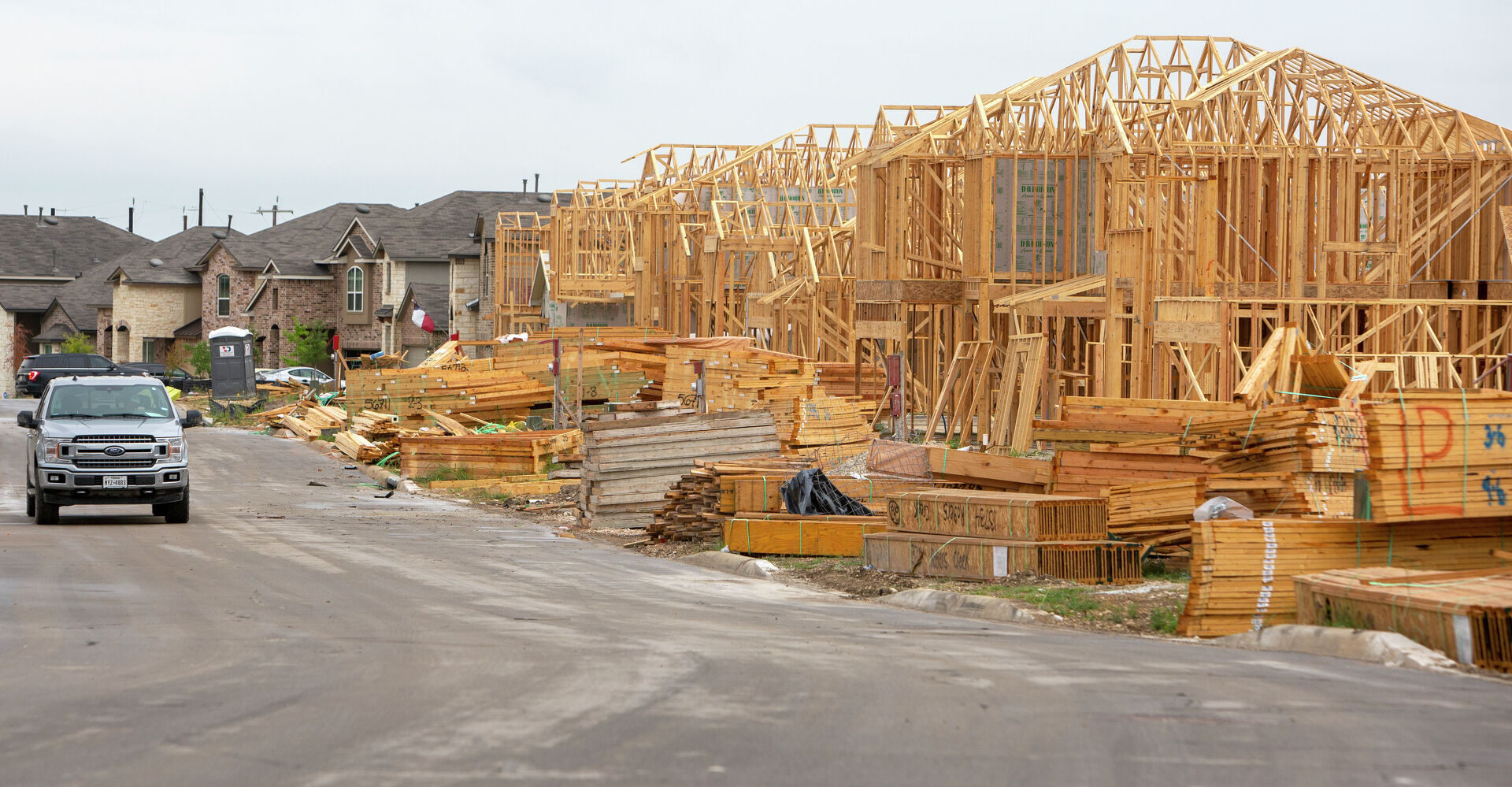
Homes are under construction on San Antonio’s far West Side. Last year, the metro permitted roughly 15% fewer homes than expected based on its population share.
San Antonio Express-News file photo
San Antonio might need to hit the books after receiving a barely passing grade for homebuilding and affordability.

The metro earned a C+ from Realtor.com, which handed out its first batch of annual metro report cards, a data-driven housing analysis grading the 100 largest U.S. metropolitan areas on housing affordability and the rate of new-home construction.
Article continues below this ad
The grades are determined by scores in four categories: each metro’s ratio of new homes relative to the population, the affordability of new-construction homes, the portion of the median earner’s income that is spent on a mortgage for a median-priced home and the affordability of homes for sale at different income levels. Realtor.com used listing data from 2025, as well as household income estimates and U.S. Census Bureau building-permit and population data.
MORE HOUSING NEWS: San Antonio home sales plunge 12.6%, the largest drop among major U.S. metros
San Antonio-New Braunfels ranked at No. 35, receiving an overall score of 59.1 for housing and affordability, among the nation’s top 100 metros. Meanwhile, Houston led Texas at No. 4, the Austin-Round Rock-San Marcos metro area ranked No. 6, and the Dallas-Fort Worth-Arlington metro area ranked No. 15. Houston and Austin were two of 10 metros to receive an A grade for balanced affordability and future inventory growth.
San Antonio Express News Logo
Make us a Preferred Source on Google to see more of us when you search.
Add Preferred Source
Texas, overall, earned the No. 4 spot on Realtor.com’s annual state-level report cards, released earlier this year.
Article continues below this ad
The Lone Star State earned an A- on its homebuilding and affordability report card. As the nation’s largest homebuilder, Texas accounted for 14.6% of building permits issued in 2025 — more than any other state. However, it fell below the affordability threshold, with a median listing price of $364,749 taking 32.5% of the state’s median income.
Homebuilding
San Antonio’s permit-to-population ratio was 0.85, meaning the metro permitted roughly 15% fewer homes than expected based on its population share.
In 2025, housing starts, or the beginning of construction on a new residential building, were down 7% year-over-year in San Antonio, according to real estate data firm Zonda. Future lots, or parcels of land acquired or held by a developer/builder with the intention of being subdivided and built upon, were down 7.55% in the fourth quarter of 2025 compared with the year before.
Article continues below this ad
Nationally, the market is short by just more than 4 million homes, according to Realtor.com.
Builders are facing higher construction costs, labor shortages and an increase in land prices. But a recent law could help boost the inventory of newly built homes.
RELATED: New federal housing law could curb big investors in San Antonio
The 21st Century ROAD to Housing Act, which went into effect in July, could help close the housing supply gap with trimmed-down regulations, sped-up local building permits and expanded financing options.
Article continues below this ad
Newly built homes in San Antonio were only about 4.5% more expensive than existing homes, according to Realtor.com. Builders are selling homes reasonably close to existing home sale prices.
During last year’s fourth quarter, there were 3,583 closings on new-construction homes, which was a 22% drop from the 4,576 in the fourth quarter of 2024, according to Zonda. The average closing price for a new build was up 10% to $324,119 at the end of 2025.
In response to the lull in demand, sellers and homebuilders tried to woo buyers with cost-cutting incentives. Homebuilders, in particular, offered amenity upgrades, reduced rates, contributions to closing costs and appliances as part of the package.
Affordability
San Antonio’s median listing price in 2025 was $331,705, while the metro’s median household income was $73,281.
Article continues below this ad
Its affordability score, or the share of inventory affordable for households of different income levels, is 0.666, trailing just behind the national average of 0.675. This indicates that the metro’s for-sale inventory is approximately average, but marginally less affordable across income levels.
READ MORE: Rebuilding expectations: Builders bear the brunt of the 2025 slowdown
Buyers have been cautious amid ongoing economic uncertainty and a housing affordability crisis, and San Antonio sales are plunging as a result. Mortgage rates have remained elevated in recent months amid overall inflation driven by surging oil and energy costs in the wake of the Iran war. The average long-term national mortgage rate rose above 7% this week for the first time since January 2025.
Article continues below this ad
Home prices in San Antonio are relatively low compared with many major metros, but they are still high relative to household incomes, and a slowdown in new construction could prevent that gap from narrowing.