
Some programs use non-conference play to stack wins, while the more competitive programs use non-conference games as an opportunity to find potential weaknesses.
TCU football finds itself in the latter category as head coach Sonny Dykes believes the Horned Frogs (2-1) found a potentially fatal flaw in their offense that must be corrected before TCU’s Big 12 opener at Central Florida (2-1) at 2:30 p.m. Saturday.
Dykes and some of the players said that Arkansas State opened their eyes to a strategy teams could use to slow down their run game after the Red Wolves were able to hold TCU to 131 rushing yards on just 3.4 yards per carry in the Horned Frogs’ 31-7 win last Saturday.
TCU’s lack of dominance on the ground came just two weeks after Arkansas State was gashed by Memphis for 335 yards. Arkansas State used a three-man front against the Tigers primarily and a four-man front against TCU, but it wasn’t just the addition of another lineman that caused some of the frustrating plays on the ground.
“I think we saw some challenging looks last week up front on the offensive line,” Dykes said. “I’m glad that we saw some things that we needed to get adjusted to and prepare for. It’s good for us to see that people are gonna really key on taking away the wide zone. I thought they had a good game plan last week about penetrating the guys up front.”
Most of Arkansas State’s success came from its stunts with the defensive line. Stunts are primarily when a defensive lineman lines up in one gap pre-snap and then ends up attacking another at the snap.
Picture your typical four-man front with two defensive ends on the outside shoulders of the offensive tackles in the C-gap. The two defensive tackles are often lined up between the center and guard in the A-gap or the guard and tackle in the B-gap.
Now imagine that defensive end looping inside to attack the B-gap while the defensive tackle replaces him in the C-gap. It can cause a lot of confusion for an offensive line not expecting it, and that one second of miscommunication is often enough to disrupt a whole play.
When TCU’s outside zone scheme is executed properly, running backs have the option of stretching the field horizontally and getting the edge on the defense, or being able to hit a cutback lane while the defense is flowing to contain the outside. But movement by the defensive line could delay the offensive tackle from being able to seal the edge, or the movement could place a defensive lineman right in the middle of the cutback lane.
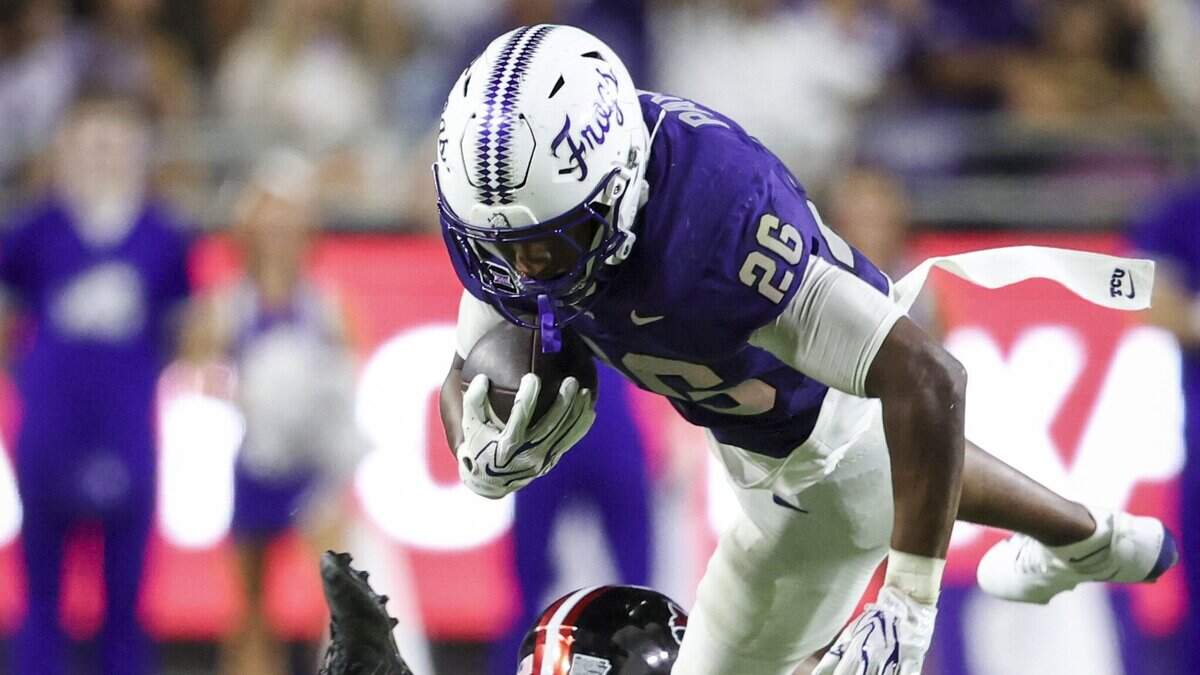
The constant movement was one reason the Red Wolves were able to hit junior running back Jeremy Payne in the backfield so often last Saturday. Reviewing the film was tough for some of the offensive line, but it ultimately served as a big teaching moment ahead of conference play.
“Going up against Arkansas State has been a big help,” sophomore offensive tackle Witten Van Hoy said. “Me and the younger guys got a lot more comfortable seeing different fronts that we haven’t seen before. It’s been good, it helps us prepare for any future teams that we’re gonna go up against.”
The defensive front of UCF remains a question mark entering Saturday, as the Knights had to replace first-round pick Malachi Lawrence up front. The unit held Pittsburgh to 103 yards and just 2.4 yards per carry in a rain-soaked game in Week 2 only to allow Georgia State to rush for 203 yards while averaging 5.8 yards per carry.
Regardless of the stats, Van Hoy says TCU is expecting the Knights to use a similar game plan as Arkansas State did.
“They’re a big movement team, and it’s been something that we’ve been emphasizing on and something we expect,” Van Hoy said.
One way to deal with stunts is making sure the entire offensive line is communicating and able to anticipate where defensive linemen may end up.
But stunts can also be exploited schematically, as it puts a lot of pressure on the agility and quickness of the defenders. If they’re too slow to get to their new gaps, then it could naturally create a wide-open rushing lane for Payne and the rest of the running backs.
Dykes and offensive coordinator Gordon Sammis will aim to exploit that movement Saturday.
“We got to be able to counter that with a bunch of different things that we can do from a formation standpoint, a play call standpoint, a motion standpoint,” Dykes said. “(There) are all these different ways to combat that and do a better job of keeping the defense on their heels. I think we let (Arkansas State) get a little too settled at times last week. It was good for us to have to battle through that and learn.”
How much TCU learned from last week’s victory could ultimately decide whether the Horned Frogs extend their winning streak to three games or suffer another frustrating early-season defeat.
This story was originally published September 23, 2026 at 8:51 PM.
Related Stories from Fort Worth Star-Telegram