
As artificial intelligence rapidly advances, many workers are asking the same question: Could my job be replaced by AI?
In Austin, a city whose business identity is increasingly tied to technology, the question is more pressing. With mass layoffs tied to artificial intelligence already hitting thousands at Oracle, Cisco, Meta and Microsoft, Austin workers are increasingly fearful their jobs could be erased.
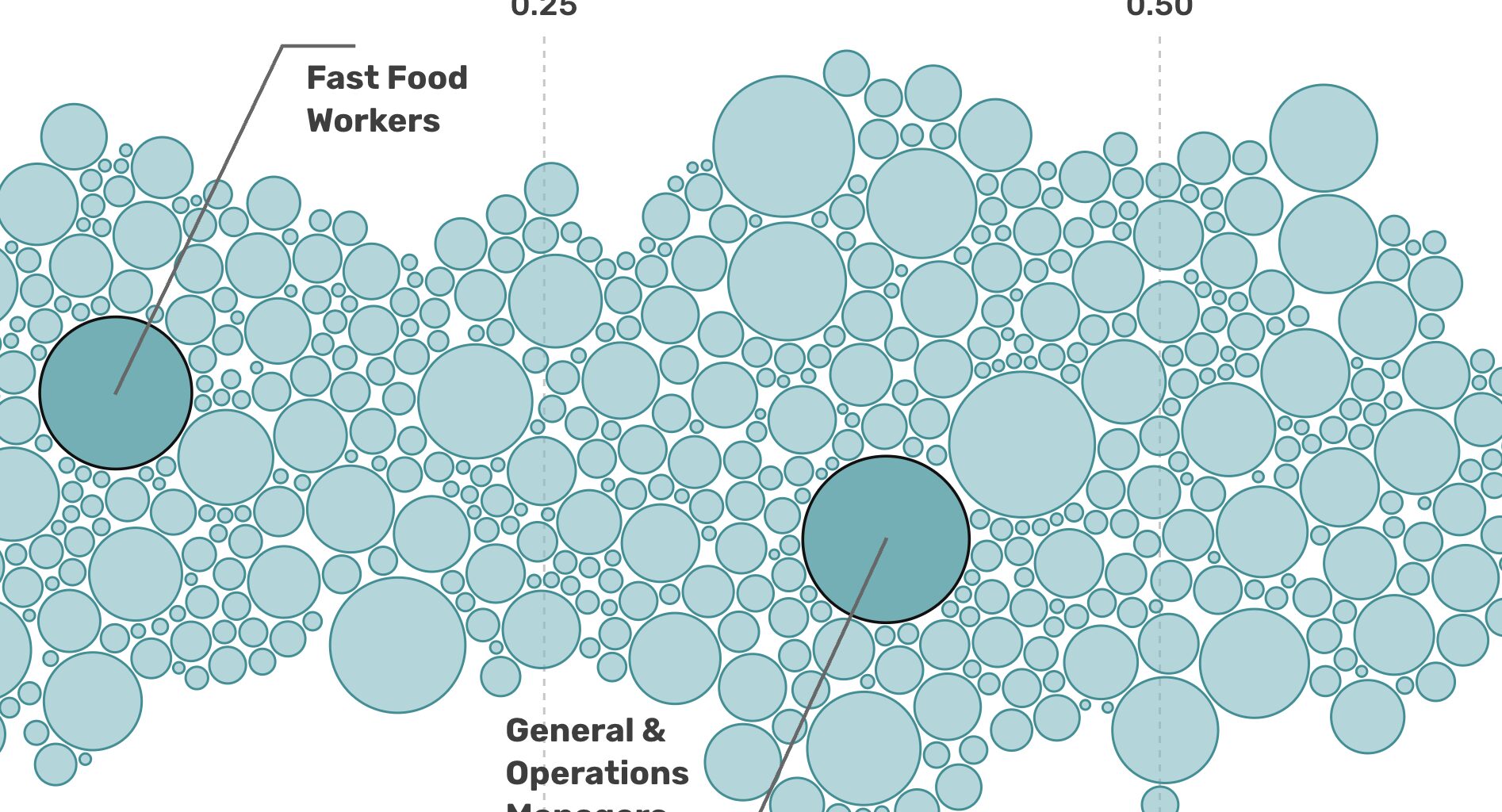
But those in the city’s fast-growing tech industry aren’t the only ones who should be concerned. In fact, an Austin American-Statesman analysis of employment data found that many occupations with the highest AI exposure are outside the technology sector.
The local white-collar workforce — communications, business operations, office administration, marketing, sales and engineering — are likely to feel AI’s effects more than software developers alone.
The analysis combines employment estimates from the 2025 Bureau of Labor Statistics Occupational Employment and Wage Statistics for the Austin metro area with AI task exposure scores developed by OpenAI and researchers at the University of Pennsylvania.
The results identify occupations in Austin with day-to-day tasks that could be performed or substantially assisted by artificial intelligence.
In the study, both a human and GPT-4 scored job “tasks”:
* 1 point if AI could cut the time at least in half while maintaining quality work
* 0.5 points if AI alone couldn’t accomplish that but additional software could
* 0 points if AI couldn’t reduce time or would produce lower quality work
Task scores were then combined for a job score. Jobs are considered “high exposure” if half a person’s tasks could be affected by AI.
Software developers and customer service representatives, for example, have many tasks that are highly exposed to AI. Others, such as construction laborers or fast food workers, have far fewer such tasks.
Public relations specialists — a substantial local workforce of roughly 4,170 people — is among occupations with the highest AI exposure.
Office-based occupations like executive assistants, human resources specialists and training specialists combine to another large local employment total with relatively high AI exposure scores.
Peter Stone, chairman of the University of Texas at Austin’s computer science department and a leading AI researcher, said it is hard to tell whether jobs will be fully replaced by AI.
But he doesn’t see the need for human intervention in such tasks going anywhere.
Exposure scores are not a forecast for layoffs. But employee efficiency due to AI could reshape the labor market if employers decide they need fewer workers to complete the same amount of work. Companies may choose to leave jobs unfilled, replace fewer workers who leave or otherwise slow hiring efforts.
“There’s things now that the computer can do that people couldn’t do, but there still remains a role for people,” Stone said. “This is true of a lot of jobs. I definitely disagree with the notion that there’s going to be no more jobs for computer scientists, or there’s no more jobs for people at all.
“AI programs aren’t going to replace people, but people who know how to use AI tools are going to replace people who don’t.”
Though Stone says he doesn’t see AI fully replacing computer science careers, there have been recent waves of layoffs at technology companies, developments that worry many in the job market.
This week, Austin-based Oracle Corp. laid off possibly thousands of employees in its second round of layoffs this year. The new cuts came after 21,000 workforce reductions made last fiscal year, which the company said were due to it spending billions on AI.
Dell Technologies Inc., Tesla Inc., Cisco Systems Inc., Cognizant Technology Solutions Corp., Expedia Group Inc. and Microsoft Corp. have all also cut jobs this year.
The latest forecast from Joseph Briggs, an analyst at investment bank firm Goldman Sachs Group Inc., predicts 9% of U.S. workers – about 15 million people – could be displaced by AI in the next 10 years.
“There’s many reasons that companies hire and lay people off,” Stone said. “My impression is there are places that are laying off people, and there are places that are hiring people. One company laying off people doesn’t mean that AI is taking all jobs.”
Instead, he said, workers will likely see their jobs change.
Stone, who helps oversee UT’s computer science and AI curriculum, said he’s suggesting all workers become AI literate, regardless of their career aspirations.
“It’s important to have some degree of literacy in artificial intelligence,” Stone said. “We’re entering a time when every student — whether they’re a humanities major, a social science major, music major — should take at least one course in artificial intelligence. That didn’t used to be the case, but now it’s an essential skill, just like reading and writing.”
Each row shows an occupation with estimated employment and its associated AI exposure score. Expand to see related occupations that don’t have employment estimate, but do have their own AI exposure score.
Occupation
Jobs ▼
AI exposure score
General and Operations Managers
42,190
0.38
Fast Food and Counter Workers
35,000
0.07
Customer Service Representatives
32,690
0.70
Software Developers
31,960
0.45
Retail Salespersons
29,660
0.36
Stockers and Order Fillers
27,430
0.19
Waiters and Waitresses
19,170
0.22
Registered Nurses
18,920
0.38
Project Management Specialists
17,470
0.40
About the data
Metro, state and national employment data come from the BLS OEWS estimates. The estimates are derived from approximately 1.1 million businesses surveyed over 3 years. The AI study was performed by researchers from OpenAI and the University of Pennsylvania. Some of the jobs scored by these researchers don’t appear in the local employment figures. The AI study included data on 97% of jobs in the Austin metro area. AI exposure scores were matched from ONET SOC occupation IDs to BLS NEM IDs using the crosswalk provided in the study. Matches with multiple occupations were assigned a match based on name, using the mean for groups like “Managers, All Other” or by manually selecting the closest occupation match.
 Start your day with the stories you need to know from Austin’s most trusted news source.
CreditsReporting by Karoline Leonard. Reporting and visuals by Wesley Ratko. Editing by Karina Kumar, Alexandra Kanik/Hearst Devhub and Randi Stevenson. Design and development by Andrew Williams.