
How much would you need to earn per year to be rich? By one metric, you’d need about $100,000 more if you live in Dallas-Fort Worth than elsewhere in the country.
Using survey and U.S. Census data, The Dallas Morning News estimates that a household income of at least $528,000 per year makes a family “rich” in the D-FW metro area.
That number is based partially on a survey conducted in 2025 by personal finance website Bankrate, which found that Americans said they would need to make about $420,000 per year to feel rich or “achieve financial freedom.” That income would place a household in the top 2.5% of earners, meaning that 97.5% of U.S. households earn less.
We took this 2.5% national threshold and translated it to metro areas, since many people compare their incomes to others in their region, rather than to the U.S. as a whole. That’s how we calculated the D-FW figure.
Enter your household income in the box below, then scroll further, to see how you stack up against different metro areas in Texas and the U.S. The income numbers are based on survey data collected in 2024, the most recent available, which we inflation-adjusted to 2026 dollars.
$93,000 is the median household income in the D-FW Area.
Household income is earnings from all sources, including wages, investment income, bonuses and benefits for all members of your household.
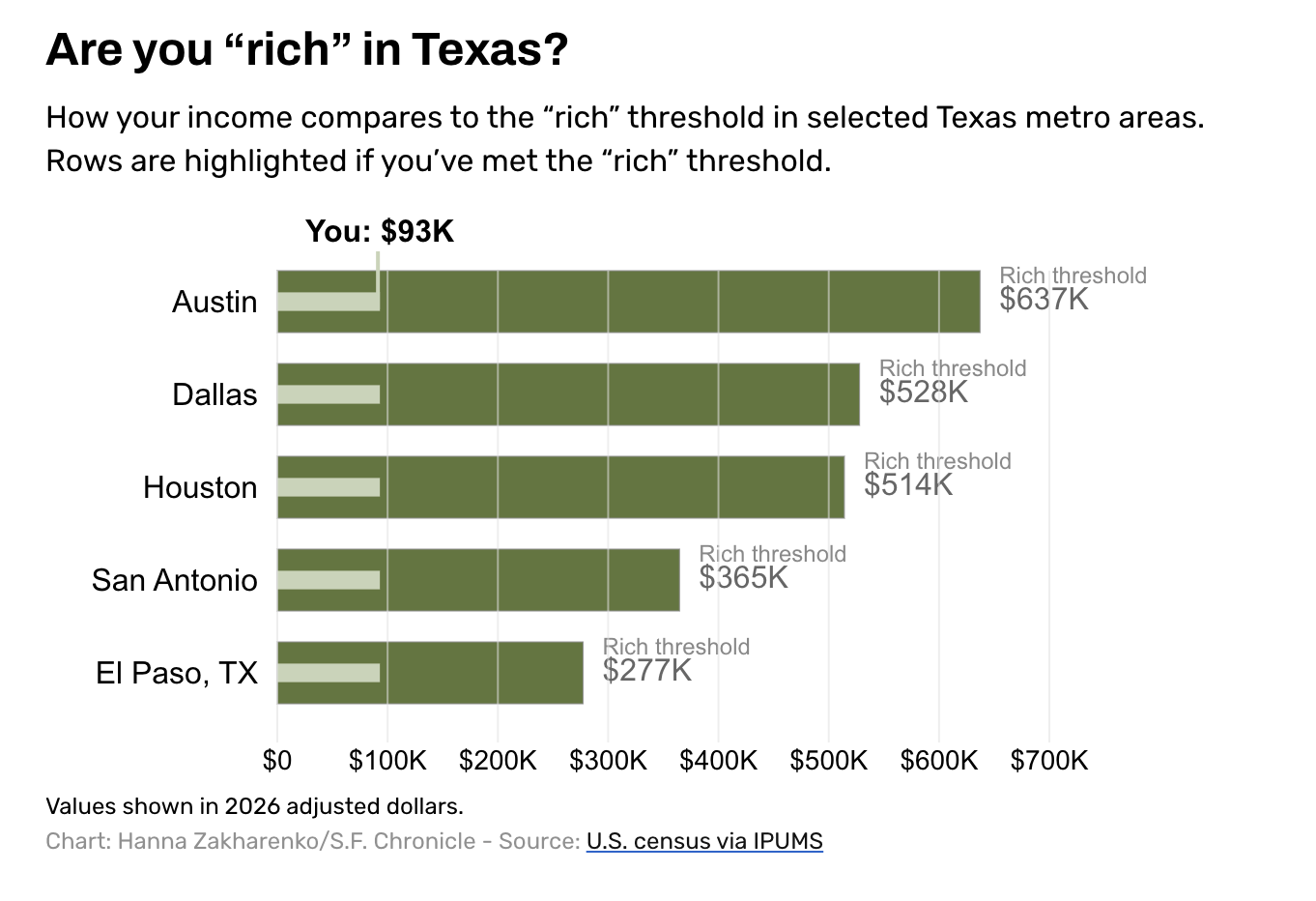
Are you “rich” in Texas?
How your income compares to the “rich” threshold in selected Texas metro areas. Rows are highlighted if you’ve met the “rich” threshold.
Values shown in 2026 adjusted dollars.
Chart: Hanna Zakharenko/S.F. Chronicle – Source: U.S. census via IPUMS
Depending on where you live, you might be closer to “rich.” For example, if your household makes $120,000, you would land around the 60th percentile of earners in the D-FW area, based on census estimates, but you’d be in the 79th percentile in El Paso.
Are you “rich” in other select U.S. metros?
How your income compares to the “rich” threshold in other select areas around the country. Rows are highlighted if you’ve met the “rich” threshold.
Values shown in 2026 adjusted dollars.
Chart: Hanna Zakharenko/S.F. Chronicle – Source: U.S. census via IPUMS
Making $528,000 a year is a level of income most people in D-FW could only imagine, with the area’s median household income sitting at roughly $93,000. One consolation: Though that median income is about $10,000, or 13%, higher than the national average, the cost of living in D-FW is only about 3% higher than in the rest of the country, according to the Bureau of Economic Analysis.
It generally takes less to be considered rich in metros where the median household earnings and cost of living are smaller. The threshold in the San Antonio metro area is about $365,000 per year, but it’s over $637,000 in the increasingly expensive Austin area.
Here’s the percentile your family’s household income would land in if you lived in different U.S. metros
This rough estimate of relative income isn’t the only way to measure what makes someone rich. Asset wealth also plays a major role. Unfortunately, data on household wealth at the local level is relatively limited.
However, we can get a better idea of people’s full assets when we look at the state level. A different census survey found the median net worth of Texans in December 2024 was about $159,000, lower than the U.S. median net worth of about $200,000. That gap reverses toward the top. At the 98th percentile — where you’d be “rich” — Texans have a net worth of $6.1 million while for all U.S. residents it was $5.8 million.
The perception of personal finances also has a lot to do with what is going on in the world. In September, the University of Michigan’s monthly consumer sentiment survey found a near 13% decline since September 2025, largely due to widening fears of inflation and high fuel prices. Added costs from tariffs throughout the year have also led to concern about savings and investments.
 Start your day with the latest news and what you need to know across North Texas.
CreditsLocalization by William Tong. Editing by Laurie Joseph and Dan Kopf/San Francisco Chronicle. Reporting, data and graphics by Hanna Zakharenko/San Francisco Chronicle. Production by Mel Fronczek and Alma Lozoya.