
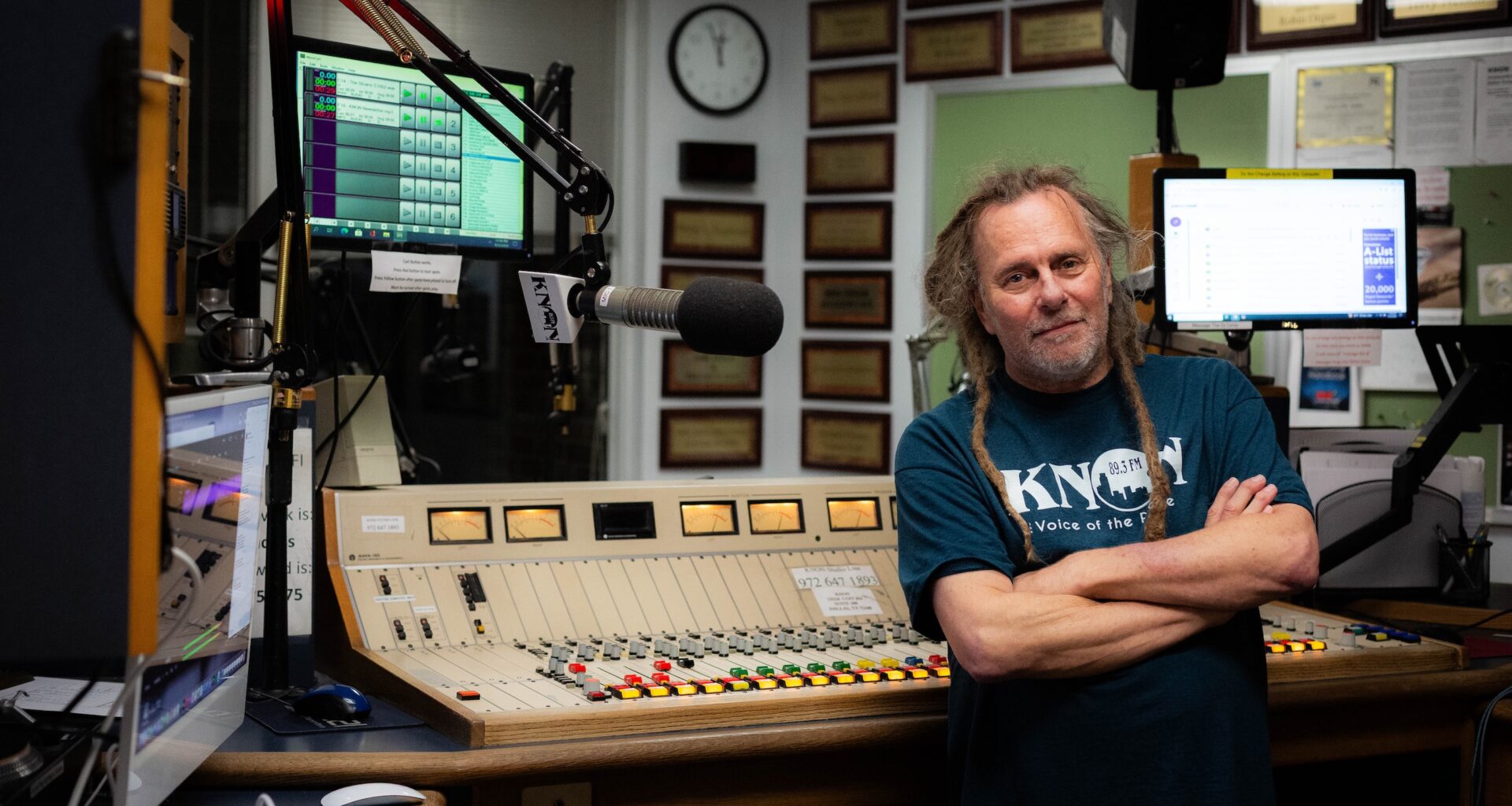
It’s a little before 10 p.m. on a Wednesday, and Jeffrey Liles is perched in a studio high above Coit Road, watching headlights streak by in the dark below. Down there, somewhere, is a late-knight KNON listener who has no idea that the next two hours of their life are about to be quietly, deliberately curated by one of the most storied figures in Dallas music. That’s the romance of it.
Nearly 40 years ago, in 1986, Liles started a radio show on KNON — then broadcasting at 90.9 FM, before the station moved to its current home at 89.3 FM in 1988 — called “Life is Hard.” This September, he brought it back — same station, same night, same name, wildly different mission. To fully appreciate how strange and wonderful that is, you have to understand that returning to the exact airwaves you launched from four decades earlier is not a thing most people get to do. Careers don’t usually curve back on themselves that cleanly.
Liles has never had an ordinary career, though. Back in the day, the show was as much a promotional tool as a passion project.
“Get the word out about the artists that we’re booking at Theater Gallery,” is how he describes the original mandate. And there was plenty to book. In the late ’80s, Liles was juggling Theatre Gallery, Club Dada, the Prophet Bar and the Longhorn Ballroom, essentially wiring the nervous system of Deep Ellum as suburban kids poured into the city chasing their favorite local bands.
Sign up for the Music newsletter to get the latest stories delivered to your inbox
THANK YOU!
You’re all set.
CLOSE
He’s the guy who took a building owner to lunch and talked him out of opening a Cajun seafood joint, convincing him to launch a little live music venue called Trees instead. He’s the guy who befriended Dr. Dre and Eazy-E, got an early cassette of “Boyz-n-the-Hood,” and played it unedited on KNON, making it the first station in the country to spin N.W.A.
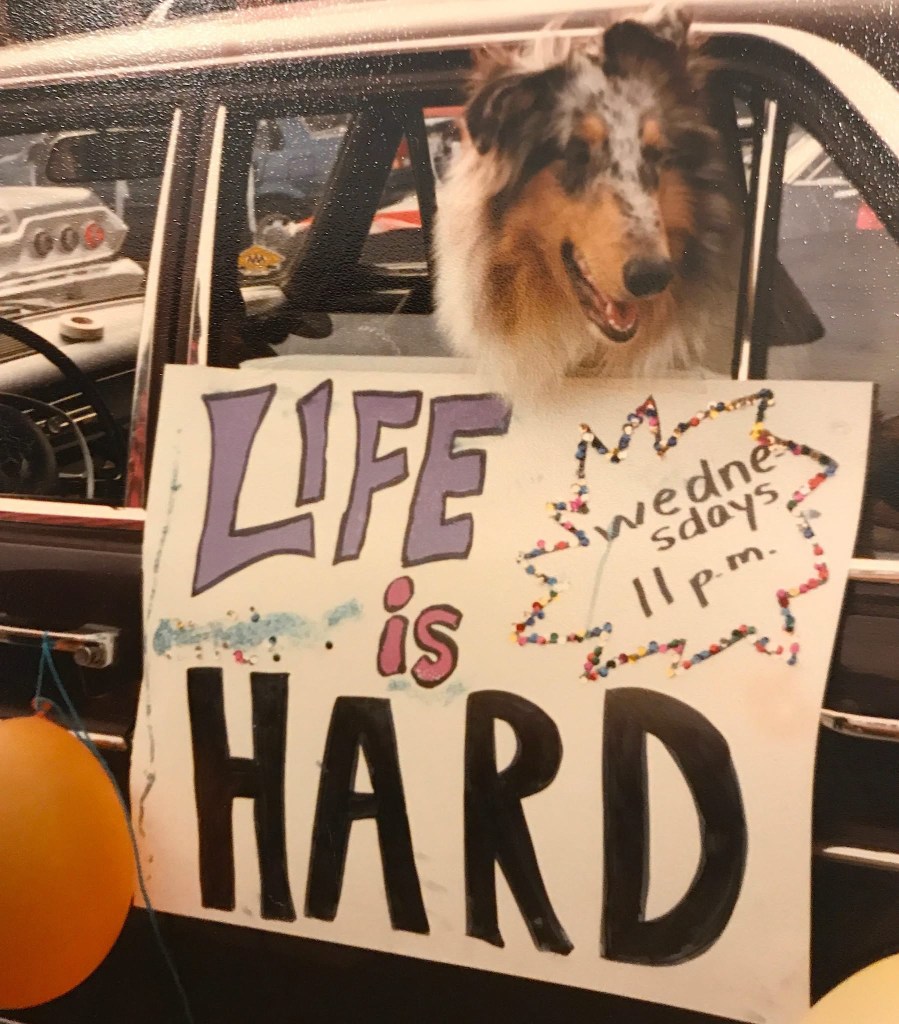 In the 1980s, a superfan loved “Life is Hard” so much they drafted their car and grinning collie as the show’s official KNON parade float.
These days, Liles serves as artistic director for both the Kessler Theater and the Longhorn Ballroom, which means he’s still shaping what Dallas hears every single night. But the man behind the microphone in 2026 wants something different from the one who signed on in 1986. Back then, the show was about volume, impact and sheer sonic force.
“In the beginning, ‘Life is Hard’ was about the music itself,” Liles says. “It was about speed metal. It was about gangster rap … how hard the beats were or how loud the arrangements were.”
The title was practically a genre description. Hard music for a hard world.
Now 64, he’s chasing the meaning underneath the noise.
“I’m really focused on the lyrics. I’m really focused on the themes,” he says. “Songs about struggle and people’s personal struggles and people overcoming just intense personal challenges.”
He curates tracks about addiction, isolation, heartbreak and PTSD — not to bum anyone out, but to keep them company. The show has become something he describes as almost medicinal, a companion for people processing grief or pain on a long drive home.
Brand new ears
So, why keep the old name at all, when the show has changed so completely?
“I figured I should use the name ‘Life Is Hard,’ just to pay homage to the first version of it,” he says.
The title stayed; only its definition grew up. The evolution didn’t happen in a vacuum. Years of running The Kessler rewired his ear.
“Being at the Kessler … has kind of fundamentally changed my taste in music,” he says.
Watching solo, self-contained artists fill a room with nothing but a voice and instruments taught him to love restraint. He gravitates now toward stark, minimalist arrangements, the kind where “the lyrics become more accentuated because they’re not battling with this noise and cacophony.” The kid who loved things loud grew into a man who understands the power of a whisper.
He also thinks like a filmmaker.
“Part of what I’m trying to curate is pieces of music that spoke to me in certain films,” he explains, name-checking the surgical needle drops in “The Sopranos” and Paul Thomas Anderson’s “Magnolia.” He’s not building a playlist so much as scoring your night.
The studio itself is a shrine to all of it. Vintage posters from decades of music festivals cover the walls, including a David Bowie poster signed to the station and manager Dave Chaos. Plaques honoring longtime listeners crowd the booth like family photos. Fellow DJ Jay Gavit, aka DJ Crash, hovers nearby, helping Liles wrangle a modern digital board, a far cry from the tape decks and vinyl he cut his teeth on in some “old creaky house” back in the day. Gavit calls Liles a “sponge,” a “massive encyclopedia of music,” a “surgeon” who refuses to play a track without knowing its complete backstory.
And then there are the moments radio can’t script. During the set, the first call-in donation of the night comes from a listener identifying himself as “Elmer Fudd.” A prank, surely — except there’s a physical plaque on the studio wall bearing that very name, a relic from KNON’s old days. Living history, calling in to fund living history. You couldn’t write it better.
That’s really what makes this whole thing sing. Liles isn’t nostalgic for 1986 so much as in conversation with it. He spends all week building each two-hour set, mapping exactly how the energy will rise, dip and drift into different realms, threading in obscure cuts from famous artists, international tracks and songs that gutted him personally. He treats a Wednesday-night slot like sacred ground.
Forty years later, the circle is complete — only this time, Jeffrey Liles isn’t just filling the air, he’s trying to heal a little of it.