
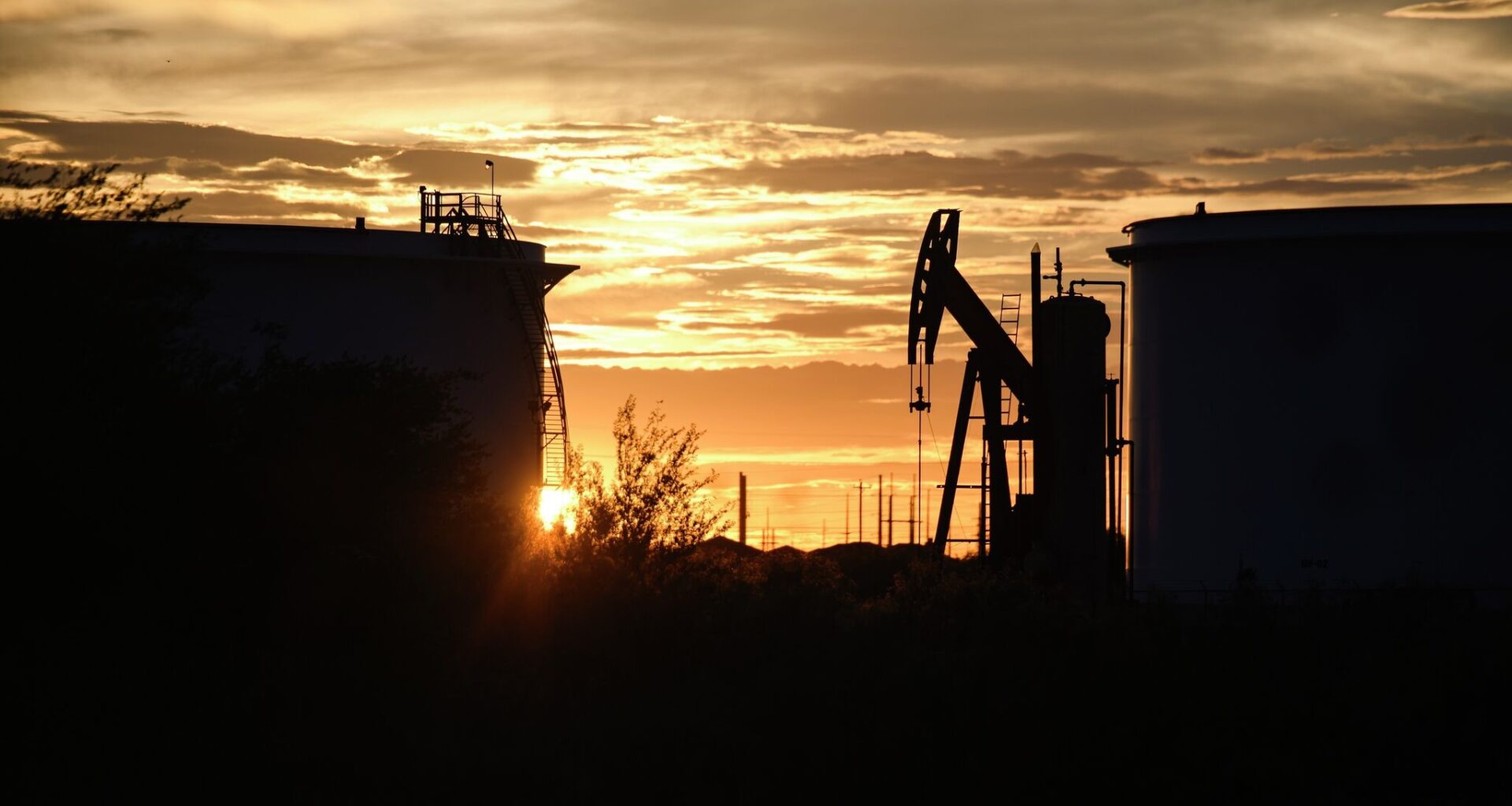
The sun sets behind crude oil tanks and a pumpjack in Midland. Texas has removed climate change courses from core curriculum. Ignoring climate change — and how greenhouse gas emissions contribute to warming — will not serve the state.
Eli Hartman/Associated Press
I’ve been working on the science of climate change for three decades. In the 2000s, when the existence and cause of climate change were already well established by the scientific community but rejected by some politicians, I strongly believed that in a few decades, climate change would be so undeniable that everyone would demand action to stop it.

We’ve reached that point. Climate change is obvious to every Texan who’s paying attention.
Article continues below this ad
In response, Texas is indeed taking action. But not action that would address the problem. Rather, the action is to prevent students at our public universities from learning about climate change.
Officials are prohibiting climate change from being taught in the core curricula of Texas public universities.
To understand why this is so important, let me explain what the core curriculum is. I teach at Texas A&M University. Every student earning a bachelor’s degree takes 42 hours of core curriculum classes. These classes are divided into different categories, including social and behavioral studies and physical sciences.
This means history majors are required to take science classes and STEM majors need to take social science classes. This ensures A&M graduates are well-rounded.
Article continues below this ad
Traditionally, any class could be in the core curriculum as long as it satisfied a set of requirements ensuring it broadens student education.
The core was a free market of education. Students could take classes on topics that interested them while also broadening their education. If students were interested in climate change, they could take a class as part of their degree plans.
Sadly, students no longer have that ability. The free market of education has been brought down by educational central planners who are now telling students that climate change is simply too dangerous for them to learn about.
SIGN UP FOR THE AUSTIN ANGLE and get Statesman commentaries in your inbox
Article continues below this ad
Texas is one of the most vulnerable states to extreme weather. We experience extreme heat and extreme rainfall. Coastal communities face hurricanes, storm surge and rising seas. East Texas is vulnerable to wildfires. West Texas faces water availability challenges. Climate change amplifies these hazards.
As a result, today’s students will spend their careers making decisions that would be aided by understanding climate change. Engineers will design infrastructure for a climate different from the one we have today.
Farmers will manage crops, water and heat as temperatures and precipitation patterns shift. Communities will decide how to protect homes, roads and electricity systems from changing risks.
Understanding climate change will help Texas graduates manage those risks and identify new business opportunities for solving the problems that climate change creates.
Article continues below this ad
The decision to remove climate change from the core curriculum is therefore impossible to defend on its merits.
But, of course, everyone understands why climate change was removed: Understanding climate change requires confronting the consequences of burning coal, oil and gas.
Reducing students’ exposure to the subject serves fossil fuel interests even as climate change will wreak havoc on our state throughout the coming century.
This is particularly easy to see when you consider the courses that remain approved for the core curriculum. The core curriculum still includes courses titled “Dinosaur World” and “Molds and Mushrooms.”
Article continues below this ad
I’m not criticizing those courses or their inclusion in the core curriculum. They sound fascinating, and I’m sure they effectively advance the goals of the core curriculum.
But there is no way either of those courses better prepares students for living through the changing climate of the 21st century than a course on climate change.
The lack of transparency surrounding the decision is equally troubling: We don’t know who ordered climate change removed from the core curriculum. A faculty committee supposedly was in charge of these decisions, but members of the committee told me that they did not make the decision to remove the course.
Texas A&M should restore climate change to the core curriculum. If university administrators want to remove it, they should do so publicly, justified by a set of consistent standards.
Article continues below this ad
If this decision is not reversed, it will hurt Texas. Climate change is real, and Texans will have to deal with it. Making it harder for students to learn about that reality will leave them and the state less prepared for what we know is coming.
Andrew Dessler is a professor of atmospheric sciences at Texas A&M University. Follow him on Bluesky or Substack.