
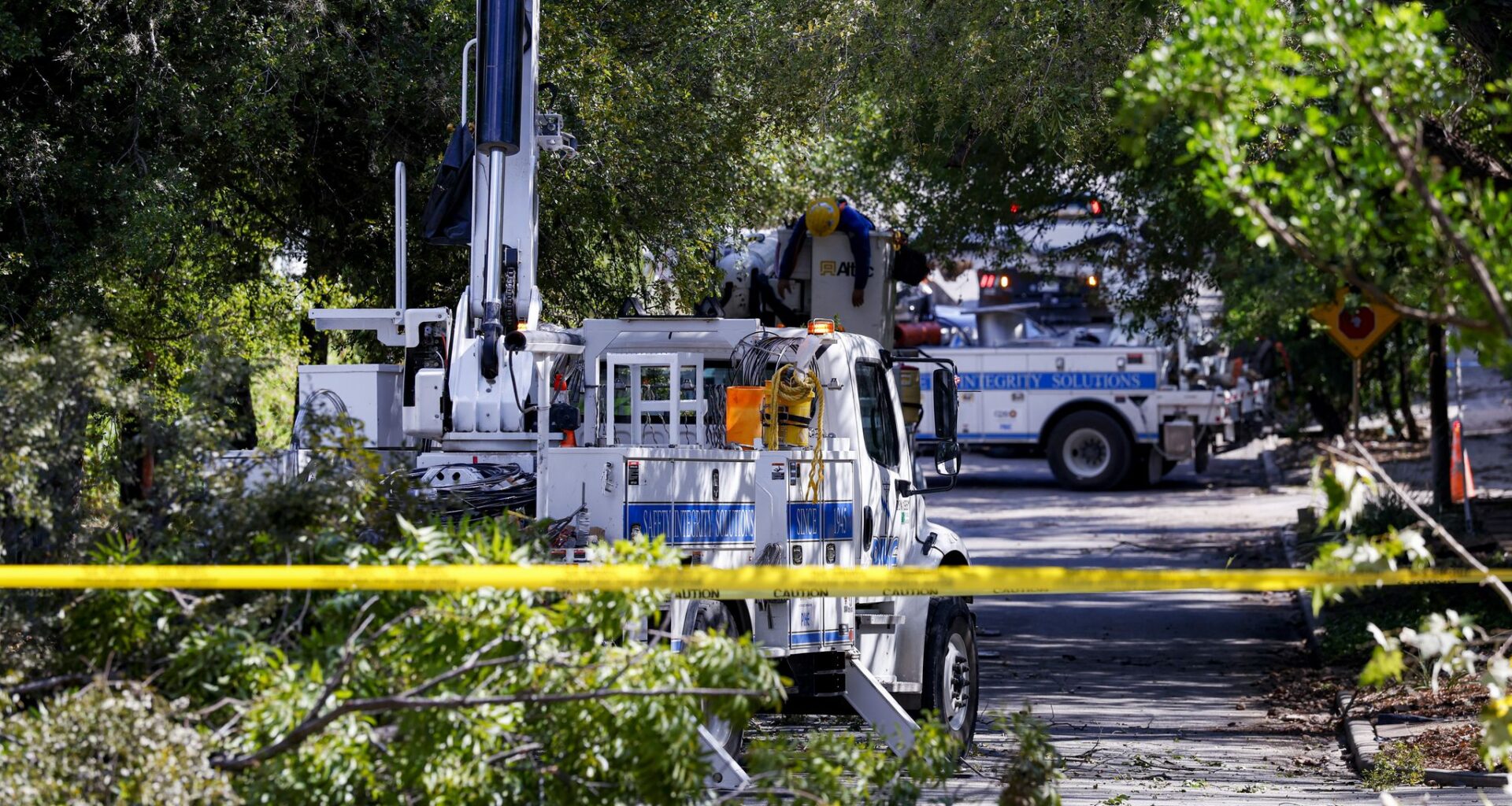
CPS Energy crews repair damaged utility poles along North Main Avenue in the Monte Vista neighborhood on Aug. 29. CPS Energy is studying the Aug. 28 storm to learn how it can better handle severe weather events.
Sam Owens/San Antonio Express-News
The storm that swept through San Antonio and left hundreds of thousands of people without power for days last month also marked a first for the city-owned utility.

After the storm’s 80-mph winds uprooted trees and broke poles throughout its path, CPS Energy called on another utility for help for the first time as it cleared debris, repaired downed power lines and replaced damaged equipment.
Article continues below this ad
The city-owned utility is a member of the American Public Power Association and the Texas Mutual Assistance Group, which provide assistance to other group members when needed. But usually, it’s CPS sending crews to different cities to support other communities.
“This is one of the first times, really the first time, where we get another utility to come and help us,” interim Chief Operating Officer Jose Treviño said during a board presentation on the Aug. 28 storm. “We do use extended contractors that we have on contract already to support us, but we have never had to call another utility to come and help.”
READ MORE: By the numbers: CPS Energy tallies the damage from fatal San Antonio storm
San Antonio Express News Logo
Make us a Preferred Source on Google to see more of us when you search.
Add Preferred Source
By calling on Pedernales Electric Cooperative, a Hill Country utility, in addition to its contractors, CPS doubled its capacity to respond to the outages caused by the storm.
Article continues below this ad
CPS Energy is studying the Aug. 28 storm to learn how it can better handle severe weather events, such as the storm headed to San Antonio this week.
Sam Owens/San Antonio Express-News
Now, a month after the storm that at its peak affected nearly 350,000 customers and left nearly 250,000 customers experiencing sustained outages, CPS is studying what it did — and what could have been done better.
The presentation on the damage from the storm and the utility’s response came as the threat of another storm looms over San Antonio.
Prepping for upcoming storm
But this time, Treviño said, “we definitely have more warning.”
Article continues below this ad
Interim CEO and President Frank Almaraz, who also was named the nominee for the permanent position at Monday’s board meeting, said the utility is bracing for 3 to 6 inches of rain, possibly more, this week.
RELATED: CPS Energy nominates Frank Almaraz as president and CEO of city-owned utility
The city-owned utility is not expecting the hurricane-force winds — and hundreds of thousands of outages — that happened during the August storm. But CPS is closely monitoring the forecast as significant flooding can still cause tens of thousands of outages, Almaraz said.
A flood watch for South and Central Texas was issued by the National Weather Service on Tuesday morning, going into effect at 7 p.m. Wednesday and lasting through 7 p.m. Friday. The heaviest rainfall is expected between noon Thursday and noon Friday.
Article continues below this ad
“We are immediately attempting to utilize the lessons learned (from the August storm) in preparation for this upcoming event,” he said. That includes staging crews to be ready for damage assessments, including the use of drones, and being strategic about pre-staging surge capacity.
“I’m assuming that there’s some additional pressure to achieve these (storm-response) improvements because of what we know is coming in terms of more frequent, more extreme storms,” Chair Francine Romero said. She pointed to this year’s short-term threat of a strengthening El Niño and the long-term risks of the ongoing and worsening storms that climatologists are warning of.
READ MORE: CPS Energy faced rising costs, longer outages even before Friday’s storm
Automation and tree trimming
Past investments CPS has made in automated devices helped mitigate the effects of the storm.
Article continues below this ad
For example, reclosers are able to help with temporary issues such as a tree limb or animal coming into contact with a line. The reclosers can interrupt the flow of electricity so that the line can be cleared. Once the obstruction has been removed, the recloser automatically reenergizes the line.
“It eliminates having to wait for somebody to go out there to clear that outage,” Treviño said.
But reclosers aren’t able to operate effectively if the wire itself is down. The Aug. 28 storm led to 1,100 reports of downed wires.
A fallen tree lies across a fence and extends into the parking lot of Laurel Heights United Methodist Church along Mistletoe Avenue on Aug. 29.
Sam Owens/San Antonio Express-News
CPS also has tripled its investment in vegetation management since the February 2021 storm. In the wake of the August storm, which uprooted trees across the city, CPS conducted 280 tree trimming and debris removal operations.
Article continues below this ad
RELATED: After San Antonio storm, West Side neighbors weathered days without power
Damaged substations also slowed the recovery effort, particularly at its Five Points substation.
“That’s one of the substations that had a lot of damage that actually caused widespread outages throughout that area and the central area of Five Points. That was very difficult to recover from,” Treviño said, noting that the main power source was disconnected because of the damage.
That area had more than 10 poles that were split during the storm, which produced more than 2,400 lightning strikes. In total, CPS replaced 81 poles and 158 transformers, both higher than previously reported.
Article continues below this ad
What CPS wants to change
Looking forward, CPS wants drones to play a larger role in its restoration efforts.
“We did use drones with the substation outages to ensure that we actually captured all the damage that was done in that area,” Treviño said. “But we do see a big opportunity here to improve on that.”
SA INC.: Get the week’s top local business stories in your inbox
Article continues below this ad
CPS said it could start using drones to do damage assessments, helping to identify where repairs need to be made and what obstacles may be in the way. That would help the utility better assess where to deploy crews and what equipment is needed, expediting repairs.
The city-owned utility also will beef up its capacity for handling customers’ outage reports. During the peak of the storm, the number of customers reporting outages exceeded the online system’s capacity, said DeAnna Hardwick, chief customer strategy officer.
CPS is permanently scaling up its online system, as well as working to identify and address limits in its reporting capacity via phone.
The utility also is developing a more transparent way to give customers more detailed updates on power outages, specifically sharing information about individual outages while still protecting customers’ private information.
Article continues below this ad
“We don’t have an answer yet, but we know that this is a problem that we have to solve, and we want to get it right,” Hardwick said.
Our Lady of the Lake University student volunteer Viviana Connolly, center, works with other volunteers to clear storm debris after the Aug. 28 storm that swept through San Antonio.
Sam Owens/San Antonio Express-News
The response to the storm required a collaborative approach, with different city and county entities lending help in the aftermath. The lesson learned from that is that the utility needs to strengthen its community partnerships, Hardwick said.
Article continues below this ad
“We want to work with partners, neighborhood associations, churches, as many different community partners as possible, to understand what they can do, what we can do, and how can we all help each other to ultimately help our community,” she said.