
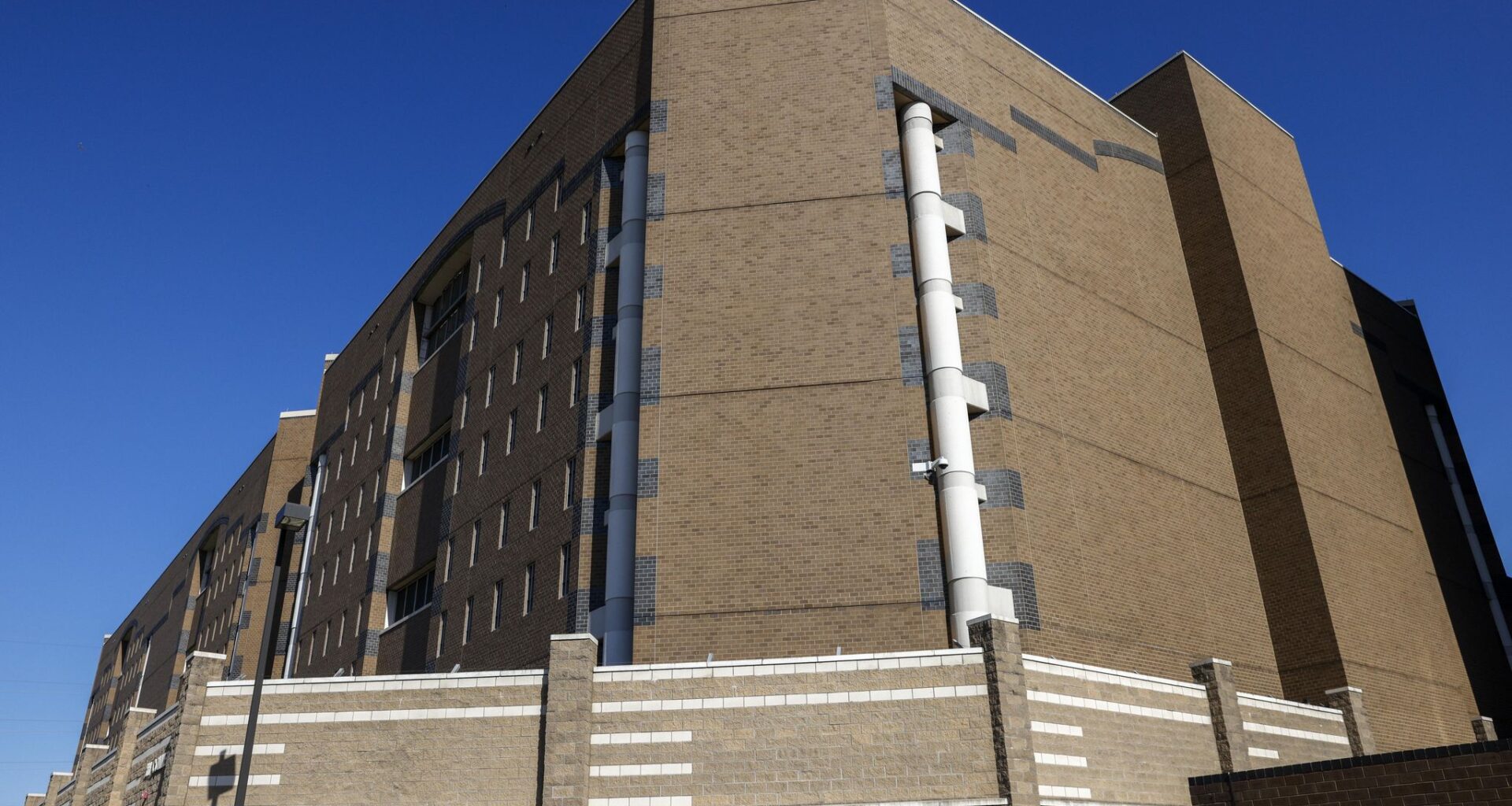
Lew Sterrett Justice Center pictured in Dallas, Friday, July 8, 2022.
Elias Valverde II/Staff Photographer
Dallas County Sheriff Marian Brown is poised to implement a new jail intake rule on Thursday opposed by 31 local police chiefs after a judge denied Carrollton’s request to block what it alleged is a “pay-to-detain regime.”

Brown announced in April the overcrowded county jail will stop accepting arrestees who have not already been “properly magistrated” unless the arresting agencies have contracts with the sheriff’s office for those services. She did not define her requirements but in Texas, magistrates read detainees their rights and set initial bail amounts, among other duties.
The sheriff’s office offered to accept detainees prior to magistration from agencies who agree to a $567 per-person fee effective Oct. 1, according to a petition Carrollton filed Monday asking a judge to halt the implementation.
Article continues below this ad
Dallas County District Judge Staci Williams on Monday denied Carrollton’s request for an injunction and set a hearing for Nov. 5.
It is not yet clear what impact Brown’s new procedure will have on municipalities or whether the jail will refuse to book people before magistration from agencies that have not agreed to pay the fees.
The Dallas Police Department, which accounts for nearly half of the jail’s monthly bookings, is the only agency with a longstanding contract for county jail services. It pays the county about $9 million per year.
Most other arresting agencies already bring defendants to a municipal detention facility to see a magistrate before sending those who don’t post bail to the Lew Sterrett Justice Center.
Dallas County Sheriff Marian Brown speaks during a press conference at Dallas Police Headquarters on Thursday, Oct. 21, 2021, in Dallas. (Elias Valverde II/The Dallas Morning News)
Elias Valverde II/Dallas Morning News
But 31 police chiefs wrote Brown a joint letter Sept. 14 asking her to postpone the rule change until they can meet to discuss a litany of unanswered logistical and financial questions. She never responded to the letter or Carrollton’s outreach in June and July, according to the petition.
Article continues below this ad
Brown declined to answer questions from The Dallas Morning News Tuesday, citing the pending litigation.
Carrollton has a holding facility with 21 cells, but it is not regulated by the state as a jail. It for decades has sent arrestees to Lew Sterrett for booking and magistration — about 1,500 per year, according to its petition. Other cities have municipal judges in their holding facilities who set initial bail.
Some agencies, like Dallas Area Rapid Transit police, don’t employ judges or have a holding facility to bring arrestees for first appearance hearings. DART booked 230 people into the county jail in August, according to county data.
“We take our public safety responsibility to our riders and communities seriously, and this complicates our ability to be effective,” a DART spokesperson said in a statement.
In her April letter to police departments, Brown said the sheriff’s office is not legally responsible for taking custody of a person at the county jail until after the arresting agency has ensured a person “has been properly and completely magistrated.” She cited state law mandating a person be brought before a magistrate “without unnecessary delay” but no later than 48 hours after arrest.
Article continues below this ad
In its petition, Carrollton alleged the county has a legal responsibility to take custody of people charged with a state crime. There is no law allowing sheriffs to charge municipalities fees for accepting, booking and arraigning arrestees, the city alleges.
Commissioner Andrew Sommerman, an attorney, said he believes cities have the legal obligation to handle magistration hearings for people they arrest and cannot pass those costs on to the county.
To facilitate the process, he is proposing a centralized video magistration system for detainees to see a magistrate from Lew Sterrett while in municipal holding facilities for a fee. He said he plans to discuss proposed logistics and costs at a November committee meeting.
“I don’t think the sheriff is saying ‘we won’t magistrate,’ she’s saying ‘you have to pay if we’re going to magistrate,’” Sommerman said.
Brown previously declined to answer what prompted her jail intake rule change for the remaining agencies. But it came after Irving stopped holding first appearance hearings for most arrestees in May 2024, instead requiring them to go from its city holding facility to Lew Sterrett to be booked a second time before seeing a judge.
Article continues below this ad
An Irving spokesperson said the change was made to “address overcrowding, enhance operational efficiency and ensure the safety” of those held in the 172-person capacity city jail.
The policy led to two federal lawsuits in April alleging Irving created unnecessary delays that violate detainees’ constitutional rights and caused some to go more than 48 hours before seeing a judge.
Before the change the city transported about 2,577 people from the Irving detention facility to Lew Sterrett in 2023, according to city data – in 2025, the first full year of Irving’s limited magistration hearings, the city booked 4,358 people in the county jail.
Lew Sterrett was 90% full on Tuesday, according to criminal justice department data.
The Irving City Council in July directed its police department to begin holding first appearance hearings again, citing the impending fee proposed by the sheriff’s office.
Article continues below this ad
In a statement to The News on Tuesday, Irving Police Chief Derick Miller said the 31 police chiefs are still asking for a pause on the Thursday rule change at the jail.
“Our goal is to engage in productive discussions and work toward a solution that is fair, sustainable and appropriately reflects the responsibilities of all parties involved,” Miller said.