
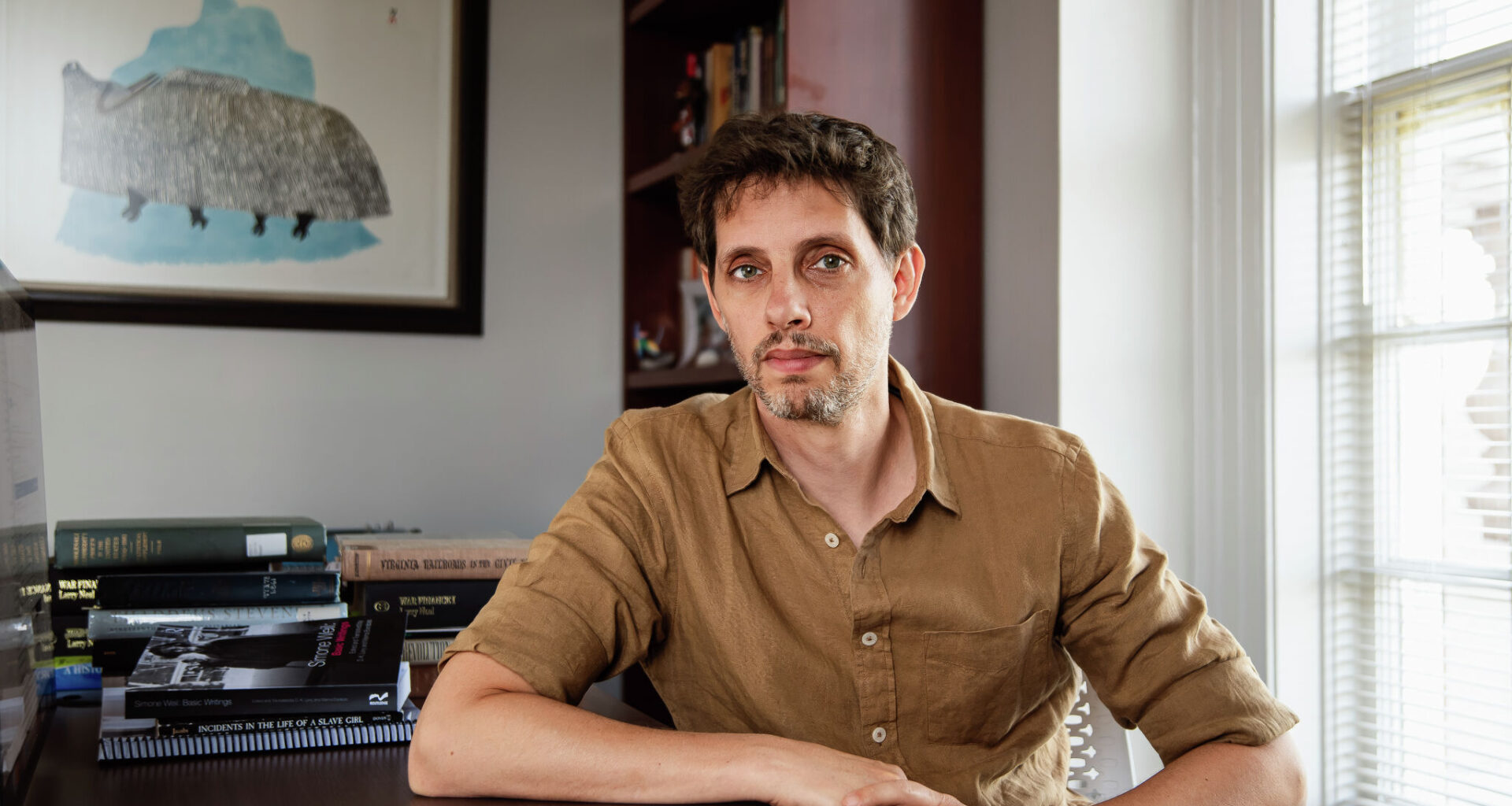
Ariel Ron, a historian at Southern Methodist University, was awarded a 2026 MacArthur “genius grant” in recognition of his exceptional creativity and his research on agriculture and economic development in the 19th century.
Courtesy / John D. and Catherine T. MacArthur Foundation
A historian at Southern Methodist University has been named a MacArthur Fellow in recognition of his exceptional creativity and his research on agriculture and economic development in the 19th century, the group announced Tuesday.

Ariel Ron, a history professor and director of SMU’s Clements Center for Southwest Studies, is one of 20 recipients of this year’s prize, often called a “genius” grant, from the John D. and Catherine T. MacArthur Foundation.
The award recognizes “extraordinarily creative individuals,” their record of excellence in their field or practice and their ability to impact society in significant ways. Winners receive $800,000 over the next five years that they can spend however they choose.
Article continues below this ad
Fellows do not apply for the award and are not aware that they are being considered. The recipients are nominated by an invited external group and are selected by leaders in the arts, sciences and humanities.
Ron, who was in his office at SMU’s campus a month ago when he received the call from the foundation, remembers being told to close the door for privacy. But the walls are thin, so he went outside into the blazing heat.
“The news was good enough that I didn’t notice,” he said.
Ron, 48, researches how Northern agriculture affected U.S. economic growth and the expansion of federal power in the 19th century.
His book, Grassroots Leviathan: Agricultural Reform and the Rural North in the Slaveholding Republic, sheds new light on divisions between Northern and Southern farmers before the Civil War and how Northern farmers’ interest in agrarian reform contributed to the creation of government institutions, such as the U.S. Department of Agriculture.
Article continues below this ad
“Through his attention to largely overlooked aspects of nineteenth-century America, Ron is reevaluating the economy of the period and uncovering the historical roots of the U.S. government taking an active role in shaping economic and technological development,” the MacArthur Foundation website says.
In a statement, Rachel Mersey, executive vice president and provost at SMU, said Ron’s scholarship “is a wonderful example of what ambitious research can do: take something we think we understand and help us see it in an entirely new way.”
Ron, who describes himself as “the kid who liked to listen to my grandparents’ stories,” said he is drawn to the Civil War period for its reverberations in present-day U.S.
“There’s still a lot of aspects of that period in that society that we actually don’t know very much about or don’t understand very well, or that maybe were once known but have been lost,” he said.
Unlike other grants, the MacArthur fellowship does not require recipients to complete a project with the money. Ron said the foundation’s support will give him “time to sit down” and conduct research for his next book about the fundamental role of hay in U.S. economy and society in the 19th century.
Article continues below this ad
“It’s kind of like a gift from heaven,” he said. “It drops down on you one day and it’s pretty strange.”
Ron joined SMU’s history department in 2016. He received his undergraduate degree from the University of Maryland, College Park and his Ph.D. from the University of California, Berkeley.
2026 MacArthur genius grant winners
Ron is one of three MacArthur recipients this year from Texas.
Kate Spradley, an anthropology professor from Texas State University, received the prize for her work as founder of Operation Identification, an initiative dedicated to recovering and identifying the remains of migrants found near the Texas border. Spradley’s work has influenced policy changes at the local and national levels, including working with the FBI to create the first cross-border humanitarian DNA database.
Article continues below this ad
Vincent Valdez, a visual artist based in Houston and San Antonio, was recognized for his work reflecting experiences of the contemporary U.S, including past moments of injustice and their persistence in the present. His work, which draws from Chicano artistic traditions, covers underrepresented political and social histories and is often in dialogue with Western traditions of narrative history painting.
Texas artist Vincent Valdez is one of 20 recipients of the 2026 MacArthur genius grant from the John D. and Catherine T. MacArthur Foundation.
Brenda Bazán/Associated Press
The rest of the 2026 fellows are:
Holly Jean Buck, 45, Buffalo, New York, a University at Buffalo sociologist whose research centers local communities’ role in mitigating climate change and transitioning to clean energy.
Felipe De Brigard, 47, Durham, North Carolina, a Duke University philosopher using cognitive science to investigate the relationship between memory and forgiveness, including victims of political violence in his home country of Colombia.
Article continues below this ad
Ellora Derenoncourt, 39, Princeton, New Jersey, a Princeton University labor economist researching the origins of racial wealth disparities in the United States and policies to reduce the gap.
Elizabeth Ellis, 38, Princeton, New Jersey, a Princeton University historian correcting the colonial record to emphasize Indigenous tribes’ alternative approaches to nationhood and the strategies Native Americans used to resist European settlement.
Kaiyu Guan, 41, Urbana, Illinois, a University of Illinois Urbana-Champaign environmental scientist helping farmers predict and optimize crop yields through data and machine learning.
Trajal Harrell, Zurich, a Switzerland-based choreographer and dancer who combines dance traditions into a “fictitious archive” that breaks down the barriers between different styles.
Marika Holland, 58, Boulder, Colorado, a climate scientist helping better predict changes in ice cover and understand the effects of polar climate change on marine ecosystems.
Article continues below this ad
Christine Sun Kim, 46, Berlin, a Germany-based artist conveying the experiences of deaf people and exploring new ways to understand sound through drawings, large-scale murals, video and interactives.
Song Lin, 40, Stanford, California, a Stanford University organic chemist whose methods are opening pathways for safer and more sustainable synthetic organic reactions.
Layli Long Soldier, 54, Santa Fe, New Mexico, a poet manipulating historical texts to emphasize the erasure of Native Americans and accompanying her written word with visual art.
Rodney McMillian, 57, Los Angeles, an artist at the University of California, Los Angeles, working across sculpture, painting, video and performance to explore how history and socioeconomic conditions impact belonging in the American South.
Maaza Mengiste, 55, Middletown, Connecticut, a fiction writer at Wesleyan University who shows the human cost of political conflicts through historically informed novels.
Chip Thomas, 69, Flagstaff, Arizona, a public artist transforming neglected spaces, mostly in the Navajo Nation, into public works grounded in community history.
Vincenzo Vitelli, 48, Chicago, a physicist at the University of Chicago building theoretical frameworks to describe how matter and materials with unique properties will behave.
Bryan Washington, 33, Tokyo, a fiction writer capturing modern relationships in his novels including “Memorial” and “Palaver.”
Saxophonist, Immanuel Wilkins poses for a portrait on Sept. 28, 2026, in New York. He is one of 20 MacArthur Fellows named in 2026.
Andres Kudacki/Associated Press
Immanuel Wilkins, 29, New York City, an alto jazz saxophone player and composer whose compositions often reflect historical narratives of injustice.
Liangfang Zhang, 46, San Diego, a chemical engineer and bioengineer at the University of California, San Diego, who is creating novel nanotechnologies for treating and preventing infectious diseases, cancers and immunological disorders.
The Associated Press contributed to this report.
The DMN Education Lab deepens the coverage and conversation about urgent education issues critical to the future of North Texas.
The DMN Education Lab is a community-funded journalism initiative, with support from Bobby and Lottye Lyle, Communities Foundation of Texas, The Dallas Foundation, Dallas Regional Chamber, Deedie Rose, Garrett and Cecilia Boone, Judy and Jim Gibbs, The Meadows Foundation, The Murrell Foundation, Ron Steinhart, Solutions Journalism Network, Southern Methodist University, Sydney Smith Hicks, and the University of Texas at Dallas. The Dallas Morning News retains full editorial control of the Education Lab’s journalism.