
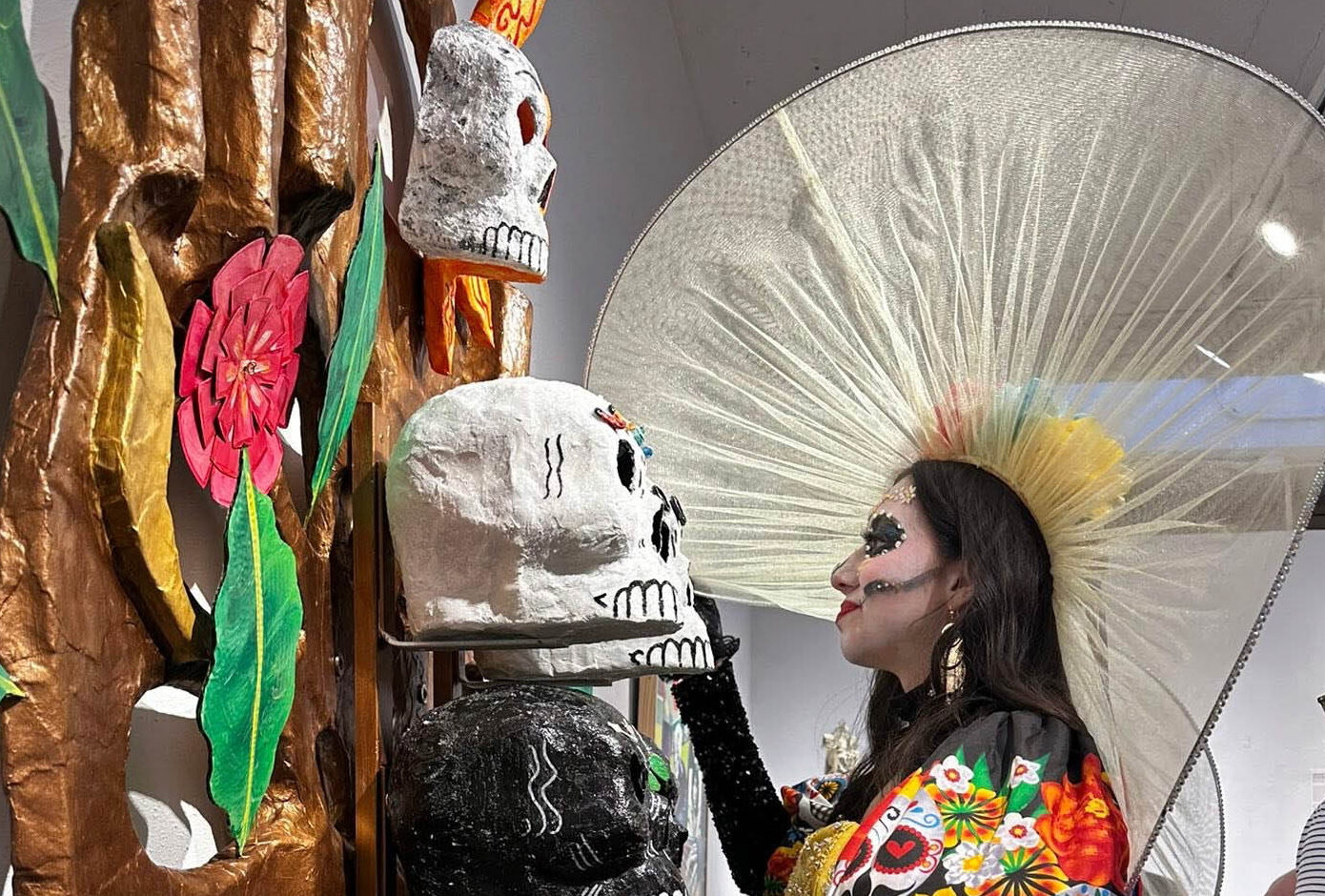
By the time Cervantes, who came from Mexico City, arrived at the Bath House Cultural Center in 1999, the exhibition had already become a tradition.
“I thought, ‘Oh, that’s a festivity that I grew up with, and maybe I can do something to continue that tradition,’” Cervantes says.
As visitors began coming to the exhibition, Cervantes noticed their curiosity extended beyond the artwork itself. They wanted to understand the symbols, traditions and details incorporated into the pieces.
Why, visitors would ask, was a monarch butterfly appearing in a work? Why were short poems written alongside certain pieces?
Among the traditions he and the Bath House have explored are calaveras — short rhyming poems that can be affectionate, satirical or even used to criticize public figures.
“So, throughout the last 10 or 12 years, we’ve thought about one thing that maybe people don’t know much about in regards to the celebration, and we explore that,” he says.
This year, about 350 to 400 works are expected to be submitted for consideration, with roughly 45-60 ultimately making their way into the three gallery spaces at the Bath House.
“The main thing I look for is whether or not the artists actually read the description of the theme,” he says. “And, that they’re following our directive to think in ways that they can illustrate the theme’s idea.”
Cervantes reviews photographs of the submitted artwork without knowing who created each piece.
“It’s not only about the aesthetic elements of the piece, although that’s important,” he says. “It’s also about what the piece is communicating and how strongly that piece is touching or moving somebody.”
After curating the exhibition 28 times, Cervantes also knows the importance of looking at the artwork through other perspectives. He occasionally seeks input from independent curators and artists who have experience with Día de Muertos exhibitions.
But the artists who submit their work — and the people who come to see it — have changed considerably since the exhibition’s early years.
Cervantes says that at the very beginning of the exhibition’s history, the majority of the artwork was submitted by artists of Latino origin. Now, the majority of the artists are no longer Latino.
Rather than seeing that shift as a departure from the exhibition’s roots, Cervantes views it as a sign that people outside the Mexican culture have found something meaningful in the celebration.
“I saw that increase of participation from non-Latinos as something flattering to my community, my Mexican heritage,” Cervantes says.
“Day of the Dead is one of the most ancient rituals of the American continent,” Cardona Hurst says. “It belongs to all of us, whoever wants to embrace it and pay tribute to our departed loved ones.”
The exhibit will run from Oct. 10 through Nov. 7.