
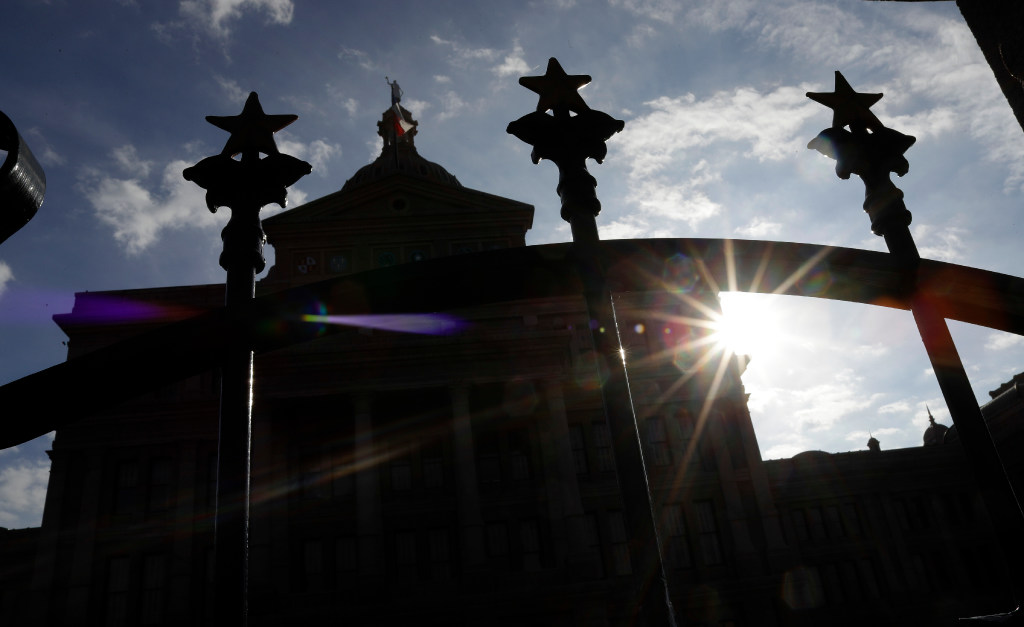
The sun begins to set behind the Texas Capitol, Wednesday, Jan. 4, 2017, in Austin, Texas. For Sunshine Week, Kelley Shannon of the Freedom of Information Foundation of Texas urges government transparency. (AP Photo/Eric Gay)
AP
AUSTIN — Texas lawmakers jested late Wednesday about a proposal to annex parts of New Mexico where officials in the state’s neighbor to the west have considered joining the Lone Star State.

“As somebody who is from the Permian Basin, and who is neighbors with a lot of the disaffected New Mexicans, who I think, in at least some cases, would greet us as liberators,” said Rep. Brooks Landgraf, R-Odessa.
“If not, we could arm the moderate New Mexicans,” Rep. Mitch Little, R-Lewisville, replied.
Article continues below this ad
“Like some old CIA psy-ops, right?” Landgraf said.
“If the president can talk about Greenland, we can talk about New Mexico,” Rep. Richard Peña Raymond, D-Laredo, added.
The debate over whether Texas should annex parts of New Mexico began in New Mexico, where two state representatives authored legislation that would allow three counties along the New Mexico-Texas border to swap states.
The proposal was left dead in the water in New Mexico, and the lawmakers who brought the idea said they created it to highlight the political differences between Republican-led Texas and Democrat-dominated New Mexico.
That didn’t stop House Speaker Dustin Burrows, a Lubbock representative, from running with the idea. Burrows said in February that “Texas would gladly welcome Lea County back to Texas, where it rightfully belongs,” naming one of the border counties floated for annexation.
Article continues below this ad
Burrows went on to state in March that studying the annexation of parts of New Mexico is a conversation “ultimately about culture, opportunity, and the right to choose a path that reflects the shared values of the Permian and Delaware basins.”
He’s asked the House Government Oversight Committee to analyze what state and federal statutes are needed to initiate the annexation process.
Practically speaking, gobbling up portions of New Mexico would require approval from both states’ legislatures and likely approval from Congress, according to the attorney general’s office. Precedents include exchanges of small bits of property between states since their boundaries were first set, usually because of shifts in river boundaries.
“So you’re saying there’s a chance,” Rep. Ellen Troxclair, R-Lakeway, said after an attorney from the AG’s office explained the ins and outs of taking parts of New Mexico.
“I am. Yes, ma’am,” said Michael Cotton, head of the attorney general’s Special Litigation Division.
Article continues below this ad
While Landgraf admitted the discussion, which came at the end of a near 13-hour committee meeting, was largely “tongue in cheek,” he used it to highlight perceived inequities in the Permian Basin on both sides of the border, which bisects the oil-rich region.
Some New Mexicans view their part of the state as an “extraction colony,” he said, that uses oil fortunes to finance massive parts of that state’s government while seeing little in return. On the Texas side of the Permian, the state has taken all of the chemical-laden produced water from New Mexico’s oil extraction industry for reinjection ever since lawmakers in Santa Fe banned reinjection in their state.
“It’s being trucked in, piped in, and reinjected into the Texas side of the Permian Basin, which means that we’re upsetting that balance even more,” he said, noting environmental and seismic concerns.
Rep. Erin Zwiener, D-Driftwood, said even discussing taking parts of New Mexico would negatively affect relations between the two states. She questioned how the two states could open a dialogue on seriously addressing water concerns when one is acting like “the bigger bully next door who can take what they want.”
Article continues below this ad
“And I’ll note we have seen that same tactic play out with our president and Canada,” she said, “with us getting unfriendly dynamics coming back to us from the country of Canada because of all of this, these ideas that we’re your bigger neighbor, we can just gobble you up.”
Texas once claimed large portions of New Mexico, but settled into its current borders in 1850.