
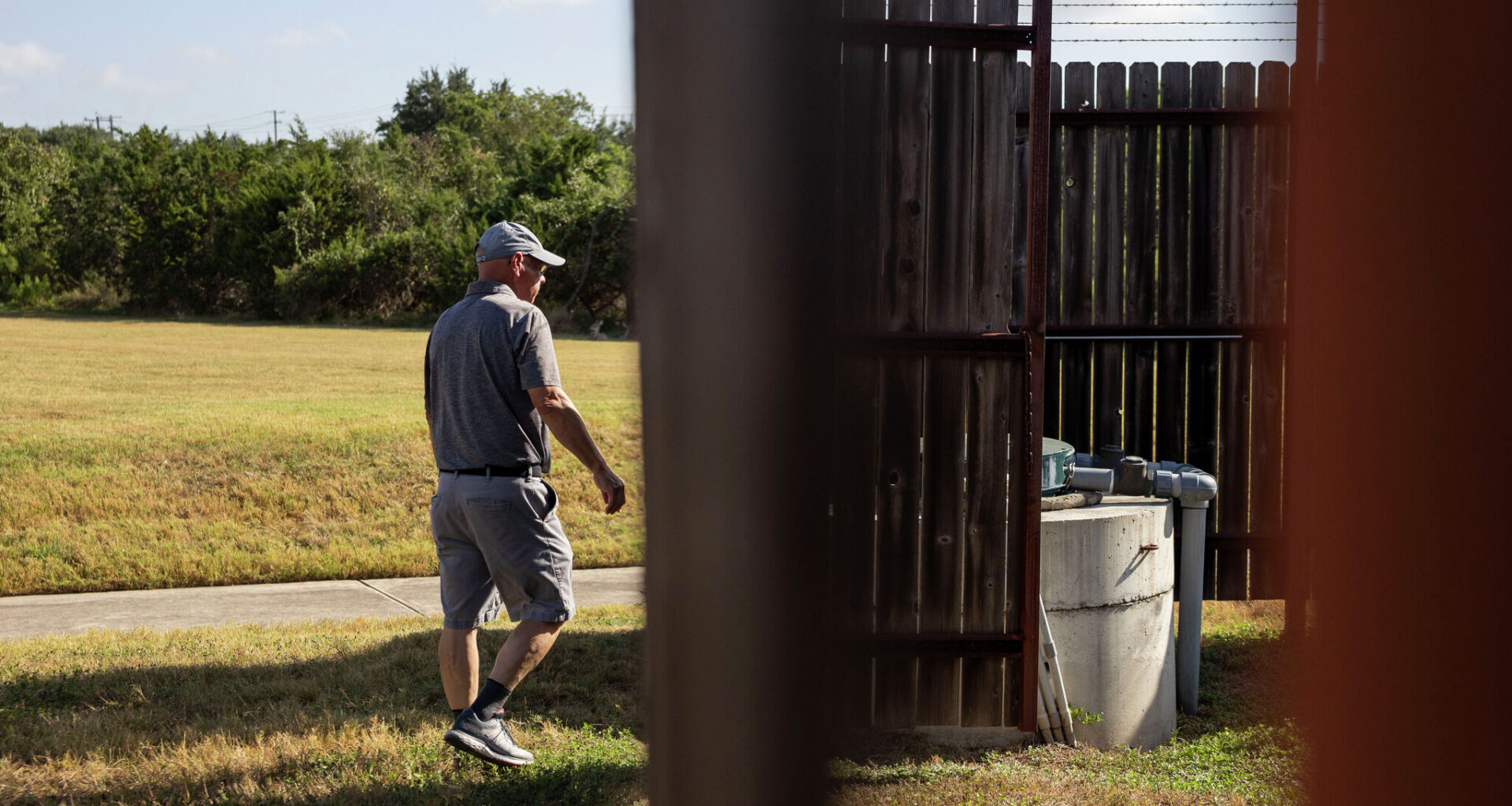
Paul Colliander, a member of the Villas at Timberwood Homeowners Association, walks by a gated area for the subdivision’s septic system. The homeowners association is asking the San Antonio City Council to waive more than $415,000 in fees to connect to San Antonio Water System’s sewer system.
Katina Zentz/San Antonio Express-News
A request from a North Side subdivision to waive fees to connect to the San Antonio Water System’s sewer system got a cold shoulder from much of the city council.

Homeowners in Villas at Timberwood, a 75-home neighborhood near Timberwood Park, want to connect to SAWS after years of struggling with a failing communal septic system.
Article continues below this ad
They’ve been awarded $2 million in American Rescue Plan Act funds from Bexar County for the effort, but the work is expected to cost $2.8 million, and the homeowners association is still trying to cover the remainder. They’re seeking a waiver of $415,575 in impact fees owed to SAWS for the connection; the fees are charged by the utility for all new hookups to its water and sewer lines.
That would require an exception to the city’s policy, which limits fee waivers to certain projects, such as affordable housing and rehabilitation, and which bars waivers for projects outside city limits. The subdivision will be annexed into the city in 2032 under an existing agreement, but residents there don’t currently pay city property taxes and won’t until then.
The request was placed on two meeting agendas in August, only to be withdrawn both times. During a meeting Wednesday, council members discussed it publicly for the first time — in the same briefing where they weighed in on SAWS’ request to raise customers water and sewer rates.
If the fees are waived, SAWS would have to absorb the lost revenue, which would require covering costs with other revenue from its ratepayers.
Article continues below this ad
‘Get this done’
Councilwoman Misty Spears, who first became involved in the issue when she worked for Bexar County Commissioner Grant Moody, advocated in favor of killing the fee. Once the area is annexed, the Villas residents will be Spears’ District 9 constituents.
Spears said the council should waive the fees because if the failing septic system isn’t addressed, it’s only a matter of time before it becomes a bigger public health and water quality problem for the Edwards Aquifer, which is the city’s largest water source.
“The biggest concern for me, cause y’all know I say it all the time, is about our aquifer,” Spears said. The septic system is in the Edwards Aquifer’s contributing zone, near Mustang Creek, which flows into the aquifer’s recharge zone — the area where surface water enters the groundwater system.
Article continues below this ad
She also said the federal funds must be spent by the end of the year, making it an urgent issue.
“They’ve gotten so far along,” she said. “It feels like man, you don’t want to throw the baby out with the bathwater, let’s just get this done.”
Spears said the impact fee policy shouldn’t apply because the houses are an existing development, not a new one. SAWS staff and City Attorney Andy Segovia responded that the fees are owed for all new connections to the SAWS system, not just new buildings.
Impact fees are intended to cover the costs of the infrastructure needed to expand the system; they’re calculated based on growth projections and expected costs to serve that growth. State law dictates how the utility calculates the fees, and requires utilities to update them at least once every five years; the current fees were approved unanimously by the City Council in March 2024.
Article continues below this ad
Spear’s only clear ally on the waiver was District 10’s Marc Whyte, who said he “would like to find a way to help these folks.”
Council not convinced
But most other council members who addressed the issue appeared likely to reject the request, with several pointing out that there are other pockets of the city where residents with septic systems would like to connect to SAWS and wouldn’t get the same deal.
“I understand that concern and plight and what the folks have had to go through,” District 4 Councilman Edward Mungia said. But he said the city should work with the county on a solution, not waive the fees.
Article continues below this ad
“We’ve got folks in my district that are not going to be connected,” he said. “And so it’s going to be hard for me to to tell folks why this neighborhood not in the city limits is going to get connected and not folks over here.”
District 3 Councilwoman Phyllis Viagran also said she was concerned about approving the fee waiver without knowing how much the homeowners association would contribute toward the effort.
In 2019, the association sued Timberwood Development Company and homebuilder Chesmar Homes over the issue; they reached a settlement in 2024, a few months after the county approved using the federal funding.
Spears said 100% of the settlement amount will go to the sewer connection — but that the amount is confidential and can’t be disclosed.
Article continues below this ad
Mayor Gina Ortiz Jones also said she does not support the waiver, suggesting instead that Bexar County cover the costs or that council members use their own “carry forward” money.
That’s money that is allocated to each council office every year, which members often use for small construction projects in their district. Unused funds roll over each year and can accumulate over time.
District 2 Councilman Jalen McKee-Rodriguez said his understanding from recent budget discussions was that Spears had $585,000 in carry forward money available — enough to cover the waiver.
He was one of several council members who suggested annexing the subdivions into the city sooner than 2032, which he said could potentially sway him from opposing the waiver.
Article continues below this ad
“If they were down to annex early, that would be something that I might be more willing to consider,” he said. But to seek more than $400,000 from “the city and our partners” without paying property taxes “doesn’t jive well with me,” he said.
City Manager Erik Walsh said the residents also have the option of a five-year payment plan to pay the impact fees.
That would amount to each home owing about $92 per month for five years, SAWS CEO Robert Puente said. But Walsh said he believes that idea hasn’t gained traction with the residents, and Spears disputed that the homeowners association had been offered that option recently.
“It’s up to them to accept or not, but it’s on the table,” Puente said.
Article continues below this ad
While most of the council wasn’t supportive of waiving the fees, they did appear largely aligned on discussing potential changes to the fee waiver policy in the future, as well as changes to the fees themselves, which have been a sticking point for some members during recent discussions about SAWS’ rate increase proposal.
“Several of our districts have these pockets where households are not connected to SAWS infrastructure,” Councilwoman Marina Alderete Gavito said, including in her District 7 on the West Side. “Now may be the time for us to look at how we’re going to deal with this holistically.”
Environmental questions
While Spears, Moody and the Timberwood residents have raised concerns about the risk to the Edwards Aquifer, SAWS said it doesn’t believe there is an immediate threat.
Article continues below this ad
Puente said the amount of waste from the homes is small, and that the largest problem is when there’s heavy rainfall. But in that case, the rainfall is also helpful, he said, because it dilutes potential contamination, which “minimizes the effect of those overflows.”
Regulation of septic systems like Timberwood’s is the responsibility of the Texas Commission on Environmental Quality, not SAWS or the Edwards Aquifer Authority, the agency that manages the aquifer in the San Antonio area.
The homeowners association has been fined for violations recently, and Puente said the state agency has been “very active in this issue.”
“We feel that there’s not a big environmental issue that we have to be worried about regarding this development,” he said.
Article continues below this ad
The Edwards Aquifer Authority has not been involved in any discussions about the subdivision, said Paul Bertetti, the agency’s senior director of aquifer science research and modeling,
But the location of the treatment plant and the creek mean that if waste from the septic system is entering the creek, it’s “very likely, and almost a certainty” that it reaches nearby Edwards recharge features, he said in a recent interview.
It could also contaminate nearby wells, which are primarily in the Trinity Aquifer, he said.
“I would say it’s highly likely that discharge water from that septic system finds its way there,” Bertetti said.
Article continues below this ad
But while the authority doesn’t have an official position on the fee waiver, he said he personally believes the burden shouldn’t be on other SAWS customers to foot the bill.
“From a water quality perspective, getting hooked up to the sewer system is the is probably the right choice,” Bertetti said. “It’s too bad that the developer didn’t make the effort and spend the money to do that in the first place.”