
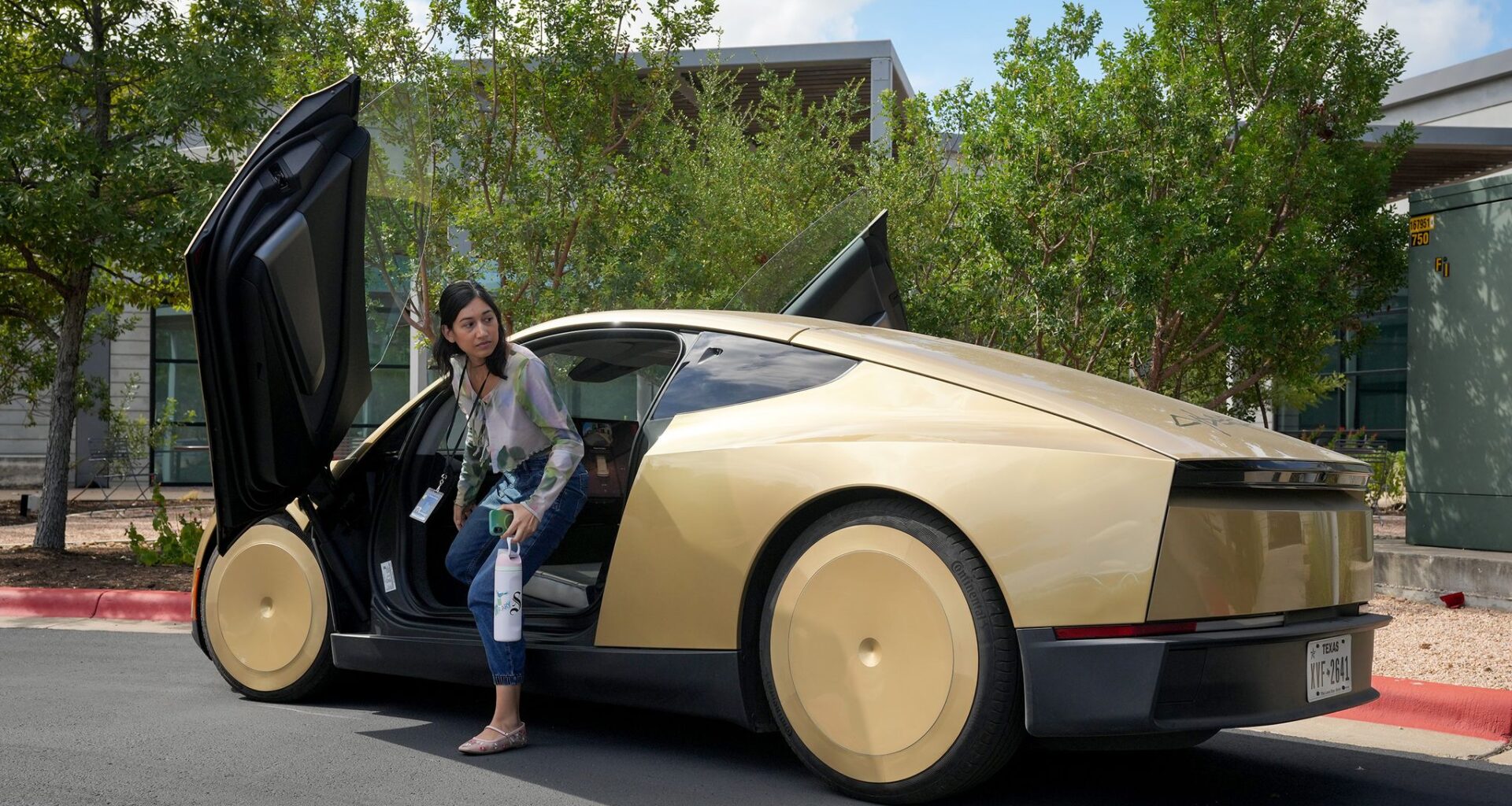
Austin American-Statesman reporter Andrea Guzmán exits a Tesla Cybercab on Thursday, Sept. 10, 2026.
Jay Janner/Austin American-Statesman
The butterfly doors lifted open without anyone pressing a button.

My colleague and I climbed into Tesla’s new Cybercab as it waited outside the Austin American-Statesman newsroom. Before it even moved, the vehicle felt unfamiliar.
Article continues below this ad
A Tesla Cybercab in Austin on Thursday, Sept. 10, 2026.
Jay Janner/Austin American-Statesman
The view from inside a Tesla Cybercab in Austin on Thursday, Sept. 10, 2026.
Jay Janner/Austin American-Statesman
The view from inside a Tesla Cybercab as another Cybercab passes by in Austin on Thursday, Sept. 10, 2026.
Jay Janner/Austin American-Statesman
There was no steering wheel. No rear window. Once we did start to move, I couldn’t immediately tell how fast we were traveling because I didn’t notice a speedometer or heads-up speed display. Instead, a large screen showed renderings of nearby cars and pedestrians.
Like other robotaxis, the Cybercab checked that we’d buckled our seat belts and asked us to tap “Start” on a screen before pulling away. The similarities mostly ended there.
A few minutes later, approaching a green light in South Austin, the Cybercab abruptly braked.
Article continues below this ad
Looking up, I didn’t spot another vehicle or obstruction in front of us. The vehicle seemingly had no reason to stop. It was what I suspect to be an instance of “phantom braking.”
The phenomenon has more commonly been reported in Tesla Model 3 and Model Y vehicles. In July, the National Highway Traffic Safety Administration closed an evaluation into such unexpected deceleration, saying it was a low hazard to drivers and reports of the issue had declined.
Hitting the road
That moment underscored why my first ride came with some apprehension. Although trying out new tech is part of my job, clicking “book ride” had initially filled me with a bit of dread.
Article continues below this ad
Austin American-Statesman reporter Andrea Guzmán hails a Tesla Cybercab on Thursday, Sept. 10, 2026.
Jay Janner/Austin American-Statesman
On the first day of commercial operations after its Sept. 3 launch, Tesla’s purpose-built robotaxi was already under scrutiny from federal safety regulators. And the Austin-based automaker has a history of investigations into the safety of its driver-assistance technology.
Apart from the sudden stop, though, most of the trip to the University of Texas Co-op — a roughly $20 ride — passed uneventfully.
The Cybercab’s driving style did strike me as more assertive than my own at times. While traveling in the left lane on South First Street, the vehicle quickly moved into the right lane after the car in front of us put on a left turn signal and slowed. My own more cautious driving habits — shaped by the thought that a speeding Texas driver might be approaching in the neighboring lane — would have left me waiting until I was sure the road was clear before changing lanes.
Article continues below this ad
About those doors
When it first arrived, the vehicle pulled up neatly to a curb and opened the door at my command, though it stopped short of opening fully because of the vehicle to its left.
Austin American-Statesman reporter Andrea Guzmán takes a ride in a Tesla Cybercab on Thursday, Sept. 10, 2026.
Jay Janner/Austin American-Statesman
Some have voiced concern over the butterfly doors crashing into people or objects. This was also on a less-busy side street by the Co-op, rather than on the busy road I’d selected out of curiosity about how the vehicle would perform on a major thoroughfare.
Article continues below this ad
After the ride, the robotaxi phone app asked if I would like to tip 69 cents or $4.20, the crude and pot-related jokes CEO Elon Musk seems to never tire of.
While it was about a 15-minute wait to summon the first Cybercab, the next ride — in a different cab that had been roaming the area — arrived quickly.
Confident, or not
Unfortunately, the vehicle hit a snag trying to exit the university area. The Cybercab initially gave a pedestrian the right of way, then started and stopped again as the pedestrian waved for the vehicle to pass first.
Article continues below this ad
The view from inside a Tesla Cybercab in Austin on Thursday, Sept. 10, 2026.
Jay Janner/Austin American-Statesman
Its confidence came back in other moments. While cruising in the right lane behind several vehicles, the Cybercab moved into the passing lane, went around a couple of slower-moving cars and returned to the right lane.
This assertiveness of the driving in Tesla robotaxis doesn’t seem to be very consistent, though. In a Model Y ride this summer, I noticed the vehicle clumsily inching forward and stopping while attempting a right turn, as though it were uncertain whether it could go before oncoming traffic arrived.
And when Tesla’s robotaxis speed up or make split-second decisions, the moves do little to make up for additional travel time tacked on by the vehicles taking less efficient routes. In one instance, a rider reported that the typical 7-mile trip from 99 Ranch to the Domain took an hour when the Cybercab headed south and drove through East Austin. In comparison, Waymo is now rolling out freeway routes in Austin, noting it can help riders get to their destinations faster.
Article continues below this ad
Comfort is also not guaranteed on longer drives in the Cybercab. While I’ve found Waymo’s Jaguar-based vehicles to offer cushy, supportive seats, the Cybercab’s seats reminded me of the flat, sleek-looking seats airlines have grown accustomed to using. Sure, there is plenty of legroom, but my glutes were sore after the second ride.
Fit and finish
Beyond the initial novelty, some of the Cybercab’s design choices may also shape riders’ sense of safety and convenience. It can be a bit of a shock stepping into a vehicle and not seeing a steering wheel, pedals or even a rear window.
The door handle inside a Tesla Cybercab in Austin on Thursday, Sept. 10, 2026.
Jay Janner/Austin American-Statesman
But it’s still shaped like a car, a similarity Tesla shares with most other robotaxi companies, while competitor Zoox is preparing to win over consumers in its carriage-like vehicle. Riders will also need to keep in mind that Waymo, Zoox and Tesla’s Model Y can seat four while the Cybercab only fits two.
Article continues below this ad
Additionally, some basic functions might not feel intuitive for those unfamiliar with Tesla’s features. My colleague’s attempt to roll down the windows resulted in a loud beep from the vehicle, warning that the button controlled the door.
And when it comes to Tesla’s doors, the Cybercab uses the same design that led to a recall in China over concerns the doors could be difficult to open in an emergency. If a safety-critical event is detected in the Cybercab, Tesla says that the doors unlock for easier exit and a Tesla representative is pinged electronically. If airbags are deployed, the vehicle windows automatically roll down.
With the Cybercab, Tesla is trying to market an accessible, futuristic taxi. The vehicle includes Braille for blind or visually impaired riders. The screen also allows riders to log into Hulu or Netflix and watch a movie, play games or ask SpaceXAI’s chatbot, Grok, some questions.
The view from inside a Tesla Cybercab in Austin on Thursday, Sept. 10, 2026.
Jay Janner/Austin American-Statesman
And, like many places in this age of surveillance, the interior is being watched. The robotaxi app tells riders there are cameras in the vehicle and riders will surely feel the stares of onlookers, a typical event with a product associated with Musk.
Article continues below this ad
For many people, the Cybercab and other autonomous vehicles remain more a novelty than everyday transportation. With commercial operations limited to a handful of U.S. cities, only 5% of Americans have ridden in a driverless car. Cybercab may not catch on quickly in Austin, either. In a recent poll, 66% of Austinites said they opposed Cybercab’s operation as a commercial taxi.
So far, Austin is the only place served by the gold-colored robotaxis. but Tesla is developing a parking and dispatch site for them near San Antonio International Airport and Musk has said Cybercab “will soon be operating commercially in Florida, in Nevada, and a couple of other states. And, probably, by the middle of next year it will be operating commercially in California.”
Austin American-Statesman reporter Andrea Guzmán gathers her belongings after riding in a Tesla Cybercab on Thursday, Sept. 10, 2026.
Jay Janner/Austin American-Statesman