
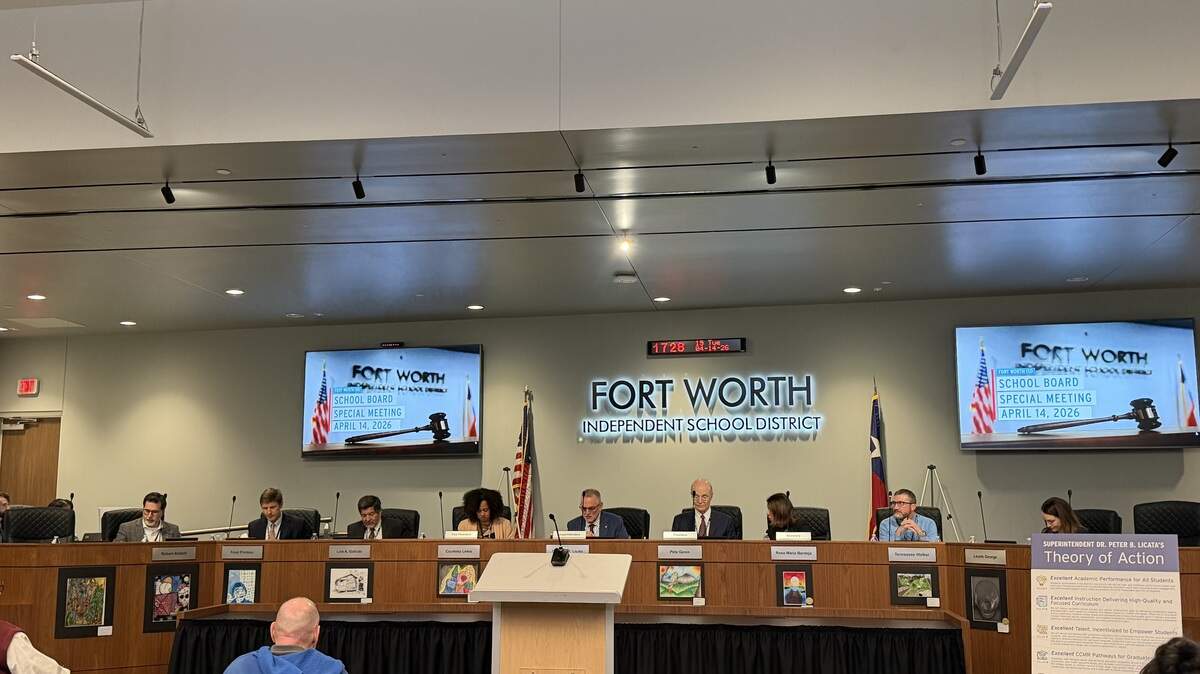
Fort Worth ISD leaders during a board workshop Saturday drafted district goals and superintendent limits after hearing feedback from more than 40 community listening sessions over the last few weeks and months.
The proposed goals and limits also come after months of clashes between parents and district leadership over changes made following the Texas Education Agency’s takeover of Fort Worth ISD, which was sparked due to stagnant academic performance. Those clashes were mainly over issues including scripted lessons, stricter curriculum and academic schedules, teacher turnover, school closures and what parents describe as a lack of transparency.
On Saturday, Fort Worth ISD state-appointed Superintendent Peter Licata and the Board of Managers drafted five goals for the district. They said the goals were formed after hearing what issues matter most to parents and community members.
Those goals are:
Student state assessment at the meets/exceeds performance level in third grade will increase at a rate of 5 percentage points per year for reading.Student state assessment at the meets/exceeds performance level in third grade will increase at a rate of 5 percentage points per year for math.The percentage of graduates meeting college, career, and military readiness bonus criteria will increase from 19% to a percent to be determined.By the end of the 2031 school year, the percentage of Fort Worth ISD eighth graders who meet/exceed grade level on all tested subjects will increase by at least 5 percent.Fort Worth ISD students are capable of effective and efficient communication and being self-determined learners.
In the days leading up to Saturday’s workshop to set the district’s goals, leaders released response data from those who attended listening sessions of filled out virtual forms with feedback.
Responses released by the district showed that parents viewed reading and grade-level core academics as the most important things that Fort Worth ISD students should know. Other top responses included critical thinking, communication, financial literacy and math.
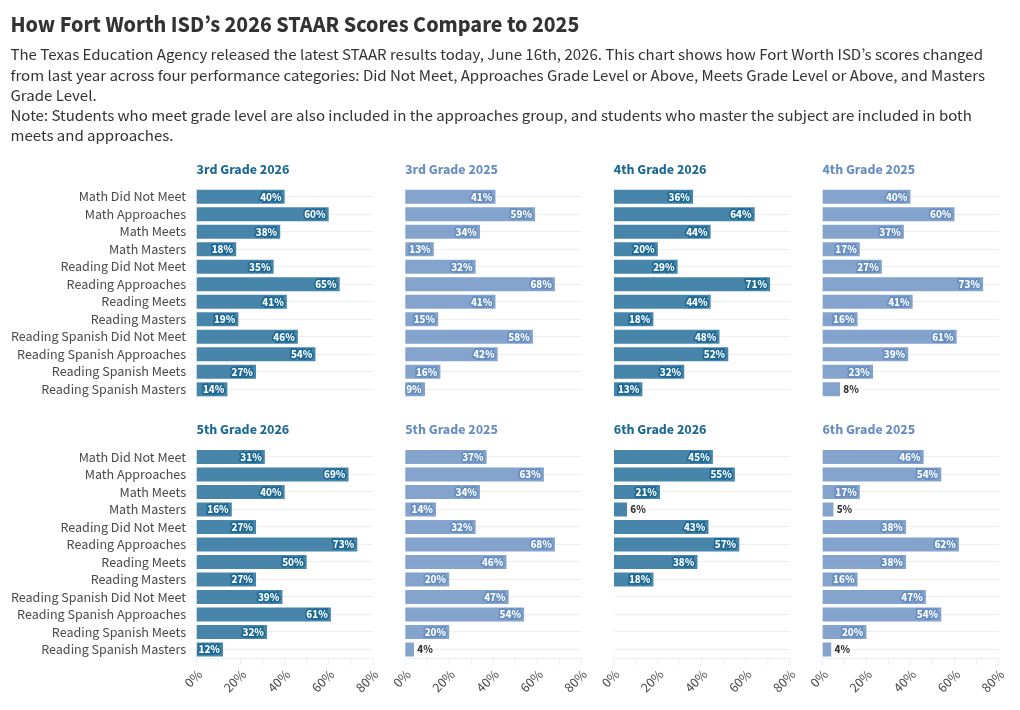
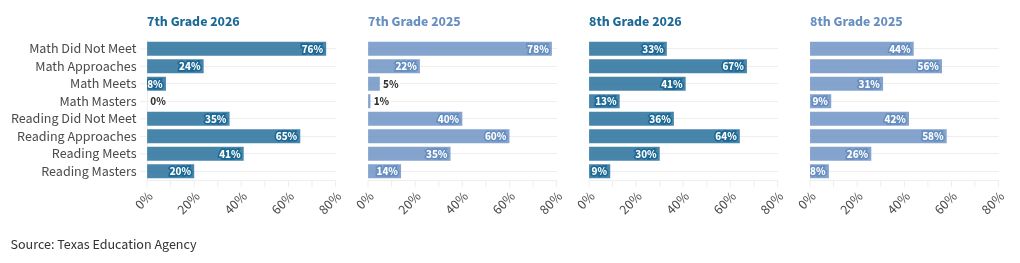
Almost 21% of respondents, both in-person and via virtual forms, listed reading as the most important thing for students to know how to do, while 19% listed grade-level core academics. Fort Worth ISD students are reading on grade level well below the state average, according to recent STAAR test data released over the summer.
 Proposed limits for Superintendent Licata
The Board of Managers also drafted six superintendent limits, or guardrails, using feedback from listening sessions and surveys.
Those six limits were:
The superintendent shall not make significant changes to or retain curriculum or instructional practices without a process for teachers to regularly review and provide feedback and without broadly communicating the rationale and evidence of the effect on the adopted student outcome goals.The superintendent will not proceed without a plan to recruit and retain high-quality educators.The superintendent will not diminish access to advanced academic programs, school of choice opportunities, or opportunity for schools to obtain earned autonomy for children of all demographic and socioeconomic groups.The superintendent will not allow any campus to go without equitable access to qualified teachers, core materials, safe and functional facilities, transportation, and advanced coursework opportunities.The superintendent will not allow discipline to be applied inconsistently across campuses or student groups.The superintendent will not operate the district in a fiscally unsound manner.
Parents’ loudest and most critical concern in recent weeks is how the district has rolled out heavily-scripted curriculum across its campuses.
As part of Fort Worth ISD’s effort to overhaul the way instruction is delivered to students, state-appointed leaders developed the Cowtown 12 instructional model, which is a scripted model through which all teachers are instructed to teach identically to each other.
Higher-rated schools gained more autonomy to teach in different ways, while lower-rated schools are required to strictly follow the model, with little tolerance for going off script, officials have said. One of the Board of Managers’ superintendent limits stated Licata cannot diminish opportunities for campuses to earn autonomy.
But several parents and teachers at campuses that gained “autonomy status” who spoke to the Star-Telegram in recent weeks still say they have been subject to strict scripted curriculum with little opportunity for independence.
Parents who attended Saturday’s workshop were hoping for a stricter limit on scripted curriculum.
“A good teacher can make learning come alive for kids,” said Lori Calder, a Fort Worth ISD parent. “But it is hard to do when teachers are being told exactly how they have to teach.”
When board members began to draft a superintendent limit that directly mentioned obtaining teacher feedback before implementing scripted lessons going forward, Licata pushed back. He said most complaints about scripted lessons came from just a few campuses. Other board members did not agree with him.
“Right now, we are getting pretty damn good results,” Licata said.
About two months into the 2026-27 school year, Licata has often touted strong early academic results as proof that his methods are working, while many parents say it is too early to actually know the results.
Fort Worth ISD’s fall MAP test scores were higher this year in every STAAR-tested grade compared to last year, district data released last month showed.
Board members eventually removed “scripted curriculum” language from the superintendent limits, despite disagreement amongst the group. The final language landed on by the board is as follows:
The superintendent shall not make significant changes to or retain curriculum or instructional practices without a process for teachers to regularly review and provide feedback and without broadly communicating the rationale and evidence of the effect on the adopted student outcome goals.
During its listening sessions and on its virtual surveys, the number one answer to the question “what should the district stop doing?” was scripted lessons and uniform campus mandates, with more than 20% of respondents choosing that answer.
Other top answers were micromanagement and overloading teachers, rigid schedules and over-restrictive rules.
The Board of Managers is expected to finalize the goals and limits at its Nov. 10 meeting.
Editor’s note: Fort Worth ISD Board of Managers chair Pete Geren is the president and chief executive officer of the Sid W. Richardson Foundation, which is a funder of the Star-Telegram’s Crossroads Lab. The Star-Telegram retains independence in all coverage decisions.
Related Stories from Fort Worth Star-Telegram

Fort Worth Star-Telegram
Samuel O’Neal is the K-12 Education Reporter at the Fort Worth Star-Telegram, covering public schools and policy that impacts them. He previously worked as a staff writer at the Philadelphia Inquirer and is a graduate of Temple University.