
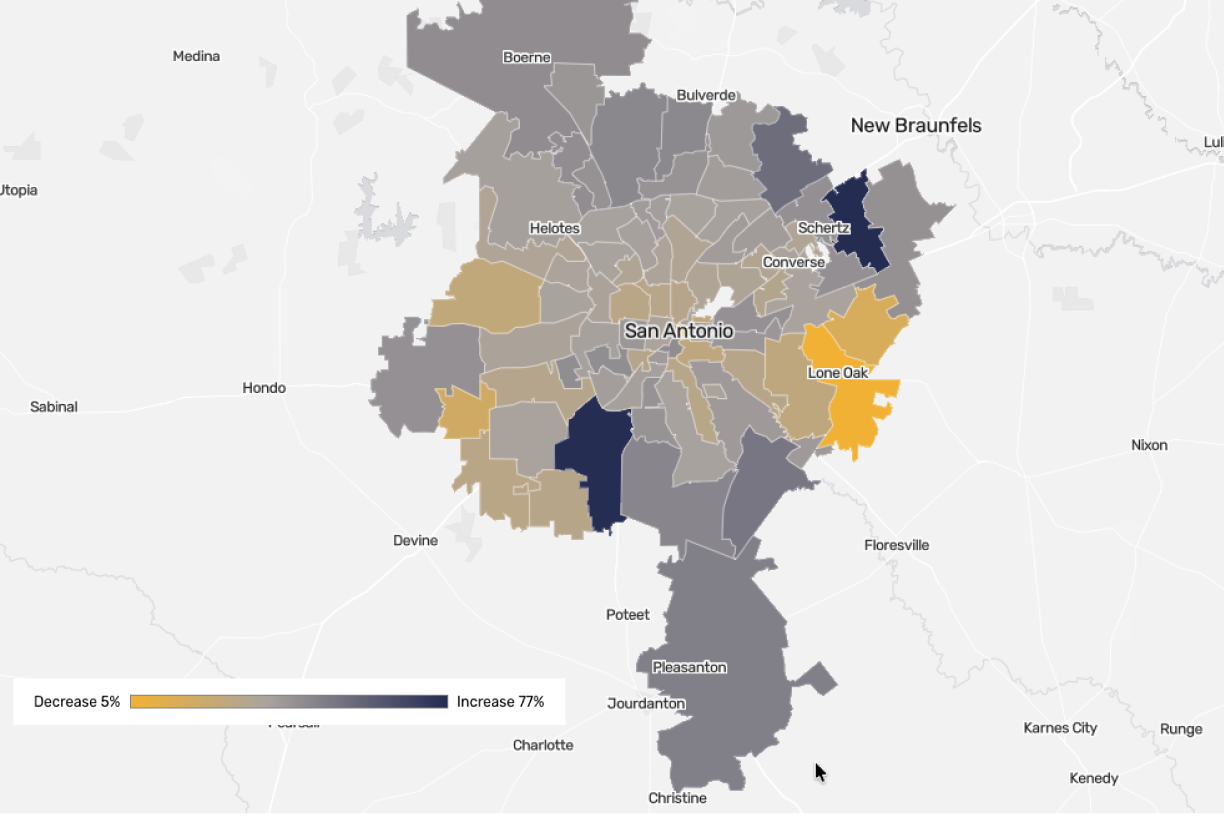
Source: Bexar Central Appraisal District
When Jason Delgado was growing up in the Schertz area, he would ride his dirt bike from his house near a grocery store through grassy fields and back roads to the Northcliffe golf course about eight miles away.
He’s watched that open land give way to single-family houses, stores and restaurants. He and his wife, Mitzi, operate a realty group helping families buy and sell houses in Schertz, Cibolo and other parts of the metropolitan area.
Buyers enjoy some of the trappings of smaller towns, like community festivals, sausage suppers and football games on Friday nights, Mitzi Delgado said, but they also like having access to plenty of grocery stores, restaurants and shops.
And there’s less traffic compared with San Antonio and Austin, though congestion in the suburban communities is increasing.
“You really have more of a small-town feel, even though we’ve gotten so big,” Mitzi Delgado said.
Schertz-Cibolo-Universal City Independent School District’s schools are also a big draw. Some parents commute across town to jobs at Port San Antonio and Joint Base San Antonio-Lackland, said the Delgados.
“You have people that are coming out of Austin and out of San Antonio that want to be more in the suburbs, more in the small town feel, with all of the amenities close by,” Mitzi Delgado said.
Homes in Cibolo’s 78108 ZIP code saw the largest average jump in median market values among Bexar County neighborhoods over the past six years, according to data provided by the Bexar Central Appraisal District.
The median value of single-family homes soared 76.8% between 2021 and 2026, jumping from $204,870 to $362,200 in the area, where census data indicates the median household income is about $113,000.
The pandemic is partially to blame for the increase, because families rushed to buy new houses when interest rates plummeted, and they wanted more space as they worked from home and their children attended school online, Mitzi Delgado said.
The supply of properties for sale plunged, pushing prices up and sparking bidding wars. The population climbed 20.9% in Cibolo and 9.1% in Schertz between April 2020 and July 2025, according to census data.
But the housing market has cooled in recent years as interest rates have risen and inventory has expanded.
“The market’s leveling out,” Mitzi Delgado said.
The San Antonio Express-News asked the appraisal district for the change in assessed market values for single-family homes by ZIP code between 2021 and 2026, a six-year span shaped by the pandemic.
Across Bexar County, the median market value climbed 28% to $253,540 in the same period.
Some of the biggest increases occurred in swaths of North Bexar County that are teeming with construction of upscale homes, and the stores, restaurants and entertainment venues that are following those rooftops.
The median market value has risen about 40% to $885,000 in 78257, just north of the intersection of Interstate 10 and Loop 1604 stretching toward Fair Oaks Ranch, and to $512,315 in 78260 north of Stone Oak.
But values also are soaring in working-class neighborhoods and rural pockets that have historically struggled to attract investment but where families are now seeing growth rippling their way. The median incomes in those areas are in the $50,000s and $60,000s.
In the 78204 ZIP code, an area south of downtown that includes the Lone Star and Collins Gardens neighborhoods, the median home value rose nearly 39% to $181,980.
People who work in the urban core or want to live within walking distance of restaurants and bars but can’t afford steeper prices in Tobin Hill, Monte Vista and King William are moving in. Industrial buildings are being replaced by apartments, and the former Lone Star Brewery complex along the Mission Reach section of the San Antonio River is set to be redeveloped.
Half of the ZIP codes with the largest increases are on the South Side.
Developers are building hundreds of single-family homes south of downtown, where there’s more available land and it’s less expensive. Employers have opened manufacturing plants and offices around Toyota’s sprawling manufacturing plant and at Port San Antonio and Brooks, two former Air Force bases that have been redeveloped.
David Trevino, vice president of the Starbright Overlook South Neighborhood Association, grew up on the South Side and said he never expected the area to attract development on the scale of a Toyota plant or a Texas A&M campus.
He worked at Kelly Air Force Base – now Port San Antonio – until it closed and later for International, which opened a truck manufacturing factory off of U.S. 281 in 2022.
He owns properties in the 78224 and 78221 ZIP codes, where values have risen more than 30%. He said he wants to sell a small ranch he bought for about $350,000 in 2016 for more than $1 million.
“It is developing really fast,” Trevino said of the South Side. “We’re really excited about it.”
But residents in parts of the South Side that the city has annexed are frustrated that they’re paying San Antonio taxes while driving on deteriorating roads, Trevino said. They’re also concerned about worsening traffic and the lack of grocery options.
“We are in kind of a food desert,” Trevino said.
In the rural 78073 ZIP code on the Southwest Side, which stretches from Loop 410 south between Interstate 35 and State Highway 16, the median home value rose from $123,440 to $217,740 – the second-highest increase in the county. The median income is about $69,000.
The area’s history is rooted in farming and ranching, which impeded investment in streets, roads and a sewer system, said Art Martinez de Vara, an attorney who is the founding and current mayor of Von Ormy, a city of 1,100 people.
Redlining – when government agencies and private lenders used maps to deny mortgages and financial services to families of color – also hurt neighborhoods. The residential stock is a mix of modest homes and manufactured housing.
“We’re still playing catch-up,” Martinez de Vara said.
He sought to incorporate Von Ormy as a city in 2008 so that residents could have a louder voice in advocating for upgrades for their community.
A sewer system is in the works, thanks to funding from Bexar County and the federal government. Martinez de Vara hopes that infrastructure – and the city’s lack of a municipal property tax rate – will entice developers to build stores and restaurants.
“You can’t put H-E-B or a hotel on a septic system,” Martinez de Vara said.
About the data
The map uses Bexar Central Appraisal District data to track market value changes for single-family homes from 2021 to 2026.