
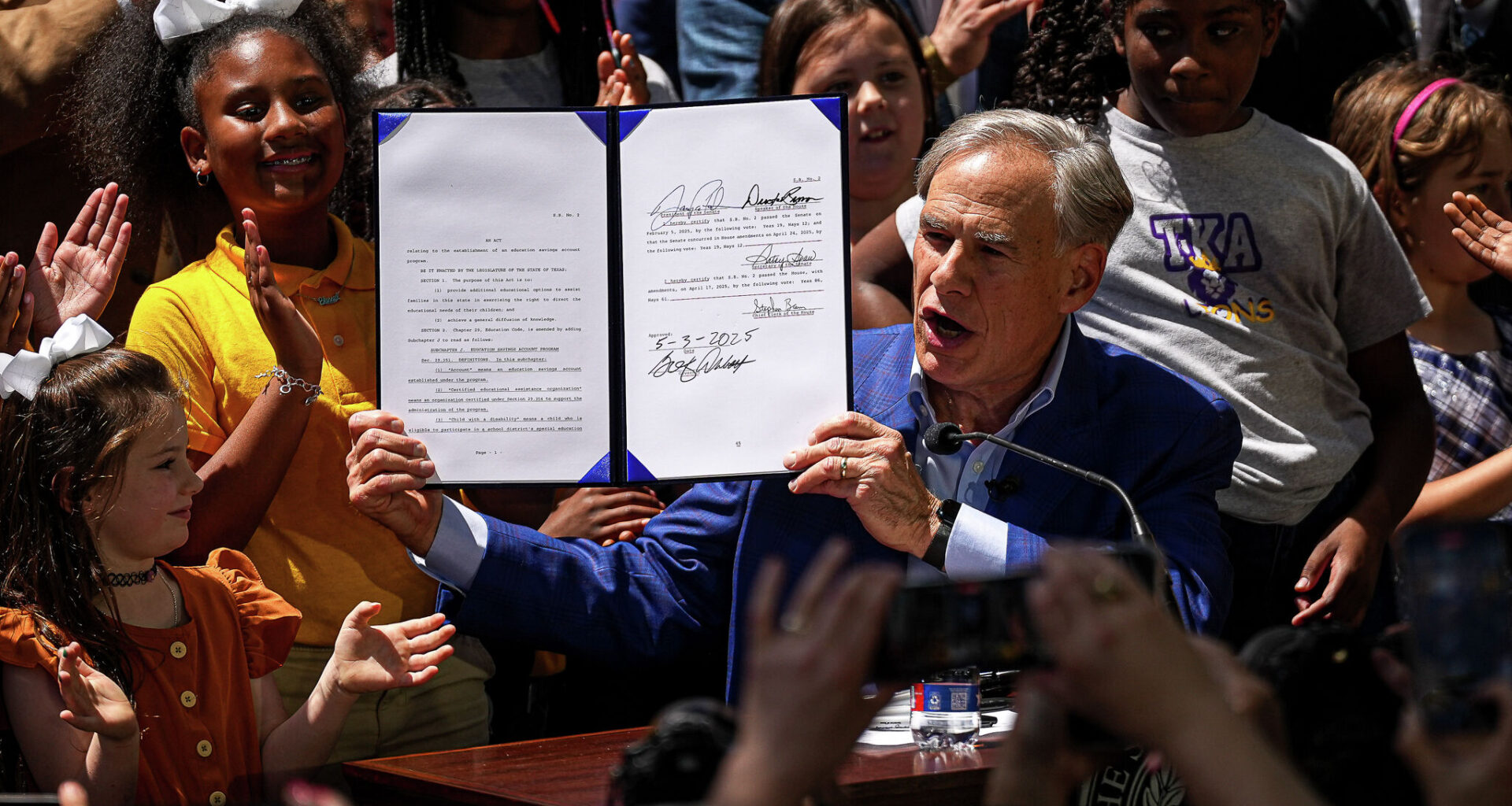
Texas Gov. Greg Abbott holds up Senate Bill 2 which he signed into law on Saturday, May 3, 2025 in Austin. A new analysis of comptroller data shows San Antonio public schools could lose $29 million in state funding because of the voucher program.
Aaron E. Martinez/American-State
San Antonio public school districts may lose $29 million in state funding because of the state’s new private school voucher program, according to new analysis of data from the comptroller’s office. The $1 billion state program gives public dollars to families for private education costs including tuition, uniforms, tutoring and homeschooling.

Two advocacy groups that oppose vouchers, the Texas Center for Voucher Transparency and Every Texan, released a new analysis on Thursday. They used the number of students previously enrolled at school districts who were awarded or used a Texas Education Freedom Account as of Aug. 10 to calculate potential enrollment loss. Not all students may have used their TEFA funds — Texas granted 122,000 students a voucher, but 20,700 returned their offer.
Article continues below this ad
The data offers a glimpse into the financial toll that the program is taking on public school districts amid declining enrollment. Texas funds schools based on how many students show up for class each day, so fewer students mean less state funding.
Considering the program’s opt-out rate, the financial impact on school districts is likely smaller than it appears. The comptroller’s office passes unused voucher funding to new recipients as awardees decline to participate. On Wednesday, the comptroller gave unused funds to 2,400 students on the waitlist.
READ MORE: Texas’ new voucher program could fuel microschool boom
While the data presents an incomplete picture of how vouchers are financially affecting the area’s public schools, it provides a window into the program’s potential future impact. Comptroller Don Huffines has asked the state Legislature to increase funding for TEFA to $4.4 billion for the next two years.
Article continues below this ad
Almost every San Antonio-area public school district served students last year who won vouchers. Data released in early August showed that more than 8,400 students living in San Antonio planned to use their TEFA funds. Alamo Heights, Somerset and Fort Sam Houston independent school districts are not included in Thursday’s analysis, according to the advocacy groups.
The analysis shows that eight area school districts stand to lose more than $1 million each to the voucher program, and the area’s largest district, Northside ISD, faces a loss of about $7.7 million if all of the district’s former students awarded vouchers use them.
Judson, East Central, Schertz-Cibolo-Universal City and Medina Valley ISDs had the highest percentage of former students receive vouchers based on 2025-26 enrollment — each had more than 1.2% of students win vouchers.
Each student who does not show up to class takes with them about $8,200 in funding, a number that includes the base level of state funding awarded for every Texas public school student and additional money that goes to support specific needs, like addressing a student’s disability, according to estimates from the nonprofits.
Article continues below this ad
Just because a student received a voucher doesn’t mean they will use it and leave their public school, said SCUCISD spokesperson Deanna Jackson.
But, she said, “any enrollment decline can affect a school district because state funding is tied largely to student attendance, while many operating costs remain fixed.”
How much money could San Antonio districts lose?
If every former San Antonio public school student who received a voucher as of early August accepted funding and left their district, the area’s public schools would lose $29 million in state funding, according to the analysis. Across Texas, public schools would lose $294 million, the groups estimated.
Article continues below this ad
“Voucher supporters promised that vouchers would expand educational options for Texas families without harming Texas public schools,” said Dee Carney, director of the Texas Center for Voucher Transparency. She said the projected funding loss means “real harm” for districts that have to cut teachers and close schools.
READ MORE: See how San Antonio-area campuses did on the A-F ratings
Military districts Randolph Field and Lackland ISDs will lose at most 29 students to vouchers, with funding losses estimated at about $240,000, according to the analysis.
Harlandale, Edgewood and Southwest ISDs face relatively smaller financial setbacks from vouchers than neighboring districts — though all stand to lose more than $400,000 — and Southwest ISD could lose more than $885,000.
Article continues below this ad
Some of the area’s fastest-growing districts may be the hardest hit financially. More than 1.2% of students who attended East Central and Medina Valley ISDs last year received vouchers, according to the data. Each district will lose a projected $1 million as a result.
East Central ISD Superintendent Roland Toscano said voucher-related enrollment decreases are “actually helping us in that we just have such rapid enrollment that we’re having a hard time keeping up.”
East Central ISD has gained more than 1,500 students since the 2019-20 school year, surpassing its pre-pandemic student numbers by more than 16%.
Toscano said he will continue to question the benefit of the voucher program until he knows whether it helps families access quality education they could not previously afford and whether TEFA students score higher on tests after switching to new schools.
Article continues below this ad
Conservative enrollment estimates
School district leaders have been monitoring their enrollment numbers with particular care this fall.
READ MORE: As classes start, thousands more students gone from San Antonio public schools
Article continues below this ad
Even as 943 former Northside ISD students received vouchers as of early August, the district’s fall 2026 enrollment surpassed internal projections by almost 500 students, according to spokesperson Barry Perez.
“We remain confident in what NISD offers and will continue to provide first-rate academic, athletic, fine arts, and extracurricular programming that meets the needs of our families,” Perez wrote in a statement.
Vouchers introduced a “huge stressor” this year for North East ISD CFO Susie Lackorn, who builds her budget based on annual enrollment estimates. The analysis released this week estimates that the 570 former NEISD students who were awarded vouchers will cost the district $4.7 million in state funding.
Article continues below this ad
Lackorn modeled this year’s budget conservatively, estimating that 51,000 students would return to NEISD this fall. When the school year resumed, enrollment figures exceeded that projection by 200 students. Still, student numbers have been trending downward since before the pandemic, with enrollment dipping by 16% since 2019-20.