
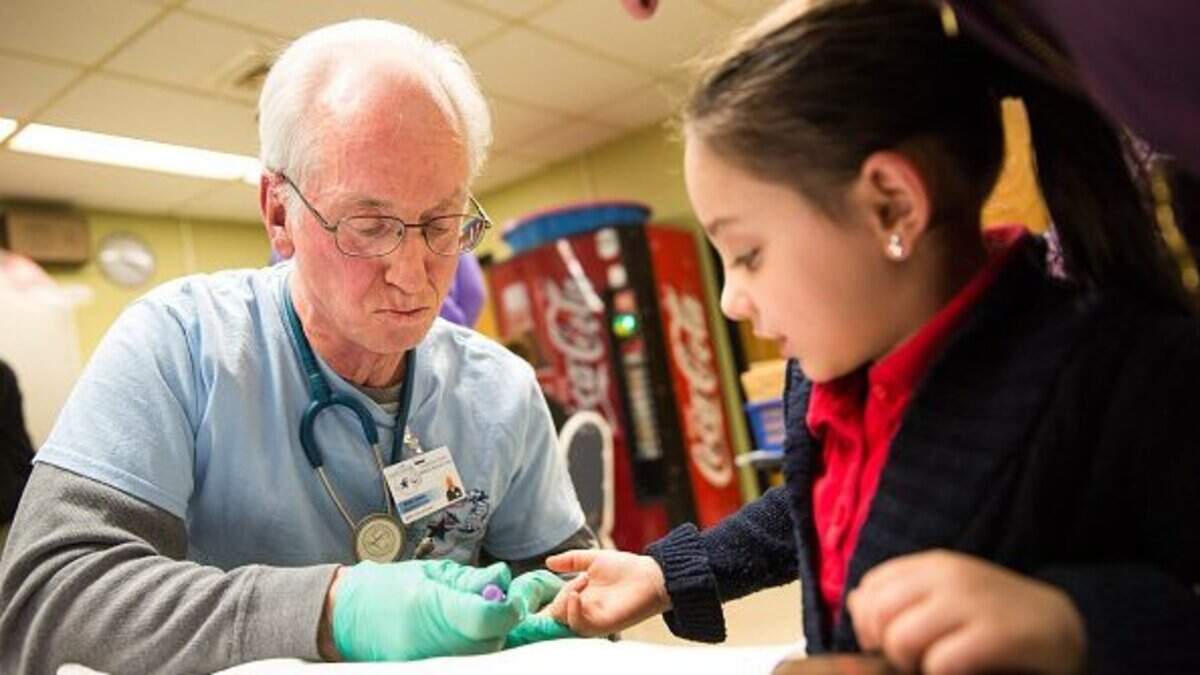
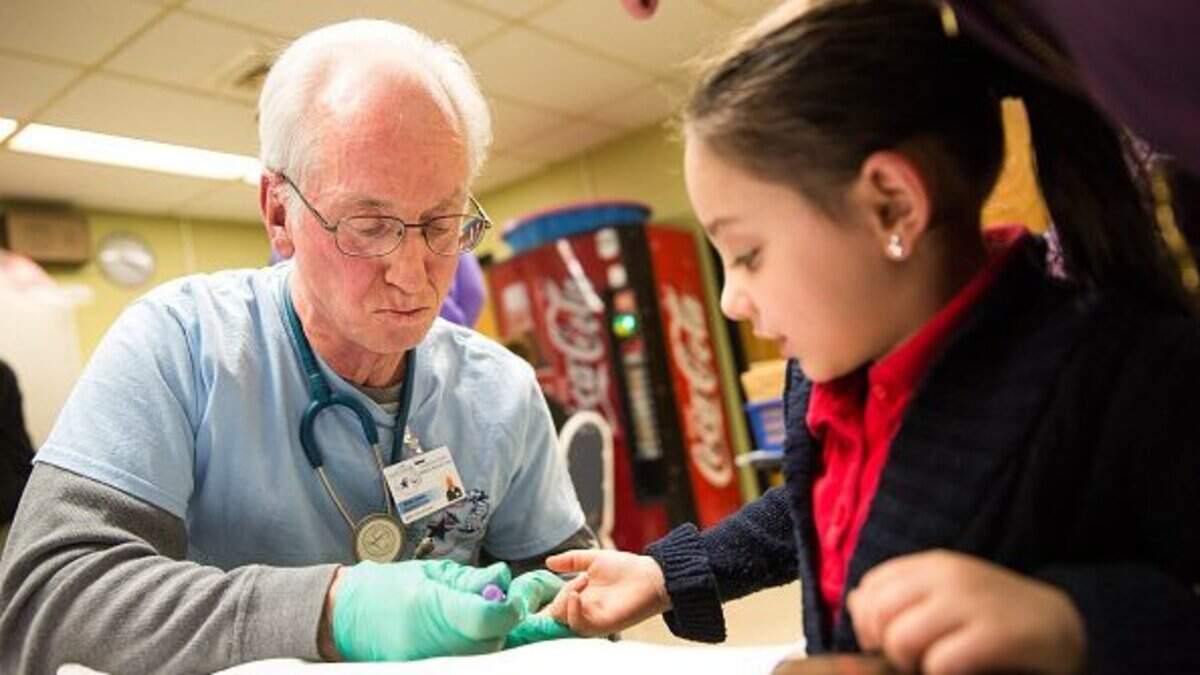
Brian Jones, a first responder for Livingston County Michigan, draws the blood of Amaria Roberson, age 5, to screen her blood for lead on Jan. 26, 2016, at Eisenhower Elementary School in Flint, Michigan. Free lead screenings were performed for Flint children 6 years old and younger, one of several events sponsored by Molina Healthcare following the city’s water contamination and federal state of emergency.
Brett Carlsen
Getty Images
Just 24% of Tarrant County children ages 1-2 were tested for lead in 2024, leaving public health and health care leaders in the dark when it comes to identifying where lead is a threat in Tarrant County.
“The blood lead test ends up being our way of finding kids” who need interventions, said Dr. Morri Markowitz, an expert in lead poisoning and a pediatrician with the Children’s Hospital at Montefiore Einstein.
Blood lead tests are how parents and physicians identify children with elevated blood levels, and are the impetus for interventions like lead remediation in homes and apartments. Across Texas, about 34% of kids at ages 1 and 2 were tested for lead in 2024.
“Kids are the lead tests in our current public health system,” Dr. Joel Davidson, a pediatrician with Akron Children’s Hospital, said. “Kids getting exposed are kind of the canary in the coal mine.”
No amount of lead is safe for children. The toxin is particularly harmful for brain development, but lead can affect every organ in the body if ingested, experts said. Lead typically doesn’t show immediate symptoms in children, but can cause permanent damage once ingested. It can cause increased aggression and a decline in IQ, according to research.
“Basically, lead makes kids stupid,” said Dr. Howard Hu, professor of population and public health sciences at the University of Southern California’s medical school.
In the U.S., lead primarily poisons children via lead-based paint in homes, experts said, but poisoning can also occur via lead pipes, lead in dirt, lead in batteries, and other sources. Children at the ages of 1 and 2 are particularly at risk, experts said, because of the increased hand-to-mouth activity common during those ages. In older homes, children can ingest lead paint via dust or chips. Lead-based paint was banned in the U.S. in 1978.
In 1989, Medicaid made it a requirement that children on the public health insurance program be tested twice for lead in their blood, at ages 1 and 2. But few states have managed to test all children on Medicaid. A report from the Office of the Inspector General in 2021 found that only a third of Texas children on Medicaid were receiving the required blood tests by age 2. In Tarrant County, there are an estimated 180,000 children of all ages on Medicaid. But just 17,000 children under 14 in the county were tested for lead in 2024.
In seven states and Washington, D.C., there are laws requiring universal lead testing for all children, regardless of whether they are on Medicaid, according to the Network for Public Health Law. Universal testing is not currently recommended by the American Academy of Pediatrics, but universal risk assessments – meaning doctors would ask parents questions about their child’s lead exposure – is. The AAP recommends that every child who scores at high risk for a screening be tested for lead.
Davidson said Akron Children’s Hospital managed to improve blood lead screening rates from 71% to 96% for 1-year-old children at the Ohio hospital. They did this by standardizing the electronic health record system to order a blood test for every child at their 1-year-old checkup.
“We basically use a computer to take out the human need of figuring out those things,” Davidson said.
Of the Tarrant County 1- and 2-year-olds who have been tested for lead, about 3% were found to have more than 3.5 micrograms per deciliter, the marker above which a child is considered to have an elevated blood level. That’s above the statewide rate of 2.1%.
Dr. Laura Romano, a pediatrician with Cook Children’s Health Care System, said that part of the reason for Tarrant County’s low rates of testing might be that more homes in the rapidly-growing county were built recently, after lead paint was banned in the U.S.
“A lot of us don’t live in houses that were built in the ‘50s and ‘60s anymore,” Romano said.
Dr. Barry Lachman, a public health expert with extensive experience in lead, said it was most important that children at high risk of lead poisoning get tested.
“If you had concentrated testing, where your rates in Plano were 5% and your rates in certain areas of Oak Cliff … were 90%, you’d feel like you were doing your job OK,” Lachman said.
Related Stories from Fort Worth Star-Telegram

Fort Worth Star-Telegram
Ciara McCarthy covers health and wellness as part of the Star-Telegram’s Crossroads Lab. She came to Fort Worth after three years in Victoria, Texas, where she worked at the Victoria Advocate. Ciara is focused on equipping people and communities with information they need to make decisions about their lives and well-being. Please reach out with your questions about public health or the health care system. Email cmccarthy@star-telegram.com or call or text 817-203-4391.