
These days, most people take photographs with their phones. A few may work with professional cameras. But how many know the history of the medium?
When and where was photography invented? How creative were early photographers? What did those first images look like?
Questions like these are answered in the Kimbell Art Museum’s latest exhibition “Photography’s First Century: Masterworks from the Bibliothèque nationale de France,” on view starting Oct. 4.
The exhibition — the Kimbell’s first-ever focus on photography — dives into how artists explored the medium after French inventor Nicéphore Niépce captured the oldest surviving image in 1827.
If you go
When: 10 a.m.-5 p.m. Tuesday-Thursday, Saturday; noon-8 p.m. Friday; noon-5 p.m. Sunday; Oct. 4-Jan. 17
Where: Renzo Piano Pavilion at Kimbell Art Museum, 3333 Camp Bowie Blvd., Fort Worth
Admission: $14-$18
The more than 170 images on loan from the French national library are curated to show the evolution of photography — from daguerreotypes, the first process used to make a true likeness, to modern portraits taken between the World Wars.
The exhibition is the first time the collection travels to the United States since 1980, said Kimbell director Eric M. Lee. The French national library owns more than 5 million photographs.
Gilles Pécout, president of the library, described the images as both masterpieces and historical documents that every photographer should study.
“You will see this in the exhibition, a world shaped by artistic and heritage traditions. A world shaped by the modernity of transportation and major urban projects, by both mass reproduction and by the aesthetic individualism of the avant-garde,” he said.
How a fresh idea became an artistic outlet
 George Shackelford, deputy director at the Kimbell Art Museum, explains how some 1920s photographers used solarization to create bright areas known as “halos” in their images. (Maria Crane | Fort Worth Report/CatchLight Local/Report for America)
The exhibition opens with a display of some of the earliest examples of photography techniques developed across Europe. Louis Daguerre invented the daguerreotypes in France by capturing an image on a copper plate polished with silver. English inventor William Henry Fox used paper to create negatives known as calotypes.
Portraits of some of the most influential figures in the 19th and 20th centuries are on display in the next section. People went to studios to pose for portraits during photography’s first 50 years, according to the Kimbell. Famous portraits on view include authors Victor Hugo and Alexandre Dumas.
By the mid-1850s, photographer Gustave Le Grey looked to push artistic boundaries, steering away from portraits and instead capturing seascapes. He innovated the use of combining two negatives to capture water and clouds in a single print, said George Shackelford, deputy director of the Kimbell.
The exhibit’s next two galleries spotlight how European photographers began capturing architecture of cities and the people who call them home, including documenting the construction of Paris’ Garnier Opera House in the 1860s and the life of Ukrainian artist Sonia Delaunay in the early 20th century.
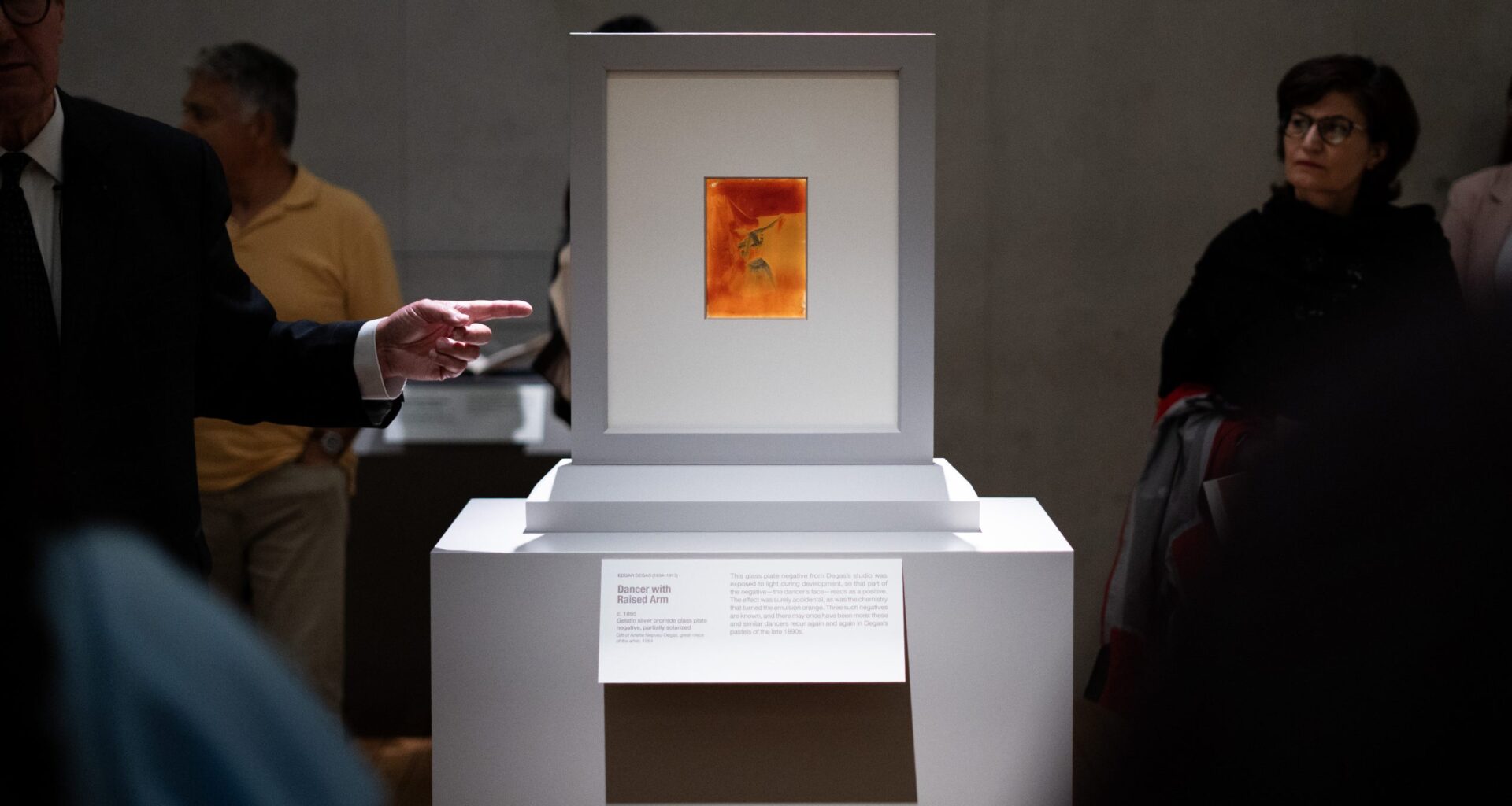
 Guests explore the photographs on view during the press preview for “Photography’s First Century” on Oct. 1, 2026. (Maria Crane | Fort Worth Report/CatchLight Local/Report for America)
The final gallery looks at how photography became a creative outlet for writers, entertainers and artists living in Paris by the 1920s. Some artists accidentally exposed their negatives to the light, which created bright areas in their images. The practice, known as solarization, was later embraced artistically, Shackelford explained.
“It is a truly remarkable opportunity for us not only to talk about the history of this medium, but to get people thinking about how it developed and what it means for what we are doing now,” he said.
“Photography’s First Century” is on view through Jan. 17.
David Moreno is the arts and culture reporter for the Fort Worth Report. Contact him at david.moreno@fortworthreport.org or @davidmreports.
Disclosure: Kimbell Art Museum has been a financial supporter of the Fort Worth Report. At the Fort Worth Report, news decisions are made independently of our board members and financial supporters. Read more about our editorial independence policy here.
This <a target=”_blank” href=”https://fortworthreport.org/2026/10/02/history-of-photography-comes-into-focus-in-kimbell-exhibition/”>article</a> first appeared on <a target=”_blank” href=”https://fortworthreport.org”>Fort Worth Report</a> and is republished here under a <a target=”_blank” href=”https://creativecommons.org/licenses/by-nd/4.0/”>Creative Commons Attribution-NoDerivatives 4.0 International License</a>.<img src=”https://i0.wp.com/fortworthreport.org/wp-content/uploads/2021/04/cropped-favicon.png?resize=150%2C150&ssl=1″ style=”width:1em;height:1em;margin-left:10px;”>
<img id=”republication-tracker-tool-source” src=”https://fortworthreport.org/?republication-pixel=true&post=812356&ga4=2820184429″ style=”width:1px;height:1px;”><script> PARSELY = { autotrack: false, onload: function() { PARSELY.beacon.trackPageView({ url: “https://fortworthreport.org/2026/10/02/history-of-photography-comes-into-focus-in-kimbell-exhibition/”, urlref: window.location.href }); } } </script> <script id=”parsely-cfg” src=”//cdn.parsely.com/keys/fortworthreport.org/p.js”></script>