
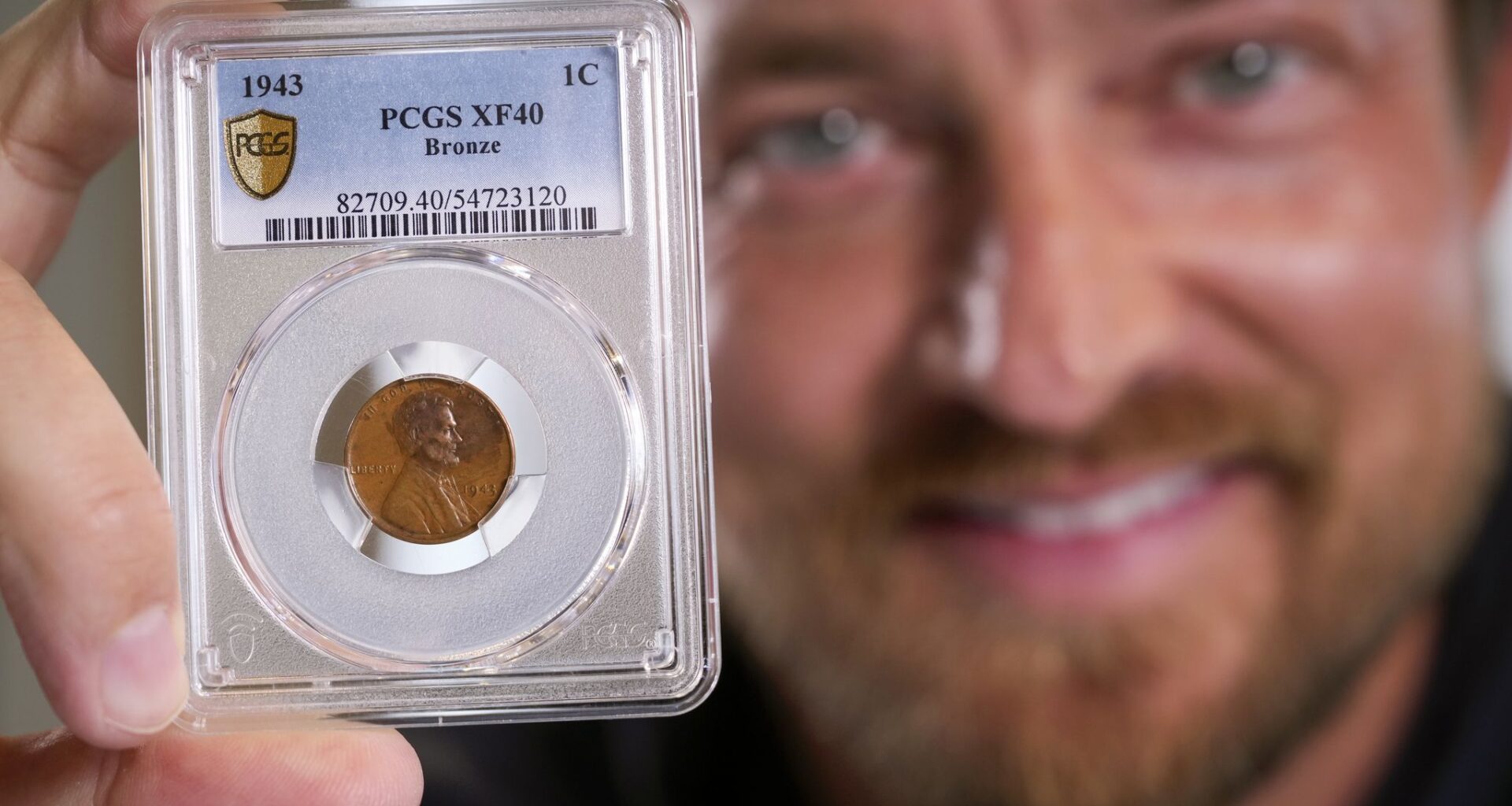
A Houston-area business recently acquired a historic cent worth more than $235,000 that experts say likely changed hands hundreds of times before someone realized its value.
The coin, known as a 1943 bronze Lincoln cent, had been in the possession of a Houston family before it was acquired by brothers Kenny Duncan Jr. and Matthew Duncan, owners of U.S. Coins and Jewelry, at 8501 Katy Fwy.
U.S. COINS AND JEWELRY: U.S. Coins and Jewelry to open bigger Katy Freeway showroom, building on 40-year tradition
Kenny Duncan Jr. poses for a photo with a rare 1943 bronze penny at U.S. Coins and Jewelry in Houston, Thursday, Oct. 1, 2026.
Brett Coomer/Houston Chronicle
“Believe it or not, we’ve been searching for one ourselves for years, but this was in a family’s collection and found its way to us after almost 60 years,” Duncan Jr. said. “I was excited because it’s the first time we’ve ever owned one. Of all the rare coins that we own — we’ve owned some of the best and the greatest — this is the one that we’ve never been able to acquire. Now that we have, we’re over the moon.”
Article continues below this ad
Duncan Jr. said the coin is rare because of how it was produced.
In 1943, during World War II, copper was redirected for the war effort, Duncan Jr. said. The U.S. Mint began producing zinc-coated steel cents, making more than 1 billion that year. However a number of unstamped copper coins, called planchets, left over from 1942 were mistakenly struck with the 1943 design, according to the American Numismatic Association.
Duncan Jr. added that many people believe they have one of the rare coins, but most are altered or counterfeit.
Professional Coin Grading Service, also known as PCGS, authenticated the coin and called it “every coin collector’s dream.”
Article continues below this ad
“Every coin collector dreams of finding a genuine 1943 bronze cent in their change,” said Charles Morgan, PCGS manager of numismatic research and programs. “The specimen acquired by U.S. Coins is one of those needle-in-a-haystack discoveries. It displays honest circulation wear and likely passed through hundreds of unsuspecting hands before its previous owner plucked it out of circulation.”
PCGS described the coin as having a classic chestnut appearance with patches of auburn-eggplant patination. The front bears the date 1943, while the reverse reads, “One Cent, United States of America.”
A rare 1943 bronze penny is shown at U.S. Coins and Jewelry in Houston, Thursday, Oct. 1, 2026.
Brett Coomer/Houston Chronicle
A rare 1943 bronze penny is shown at U.S. Coins and Jewelry in Houston, Thursday, Oct. 1, 2026.
Brett Coomer/Houston Chronicle
The first known example was discovered in 1944 by a 14-year-old boy who found it in his change. One of the most recent discoveries was reported in 2023 and involved a coin struck at the San Francisco Mint, according to PCGS.
Article continues below this ad
PCGS values the coin at more than $235,000. Duncan Jr. said he plans to display it at the shop moving forward, starting this Saturday.
This is not the first rare coin or high-end collectible acquired by U.S. Coins and Jewelry.
The shop, founded in 1985 by Duncan Jr.’s father, buys, sells and trades a variety of rare items, including coins, sports cards, jewelry, artwork and signed historical documents.
“Just about anything that you can collect is what we started to hunt,” Duncan Jr. said. “Now, it’s really just a mad hunt to find the coolest stuff and bring it to the shop. That’s the mission now.”
How can you tell whether a coin is valuable?
Although fewer people carry cash today, and the U.S. Mint stopped producing pennies for circulation in 2025, coins still pass through people’s hands every day.
Article continues below this ad
Determining a coin’s value is not always straightforward. Duncan identified several factors that could increase its value:
Date: Rare coins span centuries. Older coins may be more difficult to find, but age alone does not determine value. Duncan said collectors can use “A Guide Book of United States Coins,” commonly known as the “Red Book,” to help identify rare coins.
Condition: Duncan said a coin’s condition matters, but there is no easy way to identify a rare coin at first glance unless you do extensive research. Conditions vary widely, but double-struck coins also known as mistruck coins, are coins struck more than once during production and can be rare and are popular among collectors. Lamination errors, which occur when metal separates from a coin’s surface, causing a missing piece, also can make a coin collectible.
Mintage: Another factor is a coin’s mintage, or the number produced, according to Austin Rare Coins & Bullion. Coins with lower mintages are generally rarer, particularly older coins.
Article continues below this ad
Potential minting errors: Most production errors are caught before coins are distributed, but some enter circulation. Examples include double-struck coins and doubled-die coins. A double strike occurs when a coin is struck more than once. A doubled die is created when a die, which is the tool used to stamp a coin’s design, is made with duplicated design elements. One rare example is the 1969-S doubled-die obverse Lincoln cent, which is worth hundreds of thousands of dollars.
Researching the coin and consulting with a dealer or professional grading service can help determine its value.