
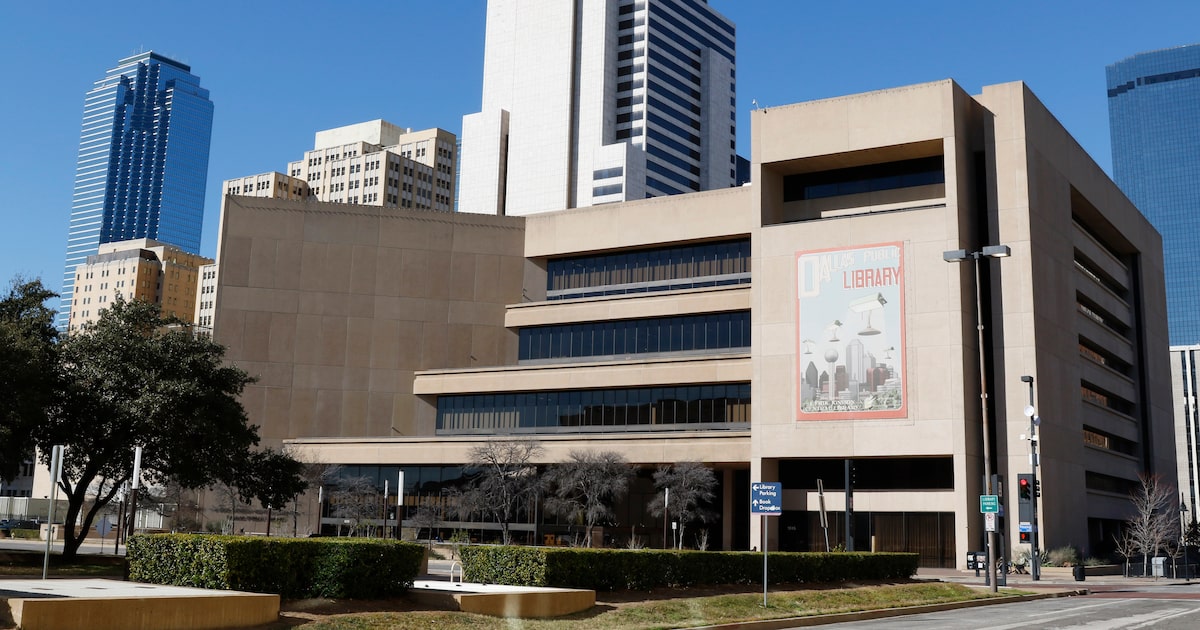

It’s either the worst-kept secret in Dallas or the most repeated rumor around; in this small town pretending like it’s a big city, it’s sometimes hard to tell the difference. A little digging revealed it’s quite likely the latter, because we sure do love our conspiracy theories. But either way, it’s a question worth asking: Is the downtown library as imperiled as the City Hall across the street?
The two buildings suffer from the most Dallas of maladies: long-deferred maintenance on a city-owned building, and around these parts that appears to be a death sentence no matter how significant or stately the structure. Just look at City Hall, whose potential demise is being fast-tracked through City Council chambers like nothing I’ve ever seen at 1500 Marilla St.
Only a few weeks back we were told I.M. Pei’s brutalist building needs somewhere between $150 million to $325 million worth of work, a figure that keeps climbing. On Wednesday, the City Council will vote on a resolution that all but seals City Hall’s fate, directing City Manager Kimberly Bizor Tolbert to look at leasing office space elsewhere while completing “an analysis of the potential economic impact of a redevelopment of the City Hall site.”
Which brings us back to the eight-floor, 600,000-square-foot J. Erik Jonsson Central Library directly across the street from City Hall and named for the mayor who proposed both buildings as part of his Goals for Dallas intended to wash away the stain of a president’s assassination. Jonsson led the fundraising efforts for the library that bears his name; by the time the library opened in 1982, just four years after City Hall, Jonsson had raised $13 million of its $43 million price tag. He said it was the best thing he’d ever done for Dallas.
Opinion
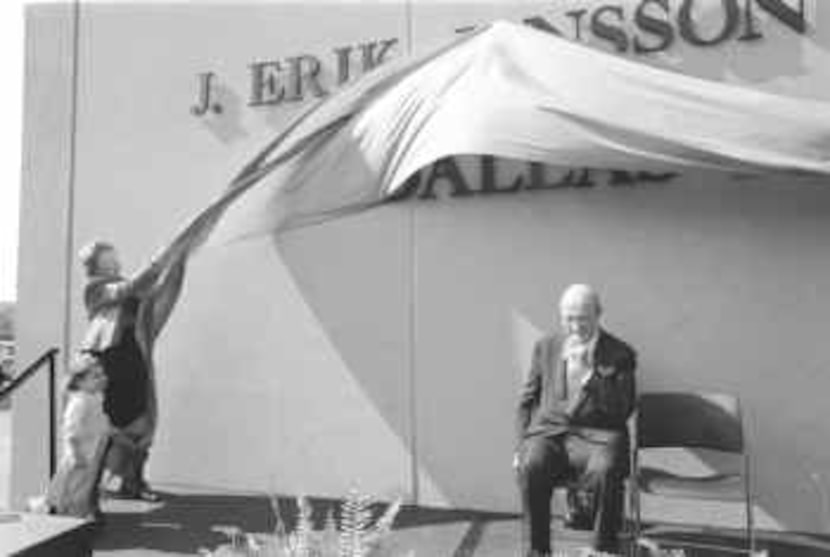
In 1986, then-library director Lillian Bradshaw, with Mayor J. Erik Jonsson and his 2-year-old great-granddaughter, Margaret Lewis, unveiled the Central Library’s new sign honoring the mayor who raised millions for its construction. Ross Perot actually pushed for the library to be named in Jonsson’s honor.
There’s a reason the buildings look like pieces of the same puzzle: “Featuring an inverted center portion and bold lines,” Dallas historian Darwin Payne wrote in No Small Dreams: J. Erik Jonsson — Texas Visionary, “it was a perfect counterpart to the new city hall across the street.” So much so it’s difficult to imagine one building without the other.
Yet it’s no secret that the central library suffers from many of the same ailments that plague Pei’s building.
In April 2024, a San Francisco-based architect who had worked on the library system’s new master plan warned the City Council’s Quality of Life, Arts & Culture Committee that the J. Erik Jonsson is “one of only two Dallas libraries assessed by the city to be in less than good condition.” Said Jill Eyres to the committee, “Many of the building’s key systems, such as electrical, plumbing and elevators, are beyond their expected useful life, [and] the longer they go without upgrade and replacement, the more likely they are to fail.”
With some understatement she warned that renovation wouldn’t be a “small job,” but noted that other central libraries nationwide, from Austin to Boston, had upgraded their facilities “with positive results.”
The master plan, too, pulled no punches.
The city hasn’t said how much it would cost to deal with the library’s myriad issues. The plan notes only that bond programs have invested more than $9 million in repairs and upgrades since the library opened more than four decades ago, but that the building has never undergone a comprehensive renovation.
A 2018 facility condition assessment warned of “significant deficiencies,” including a leaky roof; heating and cooling systems “that are aged, non-functioning, or obsolete/operating on borrowed time”; a long-outdated electrical system; and elevators “still relying on original motors and ‘obsolete’ controls.” For starters.
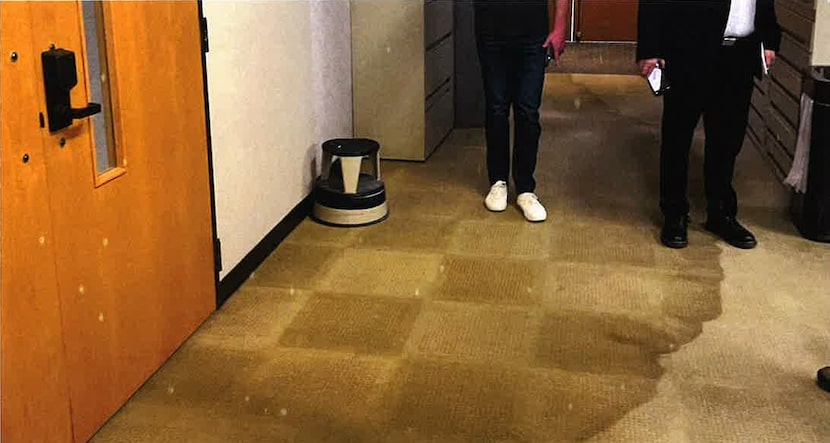
The latest library system master plan includes this photo from inside the J. Erik Jonsson Central Library after a flooding incident.
From the Dallas Public Library Strategic + Facilities Plan
In that master plan, library staffers complained about broken elevators that make them feel unsafe. Community survey respondents complained of the building feeling unclean and outdated. One staffer fretted that the library’s “world-class collection,” which includes one of the 26 surviving broadside copies of the Declaration of Independence printed on July 4, 1776, is “constantly threatened by building catastrophes.”
When I started digging into where rumors of the library’s possible demise began, I was directed to the June 24 meeting of the Municipal Library Board, where former Fort Worth library director Manya Shorr introduced herself as the Dallas library system’s new leader. Straight off, Shorr said she wanted to address the elephant in the room, “which is that I closed the central library in Fort Worth.”
She explained that city leaders had been approached by someone interested in buying the site and converting it into a mixed-use residential development. Selling it made sense, she said, because few people used the downtown library and it was “showing its age,” despite being a decade newer than Dallas’.
Turning her attention toward the J. Erik Jonsson, Shorr concurred with the master plan, telling the board that there are “a lot of issues with this building … a beast of a building.”
“This is a building clearly designed for a paper-based world that we no longer live in,” she said. “So there is space. We don’t know what to do with nothing but space. It seems like there’s a lot of deferred maintenance on this building, a lot of issues. And I think the conversation is worth having about this building.”
But the city doesn’t appear to be in any rush to have that talk.
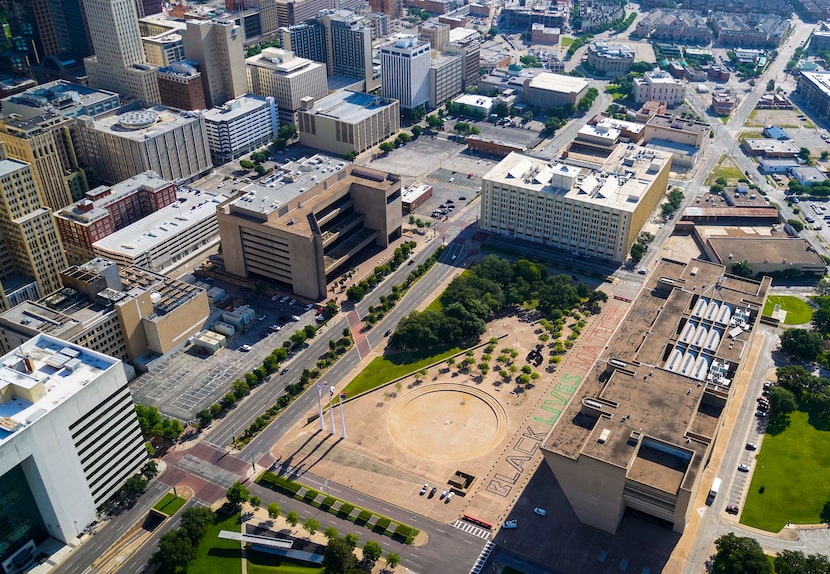
Dallas City Hall and the downtown central library were intended to serve as two pieces of the same puzzle, as both were conceived by then-Mayor J. Erik Jonsson.
Smiley N. Pool / Staff Photographer
At the end of last week, I sent Tolbert and other city officials an email asking about the issues at the library, and whether those, too, could one day force the city to consider moving out of the building. City spokesman Rick Ericson responded that city staff is focused solely on the deferred maintenance at City Hall, and that “the Central Library is not part of that maintenance review.”
Which is part of the problem: If we’re going to at least pretend a City Hall do-over is necessary to help remake the southern stretch of downtown, then shouldn’t we be talking about the totality of the so-called Municipal District in danger of being dismantled? Making these decisions piecemeal isn’t a vision. It’s a recipe for chaos, skepticism and — yes — rumors.
According to the library’s website, the city is looking at adopting a regional model, which would divert a majority of its services and resources to a handful of branches around the city while closing others. If that model isn’t adopted by next year’s budget, the library warns, it “will still be tasked with saving $2.6 million in FY27 [which] would mean eliminating positions and reducing the number of days and hours at all library locations.”
I requested an interview with Shorr and received only a statement in return about some cosmetic upgrades — a $150,000 fenced-in garden courtesy of Downtown Dallas Inc. and $35,000 worth of garden furniture donated by the Friends of the Dallas Public Library, of which my wife was executive director until earlier this year. Shorr also wrote that $240,000 has been budgeted to make the first-floor restrooms ADA-compliant.
“While there are issues with the building,” Shorr wrote to me Monday afternoon, “we have been taking steps to address some of those issues and reinvent operations at the Central Library.”
Shorr then sent a much longer email Monday evening to library staff and the Municipal Library Board in which she mentioned a coming Dallas Morning News story addressing rumors of the library’s sale — a rumor, she wrote, that “is not true.” In that email, which landed in my inbox Monday night, Shorr also mentioned the need to reimagine the library amid the deferred maintenance.
“I also know the challenges of such a vast space created in the early 1980s when the building was constructed — when no one fathomed what the future of libraries would be,” she wrote in that email. “The services we offer are incredibly valuable, as is the work you do with our community. But they are separate from the space they occupy and that’s what I ask us to focus on. No matter what happens in the future, there will always be a plan for the services to continue, including the unique and valuable collections we have.”
Sure feels like we better start having that conversation, before they City Hall the J. Erik Jonsson.