
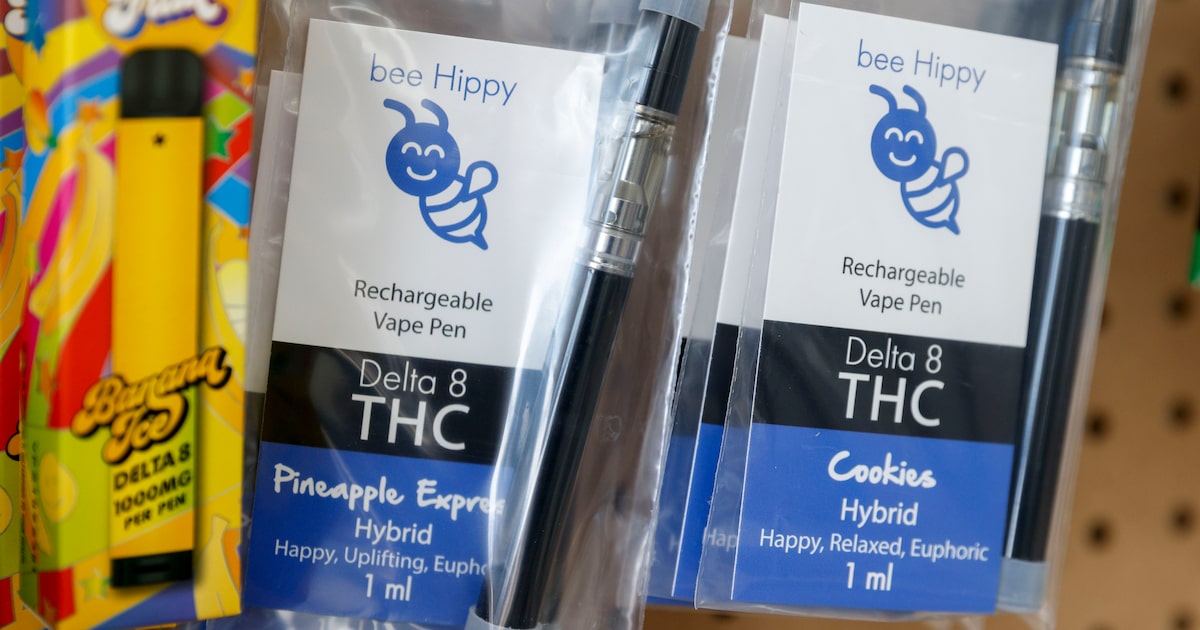
AUSTIN – Legislation approved late Monday by the U.S. Senate to end the government shutdown comes with a potent side effect – ending the unregulated sale of intoxicating hemp-based products in states such as Texas, where they are widely available despite state-level efforts to crack down on them.
The language was included at the last minute via the full-year spending bill that funds the U.S. Department of Agriculture. The provisions would reverse 2018 Farm Bill provisions that allowed hemp agriculture to flourish. They’d go into effect one year after the bill becomes effective.
The bill passed by the U.S. Senate late Monday would ban all consumable retail hemp products containing any synthetic form of THC – more common ones include compounds known as delta 8 and HHC – and all products containing THC in any form above trace levels.
Technically, that leaves some products with non-synthetic THC, such as delta 9, available to sell. But because the language takes the allowable amount to miniscule amounts – well below Texas law – it also effectively bans everything on the market right now, said Susan Hays, a cannabis lobbyist and lawyer in Texas.
Political Points
And it has the same effect as a total ban that Texas Lt. Gov. Dan Patrick has tried to pass on three separate occasions this year, she said.
“The federal language is a more sophisticated version of Dan Patrick’s ban bill and the backlash is already rising up,” Hays said. “The most unfortunate piece about it is if it goes into effect a year from now, the worst actors in the business will stay in the business and the responsible actors will get out.”
The provision is far from a done deal – the bill hasn’t passed both chambers, and the one year delay in implementation gives Congress the opportunity to change it through separate legislation before then.
And it does have its detractors among Texas Republicans.
“Should we really be regulating this from the federal level?” U.S. Rep. Dan Crenshaw, R-Humble, said in a post on X. “We’ve had the debate already in Texas. I’m sure we will continue to have it.”
In response to the federal Farm Bill, Texas lawmakers in 2019 mirrored the new federal law by legalizing the growing and selling hemp and hemp products. It limited the amount of delta-9 THC, the primary psychoactive compound in cannabis, in the plants to no more than 0.3% by weight as a way to avoid high-potency products getting into the market.
The state law, like the federal, did not place limits for any other hemp derivatives, and there was little market for consumables at the time. Hemp was removed from the state’s Controlled Substances Act, effectively legalizing all of its derivatives without potency limits on most of them.
The Texas Supreme Court upheld a prohibition on manufacturing consumable hemp products for smoking within Texas, but the law allowed retail sales and wholesale distribution of products made outside Texas.
It was a loophole lawmakers, including the 2019 bill’s author, insist was never supposed to happen.
Through it, the state’s retail hemp industry grew at one point to 8,500 consumable-hemp retailers, raking in an estimated $8 billion in 2022 and creating a reported 50,000 jobs in the state, according to insiders.
Nationally, the hemp industry employs more than 300,000 people and generates $28 billion in revenues, said Adam Terry, CEO of Cantrip Seltzer, which makes THC drinks. And all of it using products from hemp farmers who would be devastated by a ban, he said in a statement on X.
Sen. Rand Paul attempted to remove that provision from the shutdown deal to protect farmers and “take it out of this unrelated vehicle so we can study hemp policy and litigate a better policy to regulate hemp products in the US,” Terry said.
U.S. Sen. John Cornyn, R-Texas, opposed the Paul amendment. U.S. Sen. Ted Cruz, R-Texas, supported the amendment, posting on X that the regulation of hemp and marijuana should rest with individual states. He said a federal prohibition “disempowers” voters and would create unintended consequences.
“There is a vital need to protect children by, at a minimum, requiring that purchasers be 21 and prohibiting synthetics and dangerous foreign imports marketed to kids,” Cruz posted. “That’s the approach Governor Abbott has taken in Texas, and I urge other states to follow Texas’s example.”
The Texas Hemp Business Council, an industry coalition, immediately promised the fight the attempt, saying hem is “too vital to the American economy and to the livelihoods of millions to be dismantled by rushed, politically driven legislation.”
“As we proved in Texas, we will continue to pursue every legal and legislative option to overturn these harmful provisions and restore a fair, science-based system that continues to protect minors, ensure product safety and preserves the economic opportunities Congress created in 2018,” the organization said in a statement.
Lt. Gov. Dan Patrick, who has crusaded against the industry for several years as a scourge on Texas young people, celebrated the possibility that the federal government – which caused the situation to begin with – could solve the problem he could not.
Monday night’s 76-24 vote against Paul’s amendment shows bipartisan support for recognizing “the danger of these poisonous THC products,” Patrick said on X.
“The THC ban has been a priority for me, and I appreciate Congress addressing this important issue at the national level,” Patrick wrote. “I believe this ban will save a generation from getting hooked on dangerous drugs.”
The products are made of compounds derived from the hemp plant, which is legal in Texas and has lower concentrations of psychoactive compounds than illegal marijuana plants. Both are members of the cannabis plant family.
Shelves across Texas are filled with vapes, gummies, chocolates and other types of candies, snack foods, drinks, and smokable hemp flowers. The products are found in every corner of the state — in coffee shops, gas stations, smoke shops, restaurants, bars and breweries, among others. They are in rural and urban areas.
Texas does not regulate the labs that test products to ensure they contain legal amounts of cannabis ingredients or to test for harmful components, such as heavy metals or pesticides. Until recently, there was no age limit on who could purchase them, the packaging, the location of stores, or similar regulations.
The state has already shrunk the hemp-based THC consumables industry in recent months by banning electronic vapes that contain the compound, wiping out as much as 30% of the business for retailers on Sept. 1.
Even as arguments in Austin got heated over the merits of allowing a regulated THC market to bloom in Texas, there was little disagreement between lawmakers and retailers about the fact that the industry as it stood needed to be reined in.
An attempt by lawmakers to either ban or regulate the entire market of vapes, smokeable flowers, gummies, drinks and snacks that contain tetrahydrocannabinol, the psychoactive compound in cannabis, fell through for the third time this year in late August when Republican state leaders couldn’t agree on limits for how strong or intoxicating the products in retail stores and coffee shops could be.
An initial ban that was sent to Gov. Greg Abbott’s desk in May was roundly rejected in June, when the governor vetoed the ban and instructed the state’s alcohol regulators and health officials to come up with a regulatory framework for hemp-based THC consumable products – arguing they should be freely enjoyed by adults who choose to use them.
Texas Agriculture Commissioner Sid Miller, a vocal proponent of the hemp industry that was buoyed by the federal Farm Bill, this week applauded the “extension” of that legislation – saying it wouldn’t impact the hemp industry in Texas, which he said is largely industrial.
He has publicly opposed a total ban on the products, echoing Abbott’s position that it was government overreach into a legitimate market, but said the shutdown deal will get synthetic THC out of the market.
Hays said the current language was just another cop-out by lawmakers who are unwilling to do the work to make cannabis and hemp safer and more accessible to the Americans who clearly want it.
“If the government does not put on its big-boy pants and regulate cannabis products intelligently, like we do alcohol, it’s going to be a disaster,” she said.