
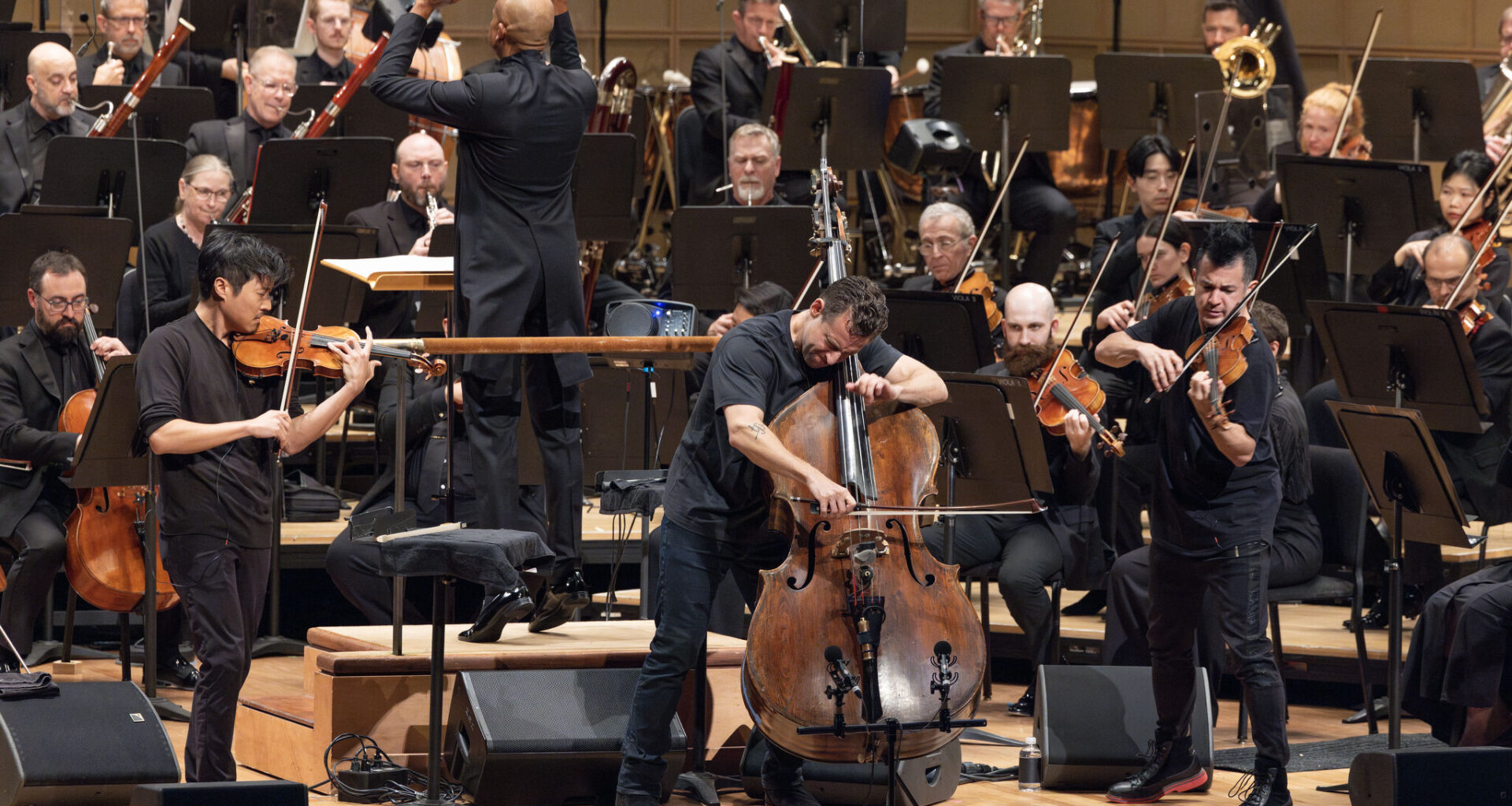
The trio Time for Three — (from left) violinist Charles Yang, bassist Ranaan Meyer and violinist Nicholas “Nick” Kendall — join the Dallas Symphony Orchestra and guest conductor Kevin John Edusei in Kevin Puts’ Contact at the Meyerson Symphony Center on Oct. 2, 2026.
Sylvia Elzafon/Dallas Symphony Orchestra
Well, that was an enjoyable concert.

With German guest conductor Kevin John Edusei leading the Dallas Symphony Orchestra on Friday night, the first half presented Contact, Kevin Puts’ dazzling triple concerto for the unusual combination of two violins and double bass. The second half luxuriated in that most succulent of late romantic symphonies, the Rachmaninoff Second. The Meyerson Symphony Center added resplendent acoustics.
Contact was composed for, and performed here by, Time for Three: violinists Nicolas “Nick” Kendall and Charles Yang and double bassist Ranaan Meyer. Sometimes doubling as vocalists, they regularly perform works by current singer-songwriters as well as concert-music composers.
Article continues below this ad
Puts is one of the more successful American composers these days, with works performed by major orchestras and opera companies. His opera The Hours was staged by the Metropolitan Opera in 2022. His Pulitzer Prize-winning Silent Night has been performed by Fort Worth Opera, and the Fort Worth Symphony premiered his Violin Concerto, with concertmaster Michael Shih.
Contact, which won a 2023 Grammy, is a 30-minute sequence in more or less classical symphony form: a moderately fast movement followed by scherzo, slow movement and exuberant finale. The soloists are necessarily amplified.
The first movement, “The Call,” started with the trio gently vocalizing close harmonies. The music proceeded through wind flourishes, upward surges of orchestral sound and brass proclamations. Solo bass pluckings were answered by yearning dialogues between the two violins, which then joined in the pluckings.
Deep-plush strings were countered by chirping winds, brasses joining for a dissonant outburst. Then various instrumental groupings and finally the soloists echoed the movement’s opening.
The ensuing “Codes” was an angular, confrontational scherzo, with mad solo fiddlings and pluckings and orchestral stabbings and scurries.
Article continues below this ad
Winds introduced the hesitant chords opening “Contact,” answered by an oboe solo (nicely played by Willa Henigman) that resumed after the string soloists contrasted long lines and rocking effects. Brasses and strings raised a dissonant protest, banished as winds advanced more hopeful music.
The frenzied finale, “Convivium,” was based on a Bulgarian folk tune, lending an Eastern European turn of melody and harmony vaguely suggesting Bartók. The orchestra dropped out for a virtuoso cadenza for the soloists, then rejoined the music’s stamp and swirl.
The performance by both Time for Three and the orchestra, led with authority by Edusei, was riveting. An encore beginning with vocal call-and-response involvement of the audience evolved into the Bob Crewe-Bob Gaudio song “Can’t Take My Eyes Off You.”
Glorious as it is, the hour-long Rachmaninoff doesn’t play itself. Edusei balanced overview and urgency with just enough yielding in just the right places. Musical sweep and surge were finely timed and lovingly contoured, and the orchestra played magnificently.
Having first and second violins divided left and right onstage clarified important dialogues, and principal clarinetist Gregory Raden elegantly spun out that sublime third-movement solo. I’d complain only about winds and brasses sometimes too prominent vis-à-vis strings. And I do wish the DSO would find a way to discourage applause after every movement, which disrupts the flow of pieces as they were meant to be experienced.
Article continues below this ad
Details
Repeats at 7:30 p.m. Saturday and 2 p.m. Sunday at Meyerson Symphony Center, 2301 Flora St. $24 to $180. 214-849-4376, dallassymphony.org.