
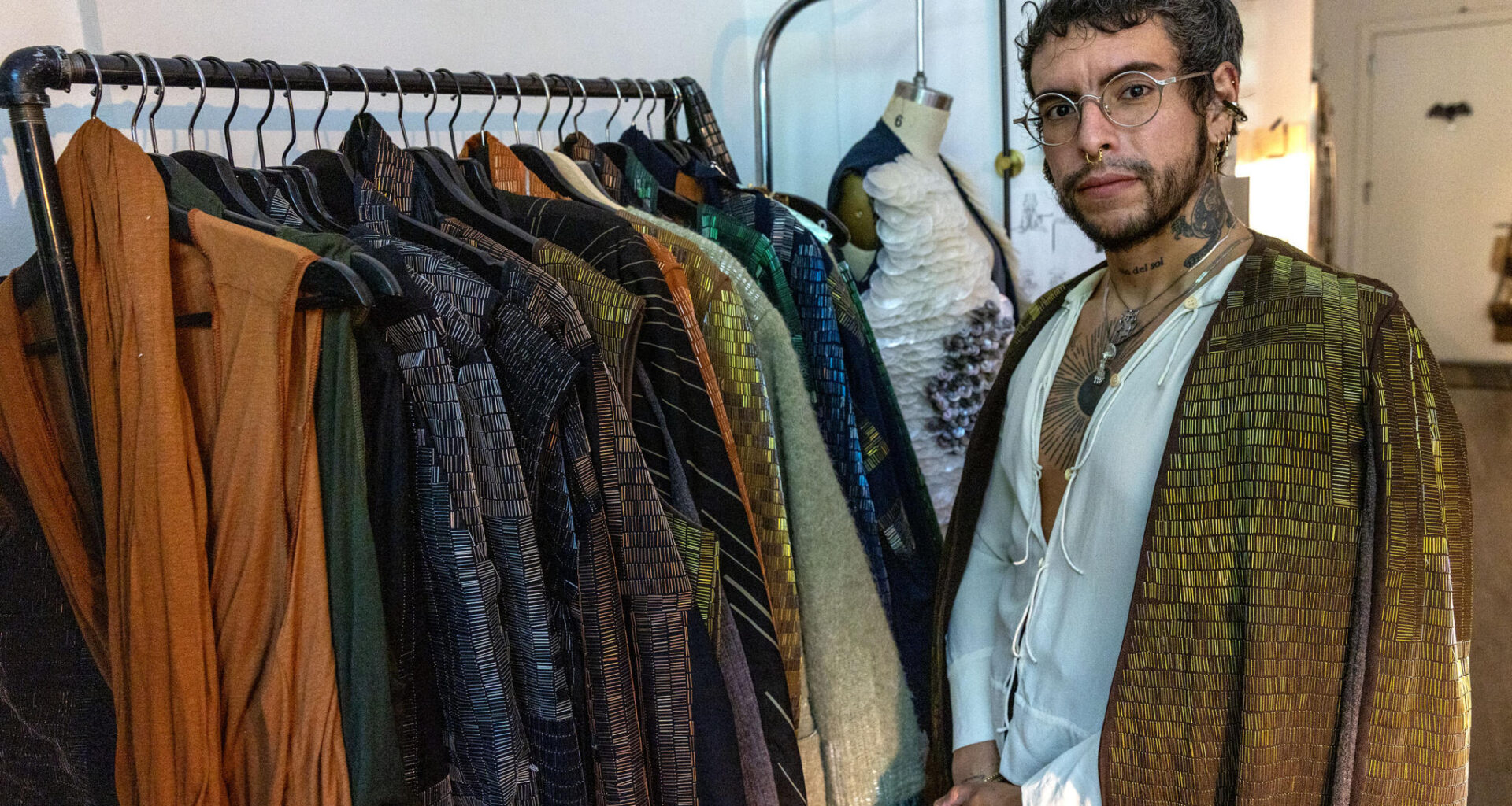
In a dimly lit room in Boston’s South End, Christian Hernán De Restrepo sat down to staple. He leaned over his desk and steadied a piece of fabric in one hand and held the stapler in the other. Each time he pushed down, a staple was added to a tightly formed row.
De Restrepo was working on a garment for the next installment of his project “A Él Mismo,” or “To himself,” which envisions life in Latin America if Spanish colonization had never happened. For the Boston-based Colombian American, it’s a love letter — to himself, his heritage and his family.
“When I’m doing my hand beading or sewing, I feel so connected to my family, which I guess leads to the project being so much about them, too,” he said.
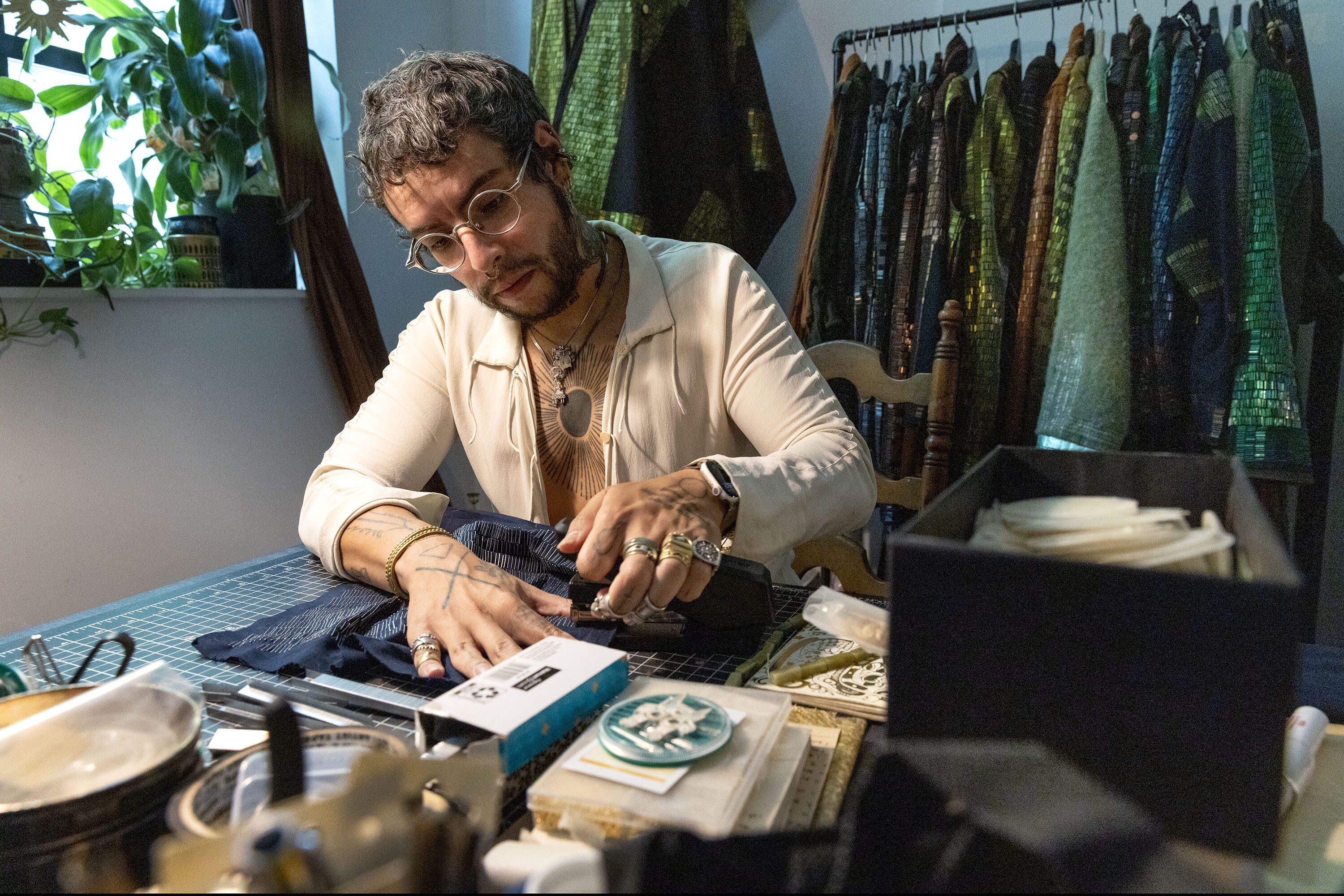 Christian Hernán De Restrepo decorates fabric with staples at his studio in Boston’s South End. (Robin Lubbock/WBUR)
De Restrepo, 36, grew up in a multigenerational household, calling a few different states home throughout the years. He describes his grandfather as someone who could build anything. His mother and grandmother sewed for the dinner theater company Medieval Times. He remembers sitting with them as they worked, playing with their thread and bobbins.
“I think it also showed me at such an early age that you have to invest time into your craft, into your practice,” he said.
De Restrepo’s first creative love was drawing. That laid the foundation for college, when he enrolled in Boston Architecture College. But it wasn’t the right fit. So an advisor suggested MassArt. He started in illustration before switching to fashion. Years later, fashion is at the heart of his creative practice, but he doesn’t think it tells his whole story.
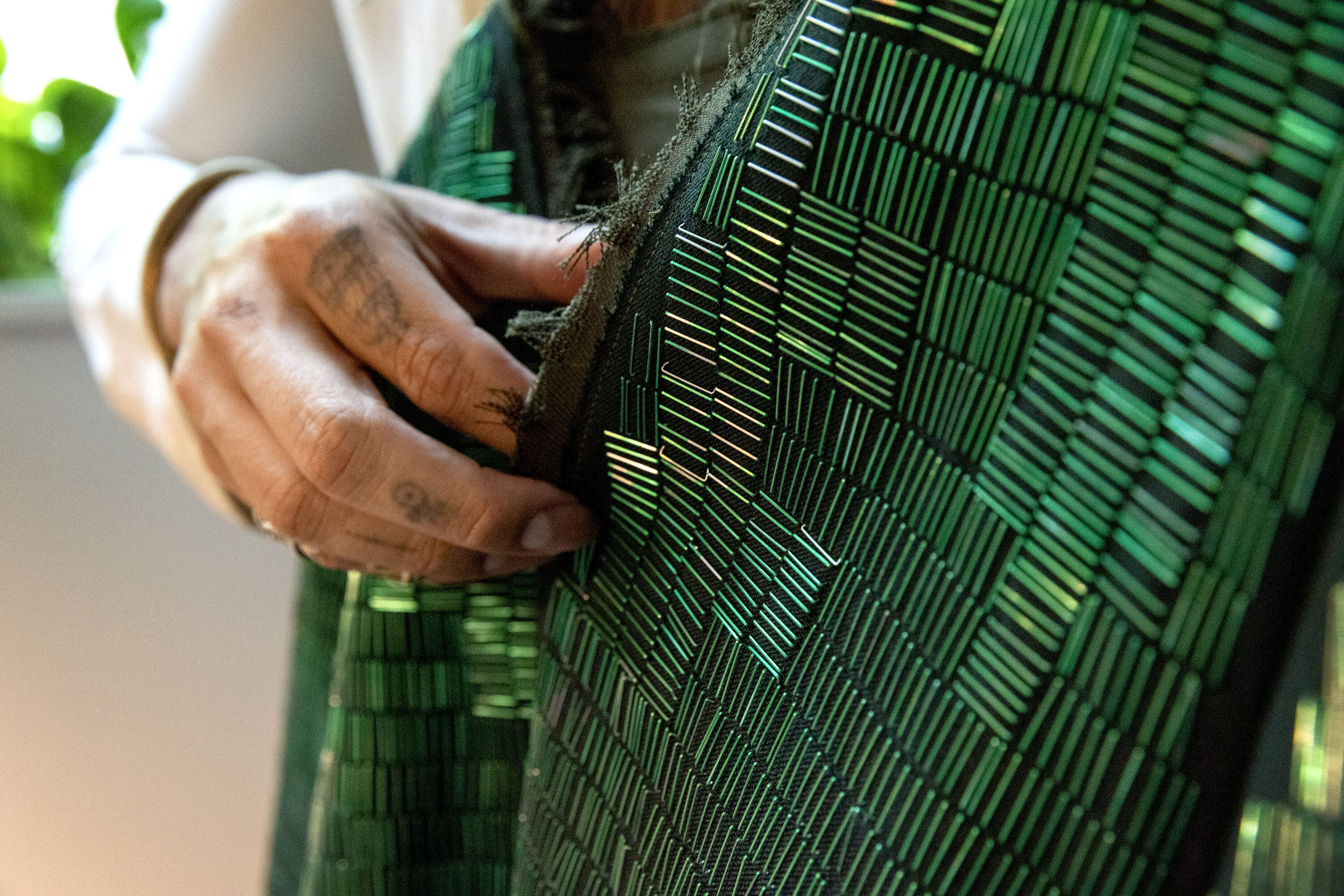 De Restrepo holds a coat he created and decorated with green staples. (Robin Lubbock/WBUR)
“I wouldn’t consider myself a fashion designer,” he said. “I feel like I’m more of just a world-building maker.”
De Restrepo started his world-building with a trip to Mexico. He says the experience helped him realize he was straddling two spheres: With his family, he was Colombian. But elsewhere, he was living a different reality.
“For so many years I was working so hard to try and just fit in with my white American counterparts, and that trip really brought forward so many things that I had subconsciously been doing and kind of hiding from myself,” he said.
This was the first time De Restrepo had been back in a Spanish-speaking country since he was a toddler. And being around that culture made him want to learn more about his own heritage.
But it wasn’t until the COVID-19 pandemic that his vision came into focus. He remembers sitting by a lake with friends thinking about how the choices made by previous generations had led to him “sitting at this quiet, beautiful, peaceful lake.”
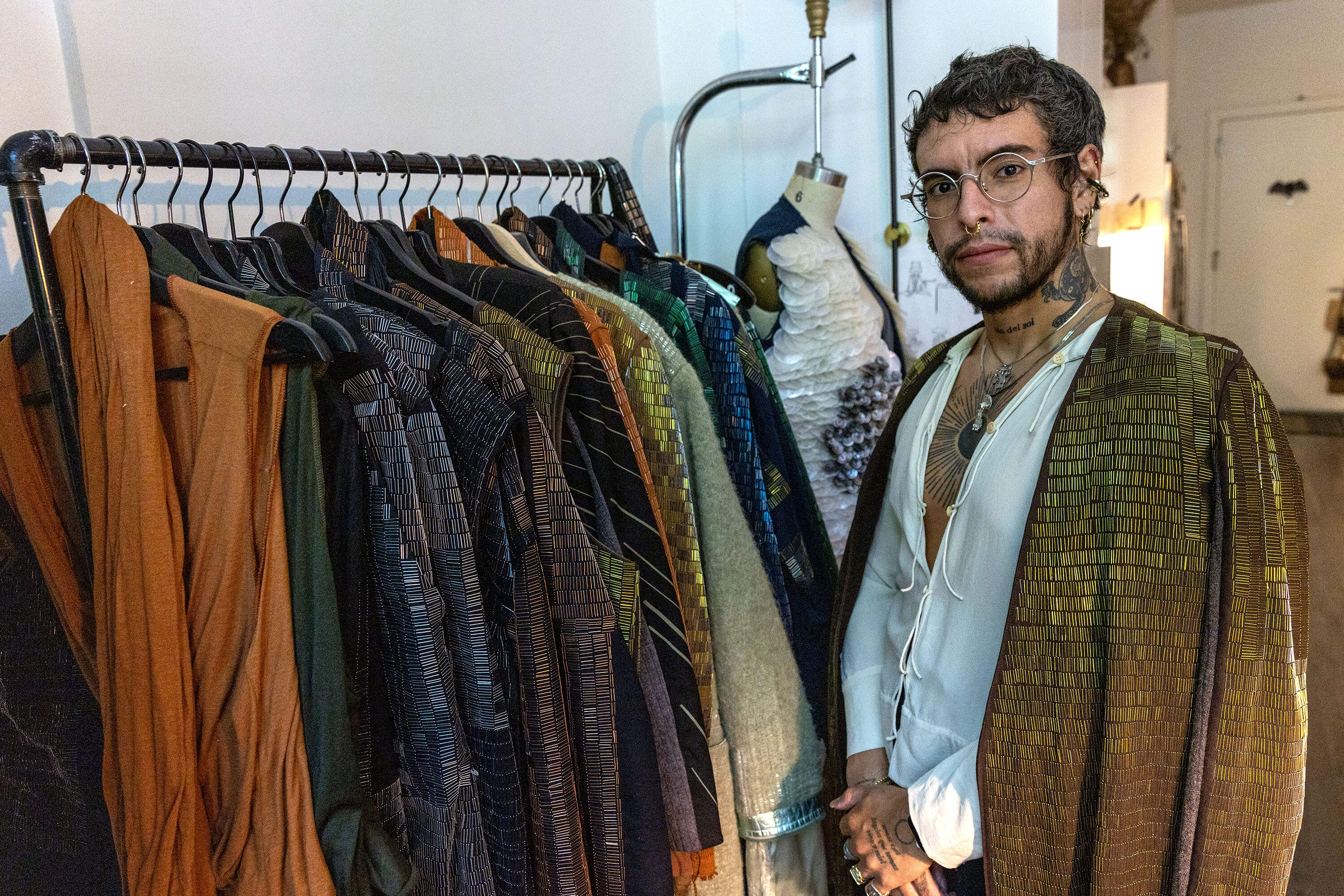 De Restrepo wearing one of his designs at his studio. (Robin Lubbock/WBUR)
De Restrepo’s family came to the States in the 1980s. He says there were certain expectations put on him as a child of immigrants.
“It was always, like, get good grades, go to school, get scholarships, get a job, make a lot of money, get married, have kids,” he said. “All of these things that were fed to them through conditioning and through what the American dream was sold to them to be.”
As an adult, he distanced himself from his family as he tried to find out what he wanted for his life. In a sense, “A Él Mismo” is the most important part on his journey of self-discovery.
“And then there was also the thought process of me thinking, ‘Wow, I get to also live as an openly gay little Latin boy where there were so many generations of my family where people couldn’t — they didn’t have that privilege, they didn’t have that access,’” he said.
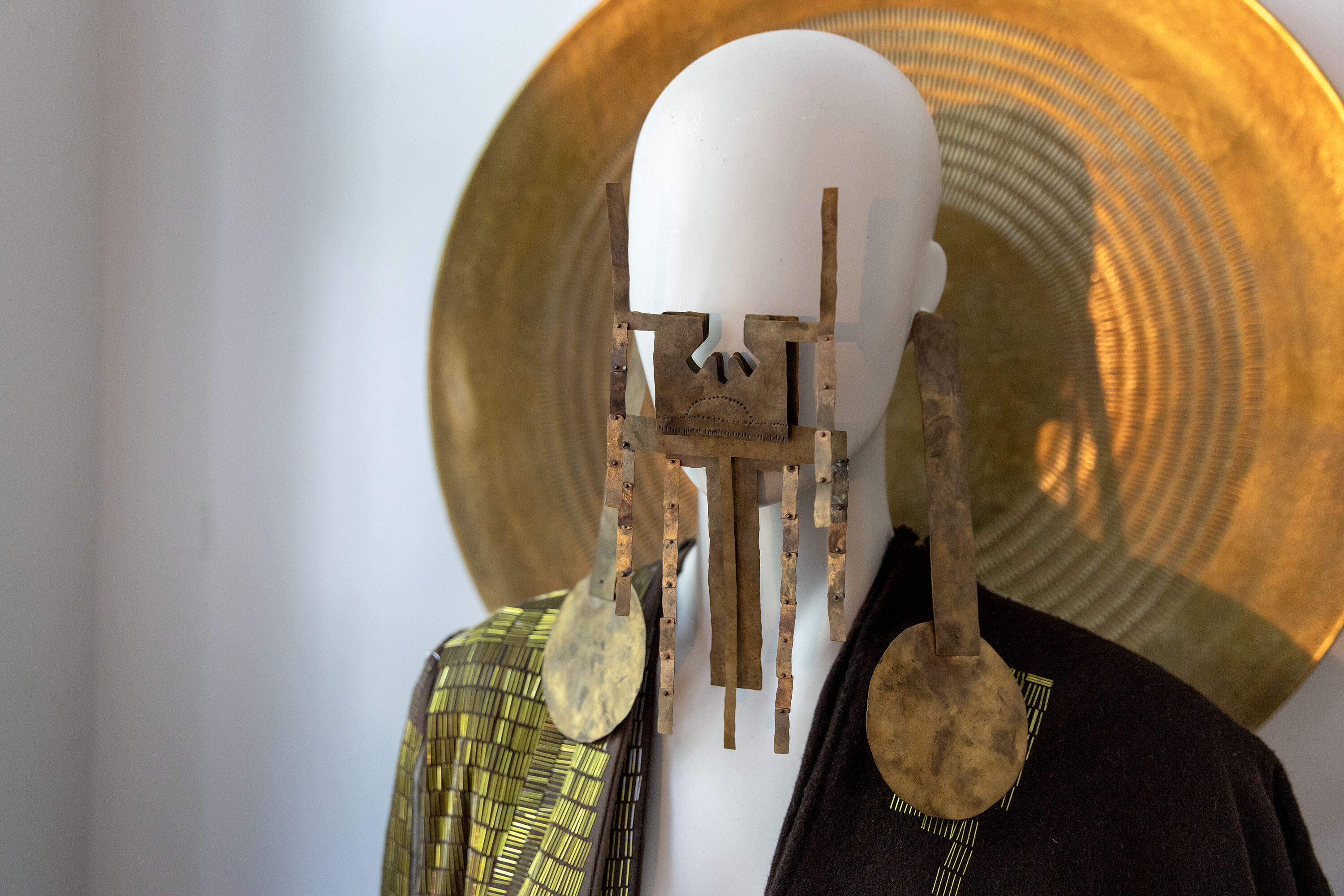 A stapled jacket and mask adorn a mannequin at De Restrepo’s studio. (Robin Lubbock/WBUR)
So he started researching more about the history of Latin America, wanting to learn more about its people and their stories. He focused his work for “A Él Mismo” on Indigenous communities who lived there pre-contact, before Spanish colonization.
“It’s a reimagining of what these various pre-Columbian cultures could grow and look like had they been able to flourish into today, outside of colonization and extraction,” he said.
Each garment or piece of jewelry he creates is inspired by an artifact or story from these communities, particularly pre-colonial Muisca and Tairona societies. He calls the world he is creating within “A Él Mismo” Perdida, named after the archeological site Ciudad Perdida in the Sierra Nevada de Santa Marta in Colombia.
“ It’s a lot of the past that isn’t really taught too much, or it’s glazed over in our education system,” said De Restrepo. “It’s lush and beautiful and tragic stories, but it’s also still very much alive, and I exist because of it, too.”
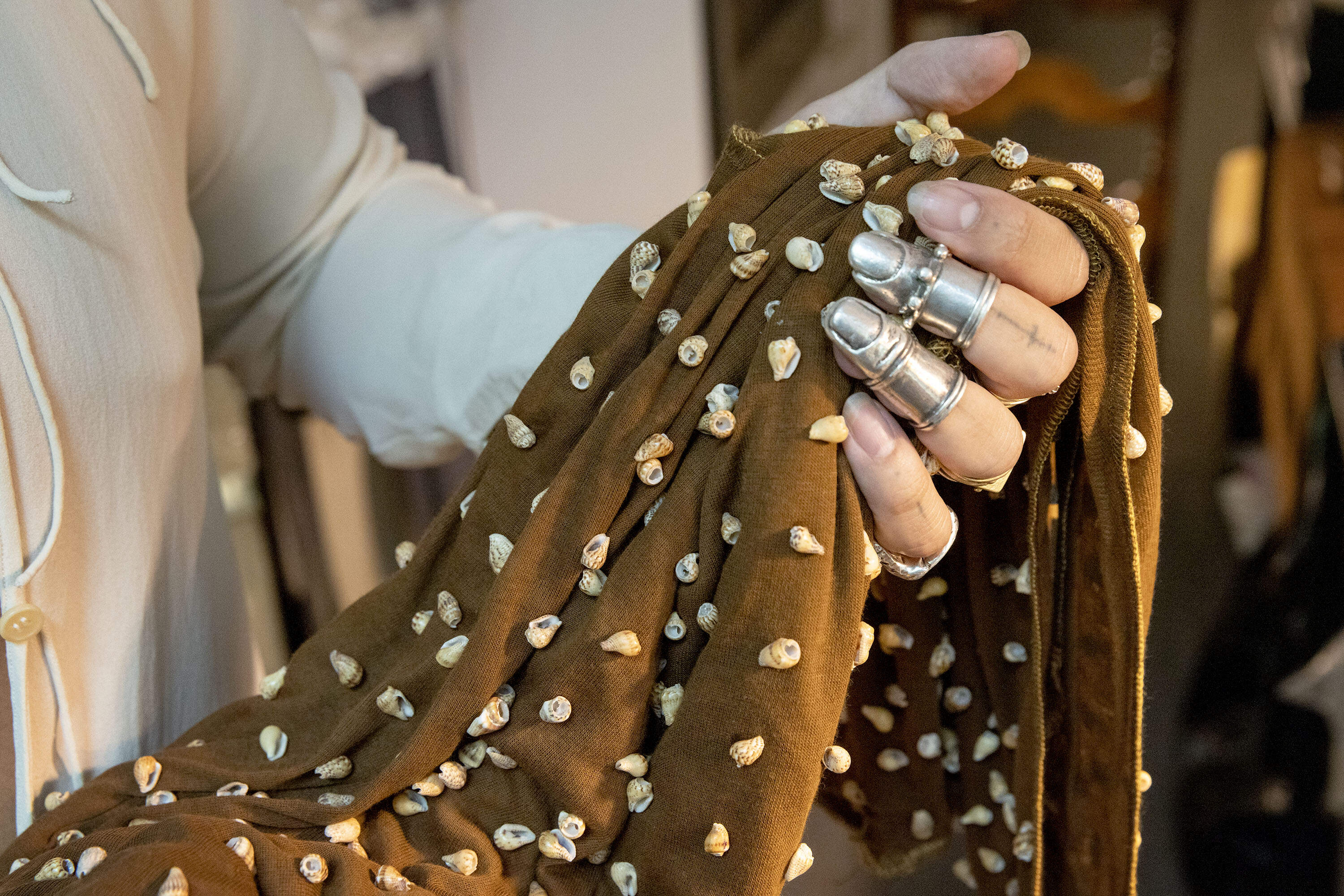 De Restrepo holds material he has decorated with shells. (Robin Lubbock/WBUR)
De Restrepo’s clothing is in beautiful shades of browns, greens and blacks. His jewelry and accessories are often created with different types of metal — an ode to ancestral artifacts, he says, which were made of similar materials. De Restrepo makes distinctive use of staples to create a textured and tactile effect. The staples are important to him — he says they represent a bridge connecting the two sides of his identity. They also exemplify something ordinary that can be transformed.
“The metals that the ancestors were working with were just these mundane materials that they found that they were mining,” he said. “But it is their time, and how they worked that material, that makes it so beautiful and so precious.”
Michelle Stevens helped bring the first public showing of “A Él Mismo” this spring to at the Boston Center for the Arts. She admires how De Restrepo honors the past.
“I really feel like it touches upon the ideas of how every decision our ancestors made, and that were made for them, kind of add up to us existing now,” she said.
The collection ties the history of Latin America with De Restrepo’s own heritage. The connection is particularly visible in a garment he made inspired by the legend of Bachué, considered an origin story of the Muisca people. Bachué is also known as “the grandmother.”
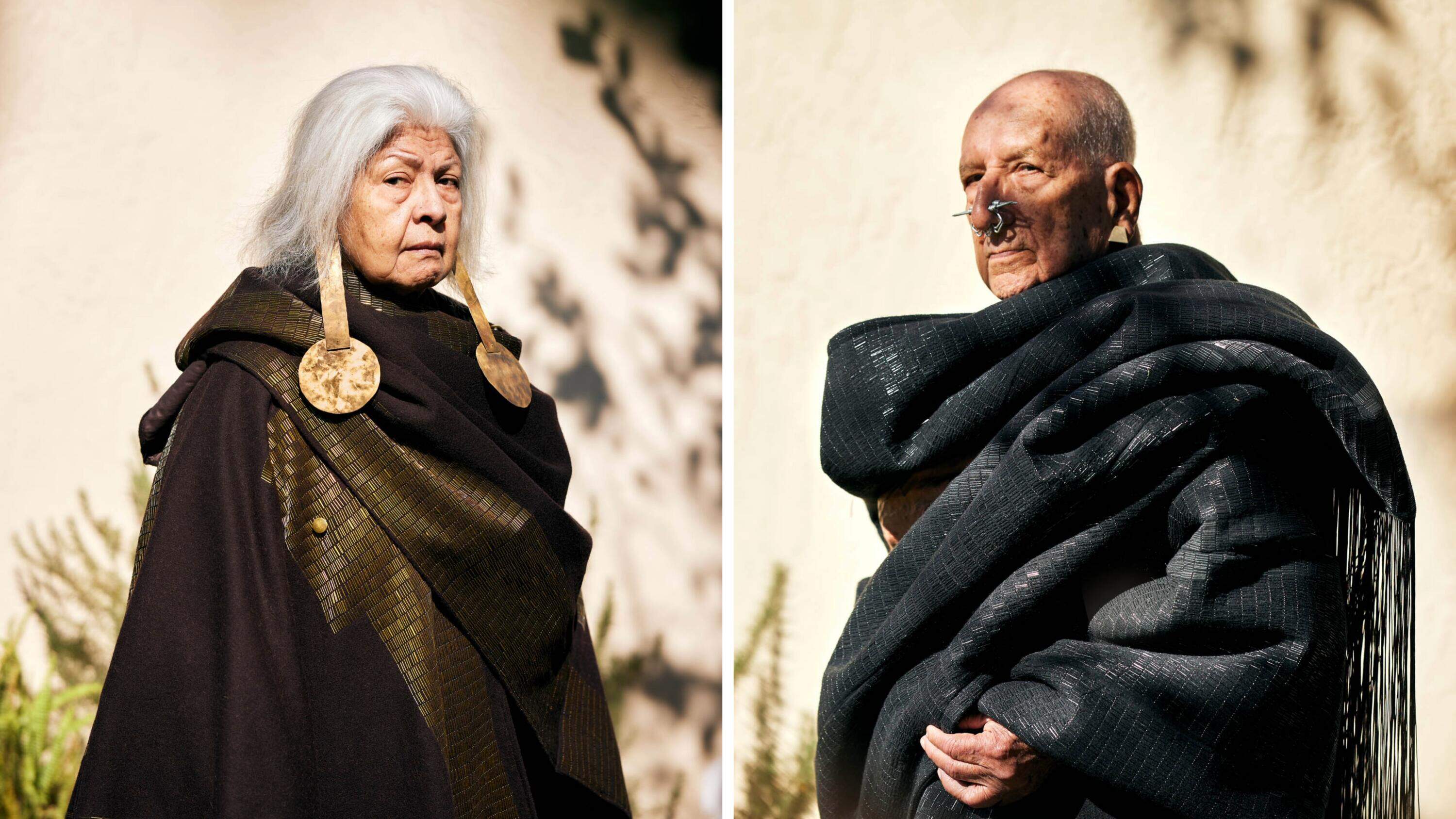 From left: Doña Alba and Don Julio, De Restrepo’s grandparents modeling pieces from “A Él Mismo.” (Courtesy Heather McGrath)
De Restrepo asked his grandmother to model the Bachué poncho for a series of portraits displaying the collection. One of the photos hangs above his workstation, along with a picture of his grandfather, also in a coat he designed. Portraits of his mother and brother also hang in his live/work space. He says there was a cost to distancing himself from them in the past.
“I lost time with them,” he said. “And that’s just something that I’ll never get back. So this project helped me reapproach them, establish a new relationship with them.”
De Restrepo is currently working on part five of the collection. It’s drawn from a trip this summer to Oaxaca, Mexico, the location that inspired part one. He says he’s exploring new materials like mother of pearl and Capiz shells, thin, shiny discs that are commonly used as substitutes for glass. He says each garment presents an opportunity to learn.
“Every expansion of this project gives me the space and time to spend with myself,” he said. “And I’m excited to keep meeting myself.”