
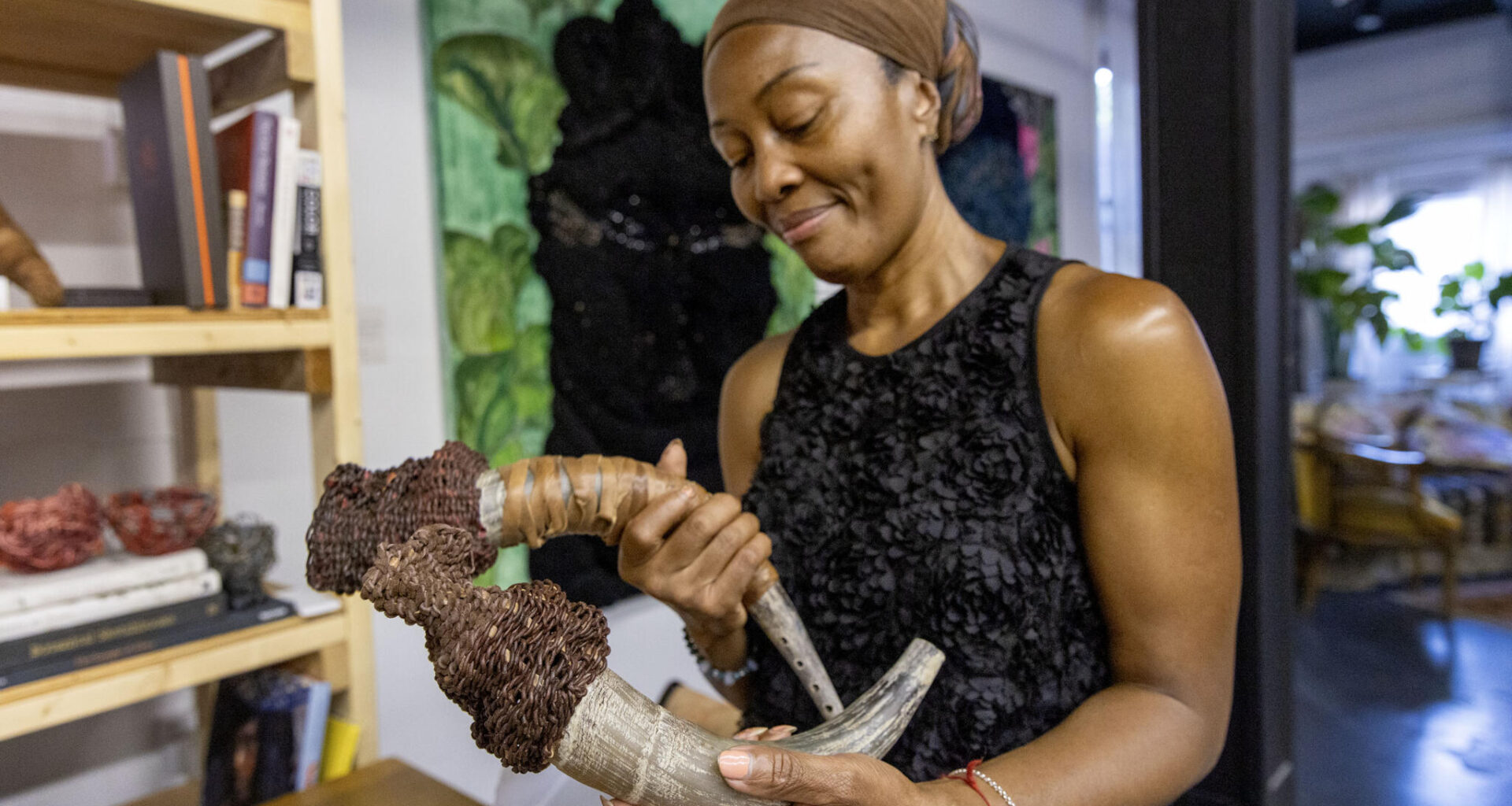
When multimedia artist Zainab Sumu steps into her Somerville studio, she enters a world of her own creation.
The space takes up the entire ground floor of Central Street Studios, a place that Sumu noted used to be a neighborhood grocery store about five decades ago.
She named it Studio Znabu. She also calls it her “sanctuary,” a place where she is surrounded by a trove of artifacts she’s gathered from across the globe.
The Sierra Leone-born artist, who declined to share her age, attended school in Paris, London, and at MassArt in Boston. She also set up shop in Los Angeles, where her boutique fashion store received attention from publications such as Vogue. Of all the places Sumu has lived, she’s spent the most time in the Boston area and considers it home.
In Studio Znabu, there’s the tea set she purchased at a marketplace in Marrakech; a guembri, a Moroccan string instrument that somewhat resembles a banjo, from the Gnawa World Music Festival in 2017; bowls made of calabash, a type of gourd commonly used throughout West Africa, from Guinea; the strips of leather and accompanying cow horns she brought back from a trip to Fouta Djallon, Guinea.
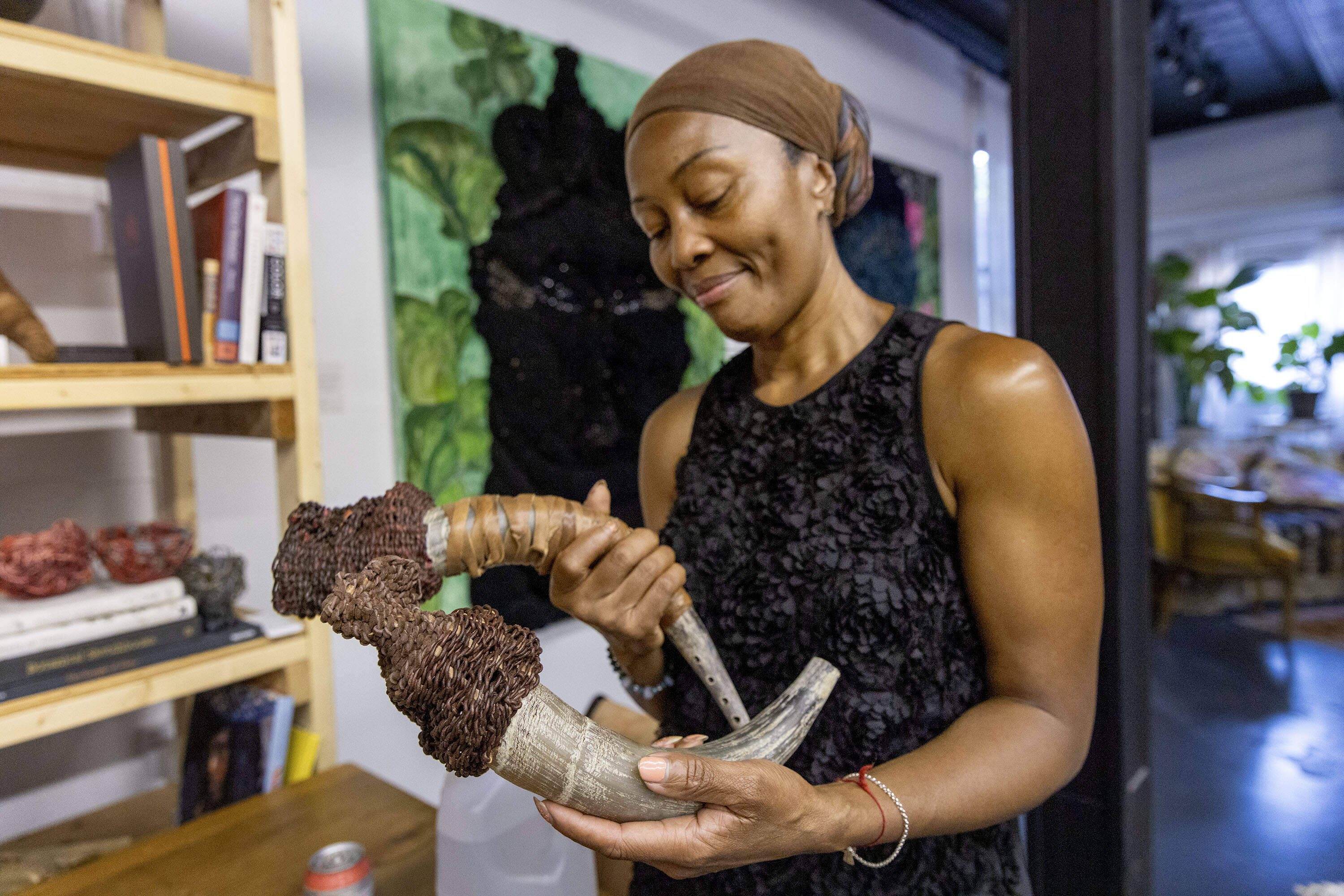 Artist Zainab Sumu examines one of her sculptures made with horn, leather and twined wool, at her studio in Somerville, Mass. (Robin Lubbock/WBUR)
Sumu calls these mementos from her travels her “collaborators.” They are both a source of inspiration and the materials she uses to construct her ornate sculptures.
Her watercolors, sculptural paintings and fiber sculptures are on display in an inviting living room in her studio, where Sumu regularly welcomes guests with freshly brewed Jasmine tea and dinner parties.
A fuzzy, nearly three-foot-tall fiber sculpture sits on one of the tables. Sumu created the object using wet reed and traditional basket weaving methods. She then placed the frame on top of an inverted calabash bowl with more reed, intertwined with rope and yarn to build out a body and expressive facial structure.
Sumu demonstrated how she dips reed in water for a few seconds to make it malleable, then tied and wove it together around the base of the calabash in order to create the framework for one of her sculptures. It’s a practice that requires patience, focus and meticulous handiwork.
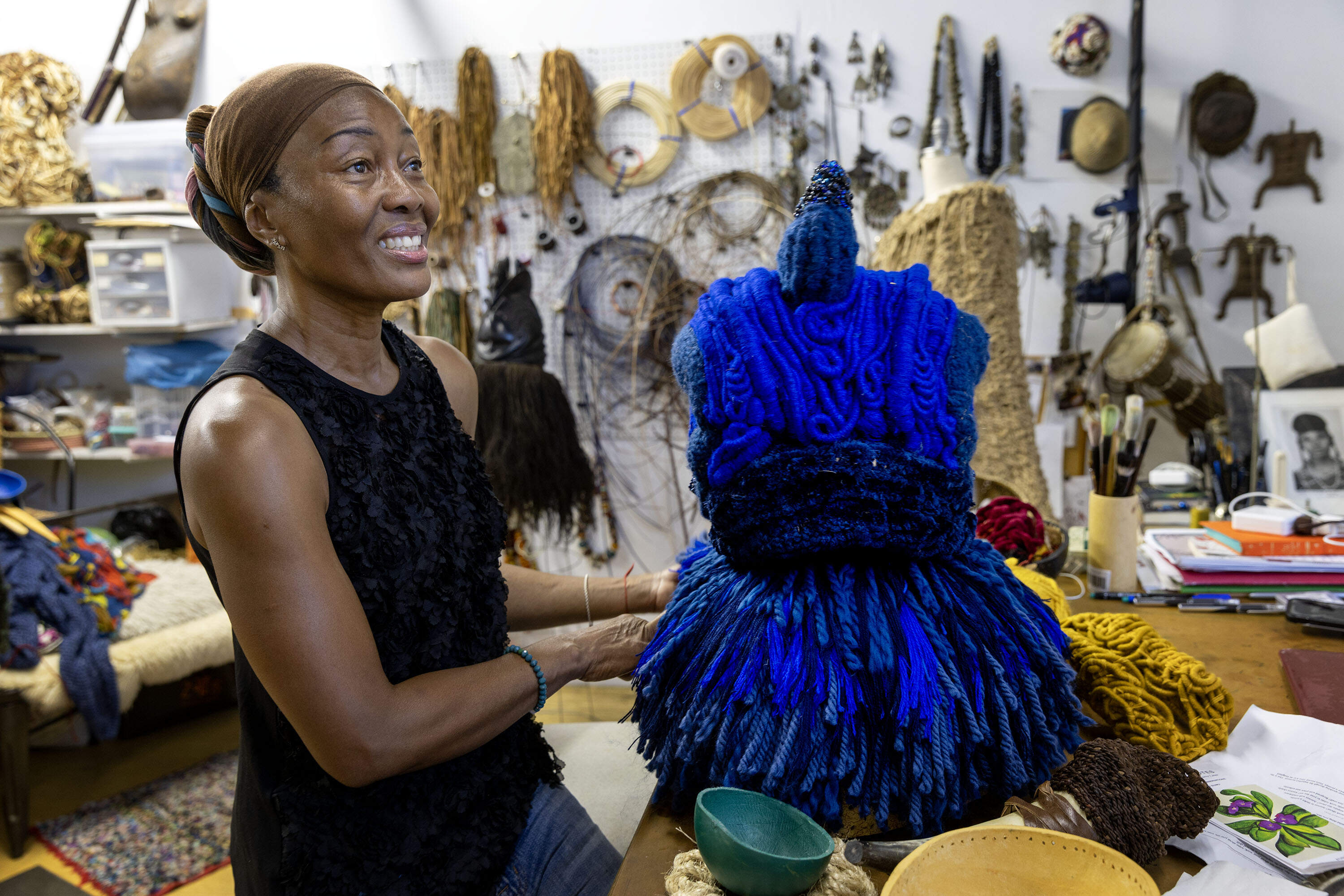 Sumu with a woven sculpture at her studio. (Robin Lubbock/WBUR)
She incorporates traditional techniques and materials into her art as a way for ancestral wisdom to be passed to newer generations and audiences.
“Part of my work is giving contemporary form to African and diasporic traditional knowledge systems and material intelligence,” Sumu said. “And through these objects, through bodies, through rituals, through the cultural practices, it is how those memories, those knowledges, get to be carried.”
The art world has taken notice. Sumu has presented at the Museum of Fine Arts in Boston and the Peabody Essex Museum.
Independent art consultant Kate Chertavian has placed Sumu’s art in private collections. She referred to Sumu as “the great experimenter.” For Chertavian, Sumu’s ability to fuse different interests and cultures is part of what distinguishes her as an artist: “her curiosity about art and anthropology and identity and resilience and African cultures, as well as her curiosity about the American culture and then, layer that with her extraordinary interpretations of woven and fiber materials and textures.”
Chertavian curated David Bowie’s personal collection in the 1990s and 2000s. She said that she had never seen anything like Sumu’s sculptures.
“She takes otherwise disparate objects from her collective life and manages to produce an artwork that fully synthesizes those ideas,” Chertavian noted. “That is very unusual.”
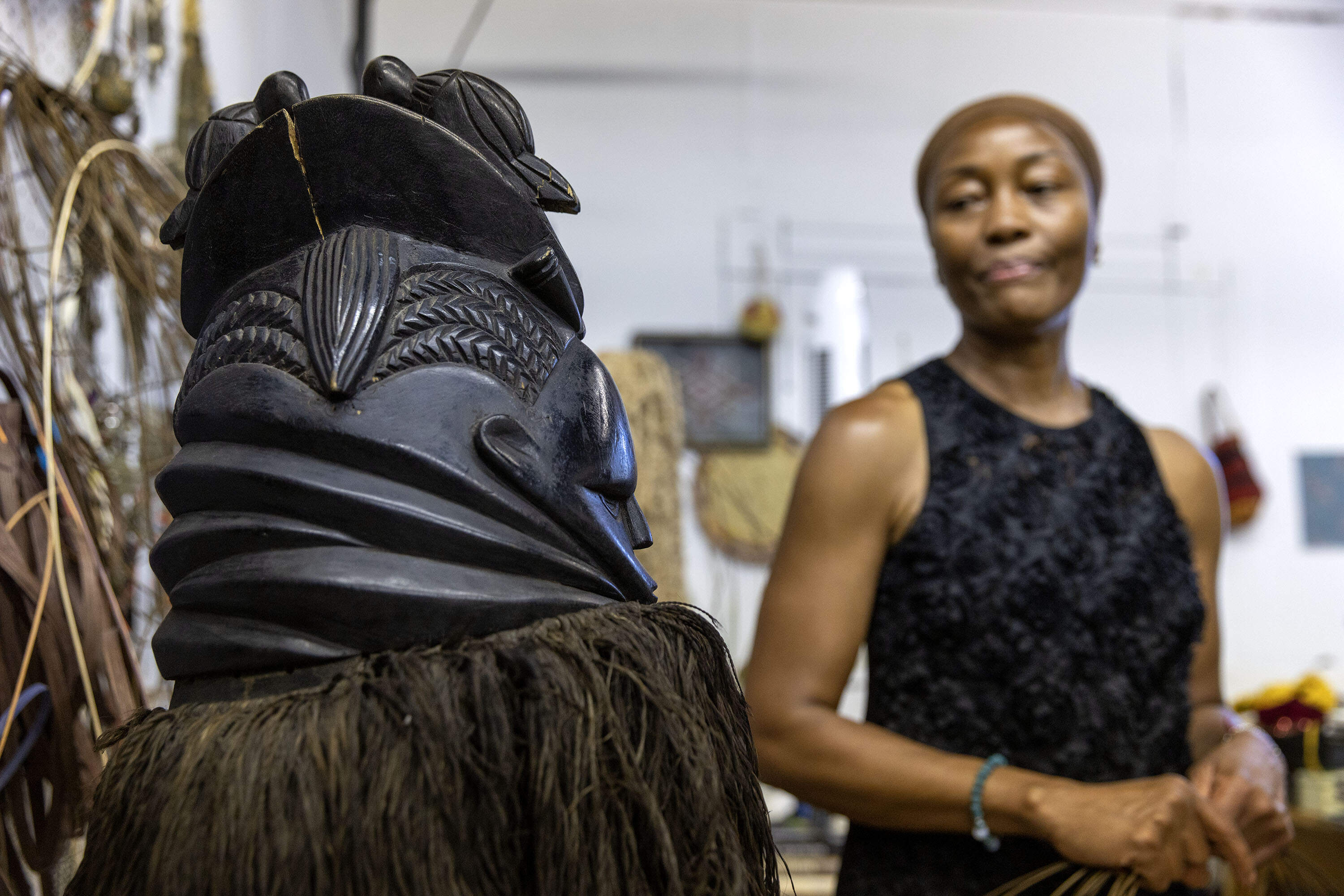 A Sande mask from Sierra Leone at Sumu’s studio. (Robin Lubbock/WBUR)
Much of her current work was inspired by a trip to Sierra Leone at the invitation of the country’s president to meet with younger generations of artists. Sumu’s visit spanned from late 2023 to the summer of 2024, and while there, she was reacquainted with the Sande, an international secret society led by women.
She was shown a helmet-like traditional mask, also known as a Bundu mask, which represents Sowei, the guardian spirit of the Sande. Sumu calls the spirit a conduit between the spiritual and the physical world and the mask a visual representation of feminine beauty.
“ Beauty that is embodied in terms of your character,” she said. “In terms of how you carry yourself, how you comport yourself, how you speak.”
Sumu asked members of the society if she could borrow one of the masks. The sacred object now sits in the workshop area of Studio Znabu, where she experiments with different ways to use it in her art.
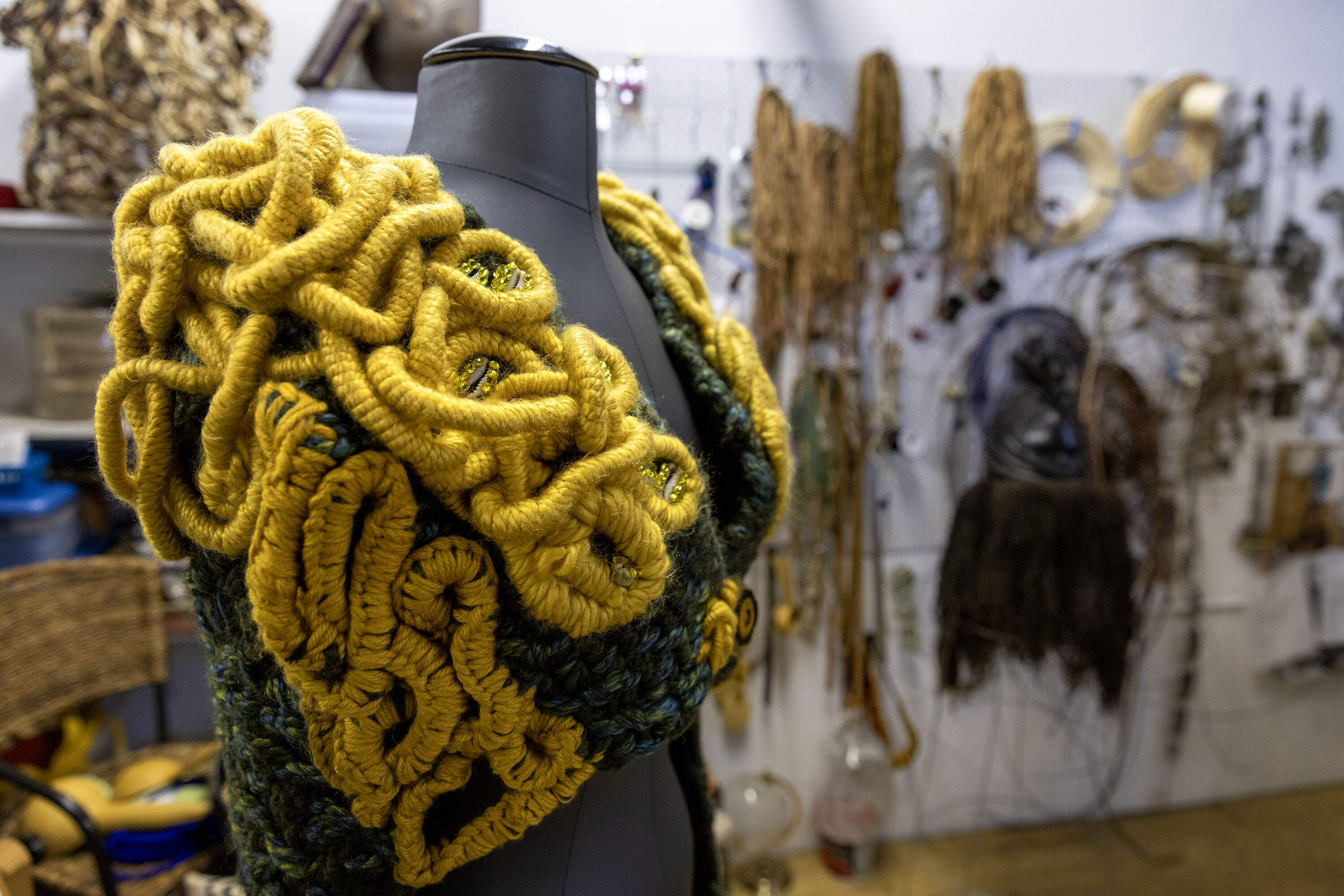 Sumu’s woven wool sculptural couture stands among other artifacts in her studio. (Robin Lubbock/WBUR)
This exploration has resulted in a new series called “Supernal Beauty,” inspired by the many ways women pass down knowledge. Sumu refers to the project as a cosmology in three forms: watercolor; sculptural paintings (three-dimensional works on canvas depicting faces using both paint and yarn); and fiber sculptures made of calabash, reed, rope and yarn.
“ The watercolors represent the spirit, the sculptural paintings represent the land, and these [fiber sculptures] represent the body,” Sumu explained.
Although each of the 20 pieces is inspired by the Sande mask, Sumu said she wants people to walk away from her artwork with a desire to examine items from their own lives.
“ What ordinary objects do you have that now you can look at and notice the extraordinary that they carry?” Sumu asked. “ Often ordinary objects do carry extraordinary meanings.”