
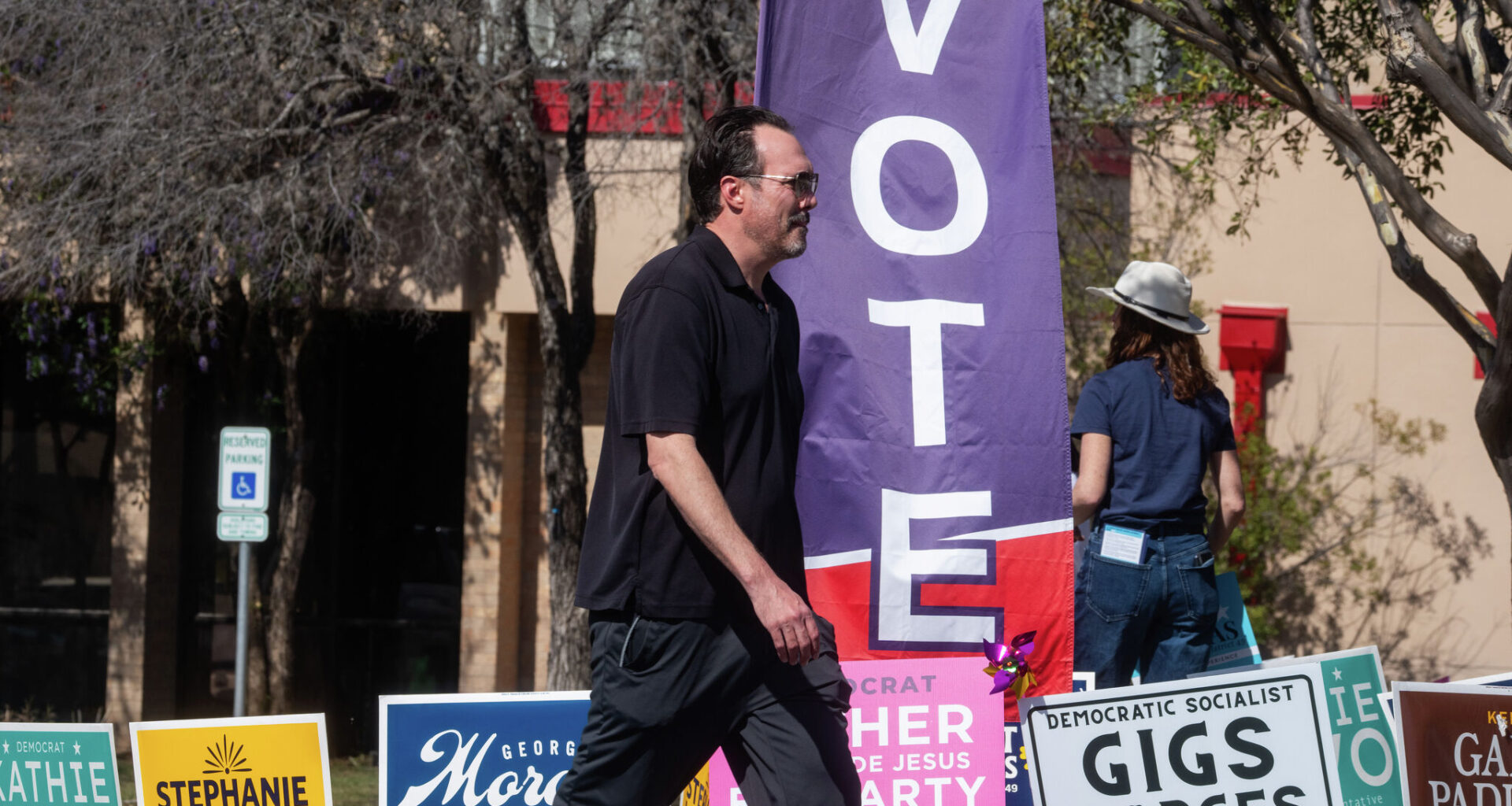
A voter exits the polls at South Austin Recreation Center in Austin Tuesday, March 3, 2026.
Mikala Compton/Austin American-Statesman
For the second time in a matter of weeks, Travis County Clerk Dyana Limón-Mercado’s office has helped block Trump administration rules that would have required local election officials to change how they administer elections ahead of November.

The latest case ended Monday, when U.S. District Judge Amir Ali struck down five election-related conditions the Federal Emergency Management Agency placed on its roughly $1 billion Homeland Security Grant Program, ruling that the agency went beyond the authority Congress gave it. The rules could have put roughly $666,500 in Austin-area counter-terrorism funding at risk unless state and local officials agreed to replace barcode-based voting systems with systems using hand-marked paper ballots, expand manual audits and conduct new citizenship checks of registered voters and election workers.
Article continues below this ad
Travis County argued those changes would have cost up to $15 million, required more election workers and interfered with procedures already required under Texas law. The Travis County Clerk’s Office, which administers elections in the county, said it took the lead locally in pursuing the case, by approaching county commissioners and working with them and the County Attorney’s Office to join the lawsuit.
The case came less than two weeks after another federal judge blocked separate Trump administration rules governing mail ballots. Those U.S. Postal Service rules would have required new ballot-envelope designs and limited delivery of mail ballots based on federally prescribed voter lists and barcodes. Limón-Mercado told the court that Travis County had already spent more than $21,000 on envelopes that would no longer comply. The U.S. Supreme Court later allowed that injunction to remain in place.
In both cases, federal judges cited evidence from Travis County about the cost and disruption of changing election procedures shortly before the Nov. 3 election.
“Twice my office and Travis County have joined a national lawsuit to halt the Trump Administration’s unconstitutional attempts to strong arm elections policy, and twice now a federal judge has sided with us that these attempts are illegal and ill-timed,” Limon-Mercado told the American-Statesman. “Travis County residents should feel confident that our office will continue our local tradition of operational excellence and unwavering commitment to democracy — even in the face of these federal actions.”
Article continues below this ad
Travis County Clerk Dyana Limon-Mercado talks to reporters during logic and accuracy testing for the Nov. 3 Joint General and Special Elections on Monday, Sept. 14, 2026, at the Travis County Clerk’s Office in Austin. The public testing verifies that ballots are programmed correctly and that voting equipment tabulates votes accurately before the election.
Jay Janner/Austin American-Statesman
The two cases are part of a broader push by the Trump administration to use executive authority and federal agencies to reshape election administration, an approach election law experts have said raises questions about how far the federal government can go without congressional approval. Courts have blocked several of those efforts, including the Postal Service and FEMA rules challenged by Travis County.
Travis County has emerged as one of a relatively small number of local governments challenging those efforts in court. In the mail-ballot case, Travis County and Madison, Wisconsin, were the local government plaintiffs alongside several advocacy groups. In the FEMA case, Travis County is one of six city or county governments suing the administration.
Travis County joined the FEMA lawsuit Sept. 1 with Dallas County, about two weeks after local governments in Harris and El Paso counties, Nashville and Columbus, Ohio, first challenged the requirements.
Article continues below this ad
Counterterrorism funding under threat
The Austin area was allocated $3.33 million through the Urban Area Security Initiative, a federal grant program that funds regional terrorism preparedness in major metropolitan areas. The money was to be shared among local governments for equipment and training, including an ambulance bus, ballistic helmets, bomb-squad robots and emergency operations upgrades in Austin, as well as an armored tactical vehicle for the Williamson County Sheriff’s Office.
FEMA would have withheld 20% of the Austin-area grant until the election conditions were met — around $666,500.
Travis County, which was allocated $260,975, said its share of that holdback — $52,195 — would have reduced a public-education campaign and prevented planned purchases of security equipment.
Article continues below this ad
FEMA’s demands would have cost millions
FEMA’s rules would have required grant recipients to submit plans to move away from voting systems that use barcodes or QR codes to count votes and toward equipment that accepts hand-marked paper ballots. Recipients also would have had to conduct a 5% manual audit, reconcile voter and ballot counts and use the federal SAVE system to verify the citizenship of registered voters within 120 days.
The agency also required citizenship checks for people working at polling places or operating election systems. FEMA said the requirements were intended to address vulnerabilities that could be exploited by terrorists or foreign actors and prevent sabotage, infiltration or foreign interference in election systems.
Travis County election technician John Luke sets up voting machines at a polling place at the Travis County Clerk Office in Austin Thursday, Oct. 16, 2025.
Jay Janner/Austin American-Statesman
For Travis County, the most expensive change involved its voting equipment. The county spent about $8 million on the electronic ballot-marking devices used in its current system in 2018 and now deploys more than 2,000 devices across roughly 200 polling places. The equipment was expected to last at least a decade, but county officials reserved as much as $15 million in case FEMA’s rules forced a transition that could require new printing capacity, equipment distribution and poll-worker retraining.
Article continues below this ad
The county already conducts post-election hand-count audits, including counts of just under 5% of ballots in the 2025 constitutional amendment election and 2026 primary under changes enacted by the Texas Legislature. The County Clerk’s Office said FEMA’s requirement would have mainly meant changing existing audit procedures with little notice while still complying with state law.
Texas law also requires poll workers to be U.S. citizens, but the Clerk’s Office does not currently run them through the federal SAVE database. In the lawsuit, the county said creating a new process to verify the citizenship of poll workers and vendors who work on or with election systems would carry significant costs.
The county had not begun buying new voting equipment or implementing the requirements because of the cost and disruption of making changes so close to the election, the Clerk’s Office said.
The rules exceeded FEMA’s authority
Ali ruled that Congress authorized FEMA to fund counterterrorism projects, not to condition that money on unrelated election changes. He vacated the five requirements, the 20% holdback and FEMA’s compliance guidance.
Article continues below this ad
The ruling did not eliminate FEMA’s broader election-security funding requirements. For example, a rule requiring governments to spend at least 3% of their Homeland Security Grant Program money on physical and cybersecurity investments for elections remains in place and was not challenged in the lawsuit. In Travis County, federal homeland security grants have previously paid for mobile panic buttons at county polling places and training to prepare election workers for threats, according to the county’s court filing.
Ali cited Travis County twice in his ruling, pointing to Limón-Mercado’s warning that FEMA’s new audit requirement could interfere with the county’s ability to complete audits already required under Texas law. He also cited the county’s evidence that complying with FEMA’s citizenship-verification requirement for election workers would impose “significant costs.”
Victoria Barton, the associate administrator for FEMA’s Office of External Affairs, said FEMA would comply with the court’s order and was reviewing it.
“The ruling does not affect FEMA’s broader mission to support state and local partners in preventing, preparing for, protecting against, and responding to terrorism, including through eligible physical and cybersecurity investments that protect election infrastructure,” Barton said.
Article continues below this ad
The FEMA rules were not the administration’s first attempt to require some of the same changes. Legislation requiring documentary proof of citizenship to register to vote passed the U.S. House in 2025 but stalled in the Senate, and renewed efforts remained unsuccessful this year.
Trump also directed the U.S. Election Assistance Commission in 2025 to rewrite federal standards to move voting systems away from barcodes and QR codes, but a federal judge in January 2026 ruled that he lacked authority to dictate those standards and permanently blocked the directive. Months later, FEMA tied access to counterterrorism grants to a similar transition away from barcode-based voting systems.