
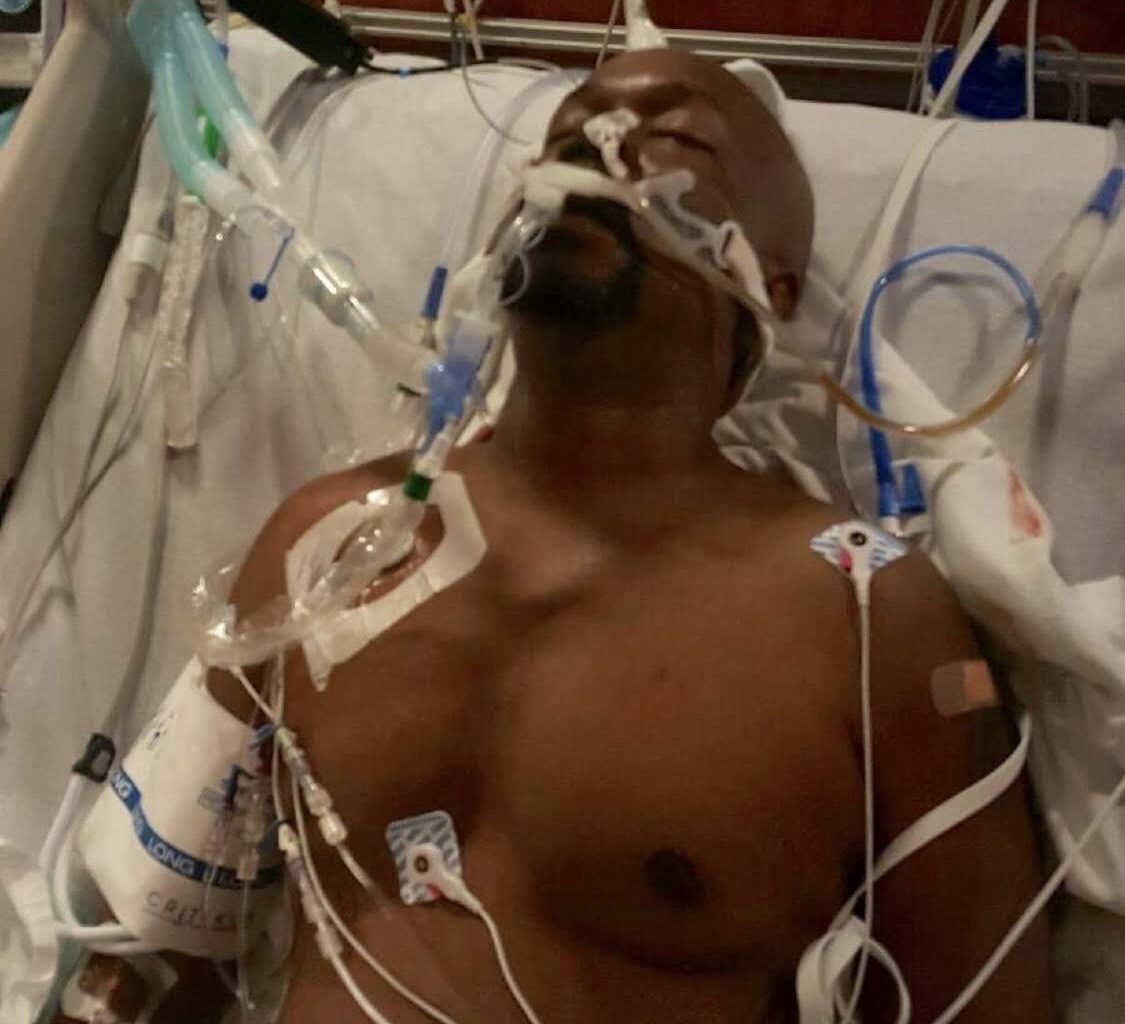
André Greene was in a medically induced coma at St. David’s South Austin Hospital after a pickup struck him during a bicycle training ride in July 2016.
Photo courtesy of André Greene
André Greene is sworn in as a member of the city of San Antonio’s Multimodal Transportation Commission in December 2025.
Photo courtesy of André Greene
André Greene poses for a photo in front of San Fernando Cathedral during a bike ride in downtown San Antonio.
Photo courtesy of André Greene
In March 2017, André Greene, center, poses for a photo at the Alamo Head Injury Association annual brain injury symposium.
Photo courtesy of André Greene
André Greene rides a VIAtrans Paratransit for a day of substitute teaching at a local school. Greene plans his travel routes the night before going to work. VIAtrans is a shared-ride paratransit service option for customers who can’t use regular bus service because of a disability.
Photo courtesy of André Greene
On July 14, 2016, just after 5 a.m., André Greene set out on his bicycle to train for the Ironman Austin 70.3 triathlon. A pickup, traveling 60 miles per hour, struck him from behind on an access road between San Marcos and Austin.

He doesn’t remember the crash. He doesn’t remember the sound of screeching tires or pain as his body struck the ditch. He doesn’t remember standing amid smashed bicycle parts, staggering several yards before collapsing into the grass.
Article continues below this ad
A 22-year veteran of the Air Force, Vincent T. Davis embarked on a second career as a journalist and found his calling. Observing and listening across San Antonio, he finds intriguing tales to tell about everyday people. He shares his stories with Express-News subscribers every Monday morning.
Greene learned these facts later from a police report and witnesses who came to his aid. Three minutes after the accident, EMS responders arrived and transported him by helicopter to St. David’s South Austin Medical Center. The 25-year-old man who hit Greene called for help and stayed with him. Police considered it an accident and the man wasn’t charged.
Greene, who was a peak-form triathlete, suffered a traumatic brain injury and vocal cord paralysis. His left toe is paralyzed and surgeons had to remove pieces of glass from his legs.
He was put in a medically induced coma for a month.
Article continues below this ad
Family and friends traveled to be at Greene’s side, praying for the former high school prom king and speech and debate champion.
“Everything seemed like broken pieces,” said Greene, 53. “But once you put them all together you realize you have a beautiful story to tell.”
‘It was a miracle’
Ten years to the day of his life-altering accident, Greene self-published his memoir, “Keep Calm & Live On – This Wasn’t the Life I Planned For, It’s the One I Fought For.”
Article continues below this ad
“I couldn’t keep it to myself,” Greene said. “It was a miracle meant to be shared.”
Speaking about accessibility for those with disabilities has now become his mission. Greene serves on the city of San Antonio’s Multimodal Transportation Commission and advises city officials on accessibility standards, inclusive civic planning and infrastructure.
With help from the nonprofit disABILITYsa, he’s been a substitute teacher for the past three years. Greene has a master’s degree in political science from Jacksonville State University and a bachelor’s degree in mass communications from Bethune-Cookman University.
His past roles include assistant director of residence life/marketing and conference services at St. Mary’s University.
Article continues below this ad
Before the accident, movement defined his life. He got up before dawn to run, swam against strong currents and rode his bike for miles on open roads. Before the crash, Greene had run several sprint triathlons, 11 half marathons and regularly cycled the 70-mile roundtrip from San Marcos to Austin and back.
Ten years ago, when medics wheeled Greene into the hospital, a miracle awaited – Dr. Davida Manor, his high school prom date, and her husband had rushed to the emergency room when they heard about the crash.
Manor, an ER physician, became his voice. She was able to explain what was going on to his family members and speak the same language to the doctors about his treatment. “They treated me as someone who took care of his body,” Greene said.
After weeks on a ventilator that breathed for him, Greene slowly opened his eyes. His body didn’t respond to his thoughts, and his voice didn’t have a sound. Medical and rehabilitation teams helped Greene with short-term memory and speech therapy.
Article continues below this ad
His initial therapy took place in Austin at Texas NeuroRehab. Weeks later, his mother, Eleicia Eva, took him for treatment in Clearwater, Florida, not far from St. Petersburg where his grandmother, Ethel Eva, raised him from middle school to high school.
Eva, a petite woman and a pillar of the neighborhood who often rode her three-wheeled bicycle near the beach, inspired Greene’s love of biking.
‘You’ve got this, Dre’
When Greene returned from Florida to San Antonio, Brett and Jessica Cortese, friends from St. Mary’s University, became his caregivers. At NeuroRestorative, he pushed his body through exercises in the gym where the smell of cleaning supplies and rubber mats filled the room.
Article continues below this ad
It took him two months after the accident to walk without aid. It took him three years to ride a bike again.
“Not being in control of your own time is the biggest theft of a disability for me,” Greene said.
Social media and technology became lifelines. His Facebook page opened his life to the world. People donated to help pay medical bills. When his confidence flagged, followers sent uplifting messages.
“Praying for you, Dre.”
Article continues below this ad
“We’re still here.”
“You’ve got this, Dre.”
The artificial intelligence chatbot ChatGPT helped him write about his recovery. A Google voice assistant did tasks such as switching on lights, playing soothing music and helping him cook again.
The device helped him overcome his fears and return to cycling. He now rides an e-bike, purchased with help from disABILITYsa and the city’s sustainability department. A smart communications bicycle helmet broadcasts music and GPS navigation during his rides.
Article continues below this ad
Chevelle Freeman, the sister of Greene’s close friend Cynthia Freeman Gibbs, gave Greene a virtual reality headset that changed his life. It became part of his healing, allowing him to cybernetically travel the world.
Gibbs said faith kept Greene going during the tough times
“He has this determined spirit as a competitor,” Gibbs said. “He knew nothing, his brain was completely empty. He’s smarter than before the accident.”
‘I felt seen’
Greene credited Gibbs and her husband, J. Maurice Gibbs, for helping him rediscover his faith. On Sundays, he’d accompany them to Resurrection Church in Schertz, having heartfelt conversations during the drive.
Article continues below this ad
In his book, Greene recounts how he was moved during a service when the pastor’s sermon focused on dreams. Greene said he had been writing about how he never seemed to dream — or if he did, he couldn’t remember them.
As the pastor spoke, tears began to fall from Greene’s eyes.
“It felt as though God was speaking directly to me through him,” Greene said. “It was a reminder of something I thought I had lost. And for the first time, I felt seen in a struggle I had never fully shared with the world.”
Article continues below this ad