
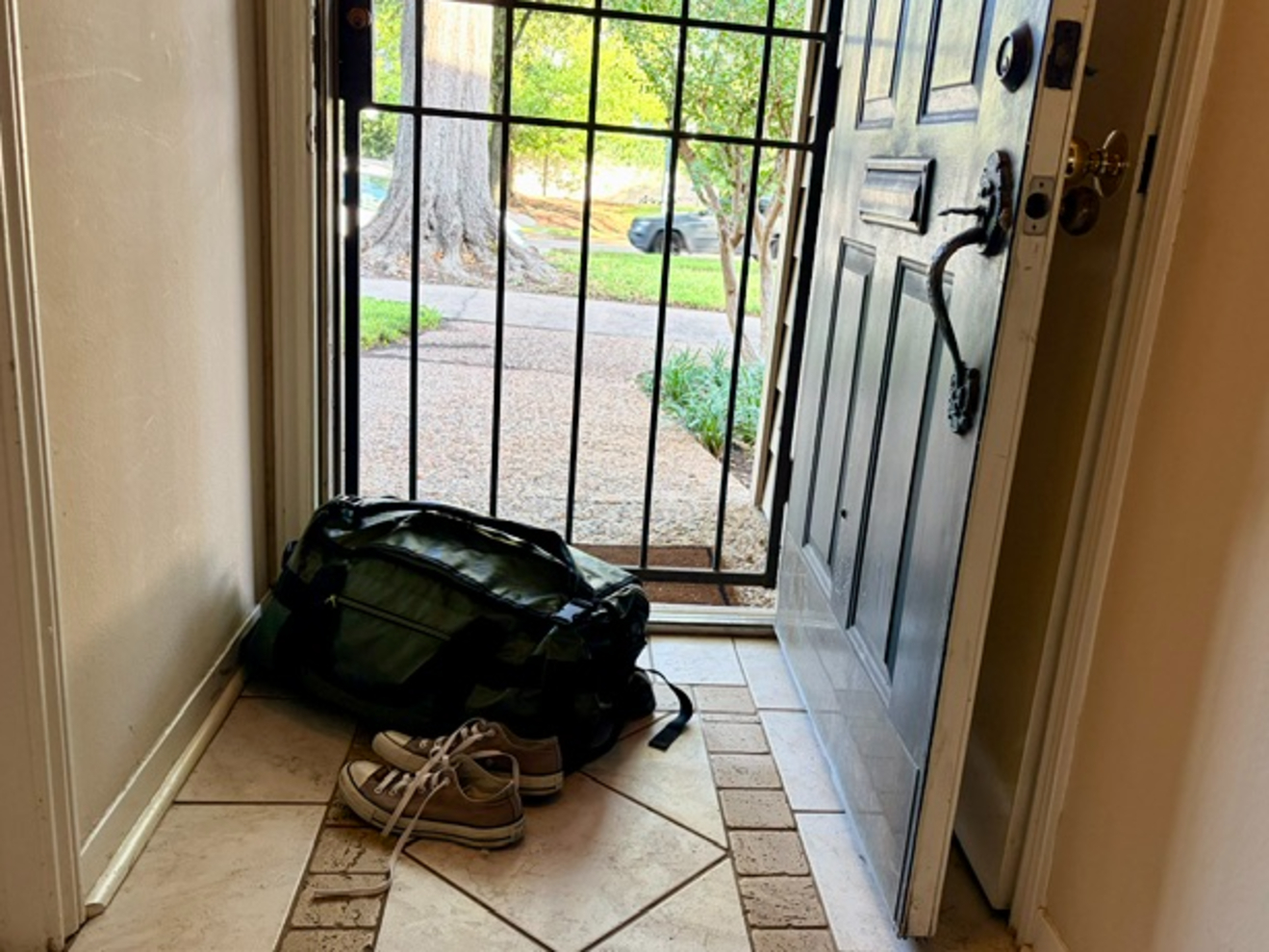
Sandra Aguilar’s mother lived as a prisoner in her Second Ward rental house for more than a decade. Aguilar (not her real name) saw the bruises on her mother’s face and arms and heard the stories of how her stepfather would punish his wife by withholding food and water, telling her that if she tried to leave, he’d have her picked up by ICE.
Aguilar pleaded with her mother, an undocumented immigrant with no criminal history, to call 911 or go to a shelter. Her mother refused, saying calling the police would certainly secure her a bunk at a detention center and the eventual deportation back to Mexico.
In June, Aguilar’s mother boarded a plane to another state, where Aguilar says immigration enforcement is even more aggressive than in Houston, to live with relatives. The nightmare isn’t over — Aguilar’s mother could still be picked up by ICE — but she’s alive and away from her abuser.
“I cry every day for my mother,” she says. “I don’t know when I’ll see her again.”
Aguilar, 24, met with more than 100 people at Ecclesia church in downtown Houston last week to pray and share experiences. Participants at the gathering, hosted by newly formed national coalition Connected Americans, identified themselves as U.S. citizens who have been affected by immigration enforcement. They say they are the sons, daughters, spouses and neighbors of the undocumented who feel helpless and isolated as their loved ones have either been taken away or are living in fear.
Several Houston nonprofits that provide resources for people in domestic violence situations confirmed last week that, since President Donald Trump began his second term last January, undocumented survivors are hesitant to call for help for fear they’ll be turned over to immigration authorities.
Those who do make the call are turned away from long-term housing solutions funded by HUD grants. Those who are bold enough to show up in family court to fight for custody of their kids run the risk of being detained by an ICE agent hoping to meet a quota.
Sure, there are workarounds. Domestic violence shelters don’t ask about immigration status but they’re frequently at capacity. Harris County nonprofits can use local funds to put someone up in a hotel for a few nights. However, those solutions are temporary.
Harris County nonprofit leaders say they don’t have final stats for the 2025-26 fiscal year and can’t say whether the reduction in calls from undocumented immigrants is being offset by more requests from people who are documented. Based on anecdotal evidence and reports from field advocates, they know that a genuine fear of detention and deportation exists among the immigrant community.
Advocates and extensive research say domestic abuse isn’t something that just goes away. Two-thirds of homicides against women by an intimate partner involve a known, documented history of prior abuse between the parties, according to the Texas Council on Family Violence. Harris County law enforcement and support groups receive up to 80,000 domestic violence calls annually, and the Harris County Sheriff’s Office notes that up to 35 percent of all homicides are tied to family violence.
Amy Smith, senior director of operations and communications for the Harris County Domestic Violence Coordinating Council, says abusers have, for years, been holding partners hostage because of their immigration status.
“Way before this administration, that was one of the power and control tools that an abuser used against a victim if the victim was not documented and their citizenship was tied to their abuser,” Smith says. “They would say, if you leave me or divorce me, you’re not a citizen anymore and I’ll make them take your green card away. That’s always been a threat. Now, the abuser can not only use that, but you see it in real time. People are getting deported regardless of whether they were even on ICE’s radar.”
Over the past year and a half, regulations on federal grants have tightened, and, in order to receive those dollars, nonprofits have to sign a statement saying they will “follow immigration laws,” Smith says. “A lot of agencies have chosen not to sign that statement, and by doing so, they have chosen not to apply for federal grants,” she says.
The Council gets most of its funding from the U.S. Department of Housing and Urban Development for a rapid rehousing program that covers rent and utilities for domestic violence victims for up to two years. Undocumented men and women are ineligible because of the new federal mandates. They also can’t receive crime victims compensation — which covers relocation funds, medical bills and counseling — if those dollars are tied to a federal grant.
Additionally, in years past, domestic violence victims didn’t get entered into a database for public housing recipients because they were exempt under the Violence Against Women Act.
“Their information is supposed to be confidential,” Smith says. “Now the government has decided that they need to be entered into that. It’s on a case-by-case basis with the city and the county whether they can exempt someone.”
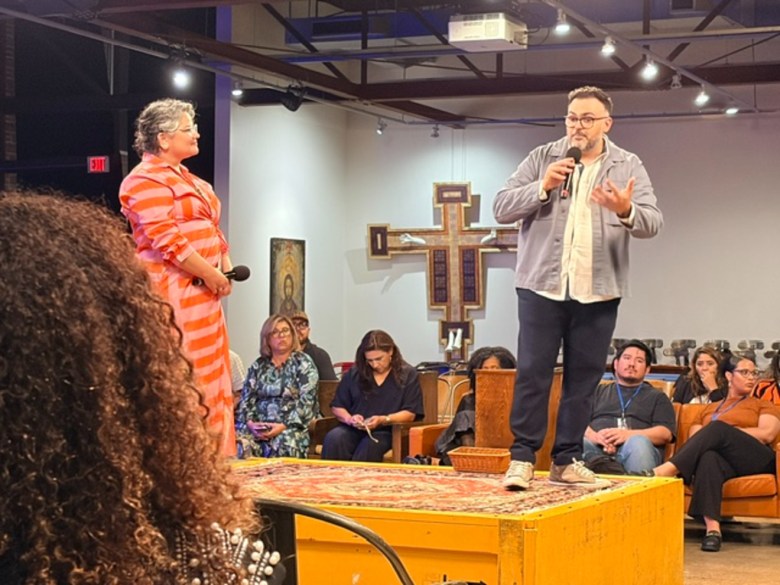 Children, spouses and neighbors of undocumented immigrants gathered on October 2 at Ecclesia church to share stories of how their loved ones are living in fear of ICE. Credit: April Towery
Another Houston nonprofit, Aid to Victims of Domestic Abuse, primarily represents domestic violence victims in family court. About 28 percent of AVDA’s clients are undocumented immigrants. That number dropped by 50 percent in 2017, when Trump took office for his first term, and CEO Maisha Colter says “we’re afraid that’s going to happen again.”
“We won’t run those numbers until the end of this year but we do see a downward trend,” she says.
Colter adds that people experiencing abuse ought to be protected under the Violence Against Women Act, a federal law that “essentially says you prioritize the crime of domestic violence over anything related to a person’s status.”
“If someone comes to us and they’re qualified based on the fact that they are a victim of domestic abuse, we serve them,” she says. “That hasn’t changed. What has changed in this recent administration is that when you get a VAWA grant, it imposes these rules that say you won’t protect someone because of their status.”
“You can help them, but you can’t preclude any type of intervention on the part of the federal government,” she added. “In this particular climate, going to family court can make someone a target because it’s an easy place to access [undocumented] individuals. We can’t stop someone from entering a courthouse, making an assessment about an individual and picking that person up.”
There’s always been a risk that speaking out about domestic violence could result in harm from the abuser, Colter says, but now the risk is elevated to “government-sanctioned harm,” and if someone appears in court for a custody hearing, they could be nabbed by an ICE agent. Colter says she’s seen it happen.
“We had a client who was named sole managing conservator of her children and the person on the other side was precluded from having access other than supervised visits,” Colter says. “He knew her status. He called the authorities. She was subsequently picked up. She was put on an ICE hold and it took a long time to get her out of custody. That’s the sort of climate that now has more bite and more consequences.”
According to Smith, there’s no sugarcoating how domestic violence nonprofits found themselves facing more barriers specifically related to assisting the undocumented. It happened during the first Trump administration, and it’s happening again. “It’s going to get worse before it gets better,” she says.
A Reduction in Calls
The Harris County Domestic Violence Coordinating Council’s annual budget is $11.6 million. About $2.4 million comes from the county, through the Domestic Violence Assistance Fund, and that allocation is then distributed by the Council to 19 nonprofits.
State grant funds go toward a special victims prosecution unit and protective order project in the district attorney’s office. That leaves a big chunk of domestic violence support services to be funded by private donors and the United States government.
Harris County District Attorney Sean Teare and County Attorney Abbie Kamin announced last week the launch of a Protective Order Extended Team whose members will meet with domestic violence victims “where they are,” rather than requiring them to come to the courthouse.
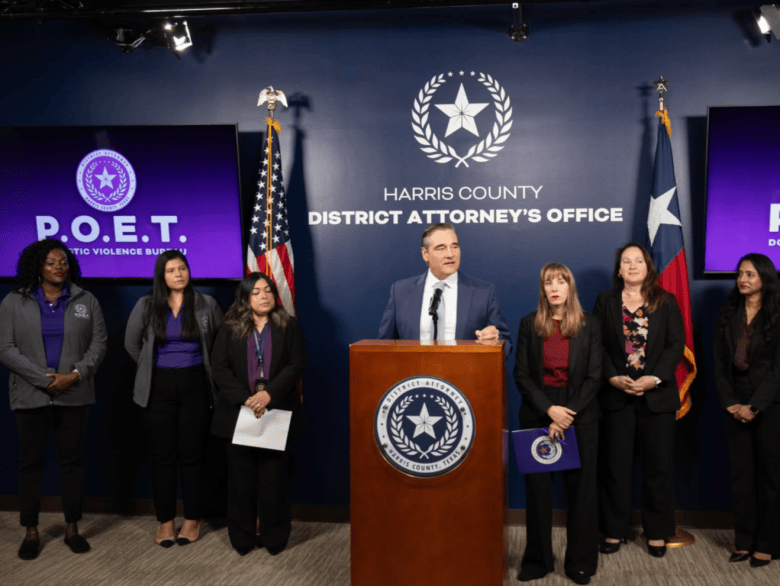 Harris County District Attorney Sean Teare announces a new program for domestic violence survivors so they can meet with advocates “where they are” rather than having to go to the courthouse. Credit: Harris County Attorney’s Office
Teare acknowledges that the Trump administration’s aggressive immigration enforcement approach is making it more difficult for witnesses and victims to come forward.
“The rhetoric and behavior of the federal government is making us less safe,” Teare said at an October 2 news conference. “People are afraid to report crimes. Many people are more afraid of the federal government than the people abusing them at home every day.”
About 55 percent of AVDA’s $6 million budget comes from state and federal grants, but the agency doesn’t house people, so the barriers they face are different from other domestic violence nonprofits.
After experiencing a reduction in calls during the first Trump administration, AVDA and the Harris County Domestic Violence Coordinating Council saw the numbers pick back up to pre-pandemic levels while President Joe Biden was in office. Now that the numbers appear to be declining once again, Smith says, “Some people are touting that as, oh, look what we’re doing, but the reality is that people aren’t calling the police as much as they used to, not that we’re doing such a bang-up job of policing.”
Smith says calls went down during the COVID-19 pandemic because people were stuck inside and relying on their partner for childcare or financial support.
“They were waiting until the abuse got really bad,” she says. “We’re seeing that now in the immigrant community. There’s a lack of trust in the police, and, ‘Are they going to turn me over to ICE?’ There’s such a huge discussion about which police agencies are cooperating with ICE, which makes it more difficult. Have we heard of any of our survivors who have been detained when they call the police? No, but everyone knows someone who knows someone. They are still very fearful of coming forward.”
Swati Narayan works for Daya Houston, a nonprofit that aims to “empower South Asian survivors of domestic and sexual violence through culturally specific services and to educate the community in an effort to end the cycle of abuse.”
While advocating for domestic violence funding before commissioners court last month, Narayan said 47 people in Harris County were killed by an intimate partner in 2024, a 34 percent increase in domestic violence deaths over the previous year.
“I have seen how difficult it can be for someone to leave an abusive situation, not because they don’t want to leave but because the practical barriers can feel impossible,” Narayan says. “A hotel room, rent deposit, transportation or childcare can be the difference between remaining in danger and getting a family to safety. These are not charitable extras. They are the basic infrastructure people need to live safely and with dignity.”
But the money for those services has to come from somewhere, and the new stipulations on federal grants mean that the nonprofits have to rely more heavily on state and local funding.
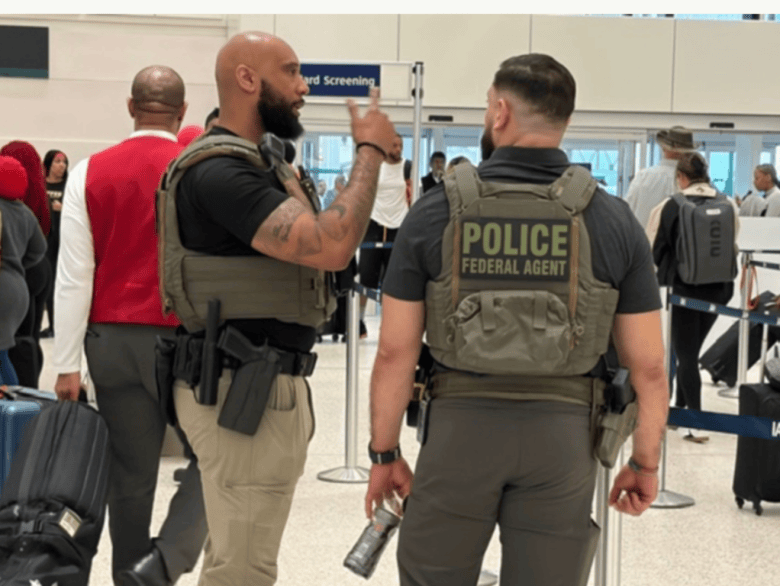 ICE agents were stationed at George Bush Intercontinental Airport in March. Credit: April Towery
The national nonprofit Alliance for Immigrant Survivors reported last year that 75 percent of 170 advocates they surveyed across the country said the immigrants they serve fear they’ll face arrest or deportation if they contact authorities.
Tahirih Justice Center, another national nonprofit that provides support to Harris County immigrants, issued a statement in June 2025 expressing concern about a Houston Chronicle report that HPD contacted ICE after an immigrant victim of domestic violence called 911 for help in an emergency.
“What survivors need in these moments is safety, care, and compassion. Instead, the worst nightmare of every immigrant survivor became a reality. The fact is, when local law enforcement cooperates with and engages in immigration enforcement, it means that immigrant survivors do not feel safe calling 911 in an emergency, reporting crime to the police, or going to court as a victim or witness of a crime,” the statement reads.
Katharina Dechert, Tahirih’s Houston-based policy and advocacy manager, told the Houston Press last week that she is certain fewer victims are coming forward due to immigration concerns.
“Many of [our clients] are afraid to call the police when something happens and in many cases have chosen not to make a report with law enforcement due to fear that doing so will lead to their detention or deportation,” she said in an email. “This leaves survivors vulnerable to further abuse and exploitation and makes all of us in Houston less safe. Our team is responding to many more questions and concerns from our clients and survivors in the community about fears of immigration enforcement at court and other government offices.”
Texas sheriff’s departments are required by state law to enter into cooperative agreements with ICE for immigration enforcement, although there are different tiers of participation. Immigration experts have told the Press that out of all the Harris County residents who are detained by ICE, most come from the county jail after they’ve been arrested for a crime unrelated to their immigration status.
The Houston Police Department has been heavily criticized for collaborating with federal immigration authorities. HPD Chief Noe Diaz mandated in March that officers stop handing over undocumented immigrants to ICE when they encounter them on traffic stops.
Shortly thereafter, a trio of city council members led by Alejandra Salinas offered an ordinance that would limit HPD’s interaction with ICE but the policy was watered down after Gov. Greg Abbott threatened to withdraw $114 million in public safety grant funds just before the FIFA World Cup came to town.
The Press reported in August that, according to a lawsuit filed by civil rights attorney Randall Kallinen, HPD officers are in some cases waiting up to two hours for federal agents to arrive after the subject of a traffic stop is flagged as undocumented.
Call Anyway
Despite the risks and the barriers, the Harris County nonprofits that assist domestic violence survivors have a message for those who are in unsafe situations: Call anyway.
“We are going to do the best we can to help you,” Smith says. “Our main concern is for victim safety, making sure that they and their children are safe, whatever that looks like.”
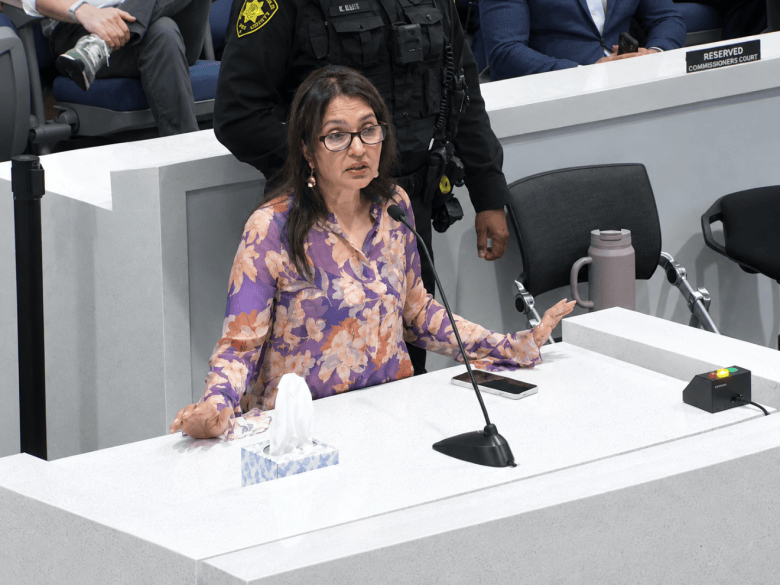 Swati Narayan advocates for domestic violence funding at a September 8 meeting of the Harris County Commissioners Court. Credit: Screenshot
Colter emphasized that AVDA prioritizes the crime of domestic violence, not someone’s immigration status.
“Candidly, we can’t guarantee anything with these spoken expectations, ICE requirements, that they pick up X amount of people on a regular basis,” she says. “Their policies and priorities can motivate someone to find every avenue that they can, whether that’s picking someone up in a Home Depot parking lot to finding people at family court. They can make it very hard for people to want to engage those systems. We understand that and we’re trying to navigate around it the best we can.”
Still, she says, call anyway.
“If we can avoid court, we’ll do a Zoom mediation,” she says. “We try to navigate those opportunities so people don’t have to expose themselves to those types of risks. We’re being told, ‘He’s going to call the police on me. He’s going to call ICE on me.’ It is happening, and we’re doing everything we can to find a pathway for them to get out of those situations.”
Aguilar says she appreciates the work that domestic violence nonprofits do in Harris County and recognizes that whether someone gets picked up by ICE is out of their control.
Still, she says, “They can’t help everyone. No matter how kind they are and how much they want to help, people aren’t safe. My mother wasn’t safe in her own home. Until this administration changes, none of us are safe.”
Related