
“For never was a story of more woe / Than this of Juliet and her Romeo.”
Thus go the tragic closing lines of “Romeo and Juliet,” Shakespeare’s familiar drama of teen love. Joyously, the production of the play now on stage at Houston’s Alley Theatre lives up to the boast.
Which is surprising considering the play as a text. It lacks the intense emotions of his “Othello,” the murderous evil of “Macbeth,” the psychological depth of “Hamlet,” and the comic fantasy of “A Midsummer’s Night Dream” or “Much Ado About Nothing.” Moreover at its heart are two of the bard’s least interesting characters: 14-year-old Juliet and her teen-idol crush Romeo—both so immature as to believe love happens only once and life is unlivable without it. Their dialogue, for all its Shakespearean beauty, has the wit and wisdom of notes passed in junior high history classes (my generation) or salacious texts my students check in the halls between classes.
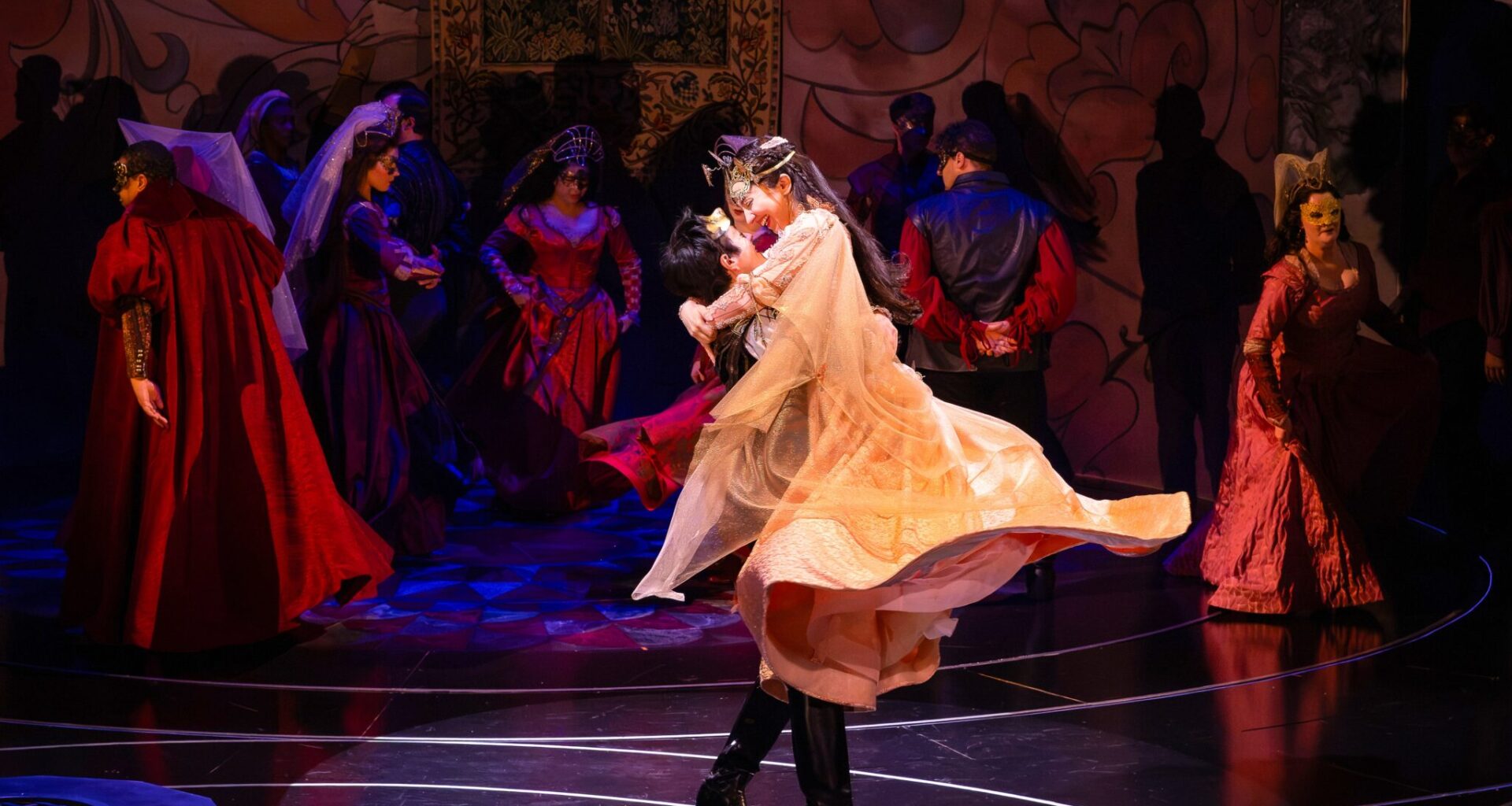
It takes superior acting talent to bring these Barbie dolls to life, and the Alley has two such talents toting this load: Rob B. Kellogg as Romeo and the Alley’s own Melissa Molano as Juliet. Kellogg brings not only the good looks and athletic abilities—he climbs tower walls like Spiderman and duels with the skills of Dumas’s d’Artagnan — of an ideal Romeo, but he also has a syncopated delivery style that clarifies his lines even as it underscores the poetry of Shakespeare’s words. Molano is both lovely and capable of moving Juliet from a moony teen on a balcony to a distraught woman waking in a tomb beside Romeo’s lifeless form. Her words matter less than her emotional range.
Moreover, the average adolescent nature of the title characters is not merely covered up by the acting of the leads. Instead, it is highlighted by two balancing characters who support them: Mercutio and the Nurse. Scholars have long noted the tendency of Mercutio to dominate the show, with John Dryden observing as early as 1672 that Shakespeare had to kill him off in Act III to avoid having him steal the show. Burning with energy and emotion that fuels a vicious if hysterically funny tongue, Mercutio is a crown prince of witty double-entendres, and if he can’t flatten the landscape with his off-color words, he’s ready to wreak havoc with his rapier. Part bully, part clown, he keeps the audience’s eyes and ears glued to his every move until, with his drying breath, he condemns both feuding families: “A plague a [sic] both your houses!” As Mercutio, Matthew Amendt blazes, using every ounce of potential the script provides. To watch him exit dying is akin to seeing a celestial nova burn out.
Juliet’s Nurse stands on the other side of the scale, and to the credit of the playwright and Michelle Elaine’s performance, she balances Mercutio by substituting comedy for his rage. She, too, is adept with double-entendres as we might imagine someone in such a body-emphasizing profession might be, but where he has fury, she has love for his mistress and a self-deprecating wit that endears her. She charms her way into our attention—never wheedling, always ingratiating, trying to please, but brassy. Her grief at the play’s events rings truer than that of characters of higher status, making her a reliable guide for the audience’s emotions.
I dwell at length on these performances because they are key to what the Alley production provides: a comparative examination on the different faces of love. Romeo and Juliet represent idealized, innocent love and remind us that for all its cuteness, its “puppy-love” inanity, it carries deep, intense meanings for those who experience it for the first time. Mercutio shows us brotherly love with its whisps of crudeness around the edges, and its confusion with anger and challenged masculinity. Nurse shows something like sisterly or whatever the female version is of avuncular love: doting, supportive, but tinted with the wisdom of experience. These set off the truly dangerous love in the play: parental love that attempts to control rather than understand children. Juliet’s father, Capulet, attempts to order his daughter into a manageable love arrangement. Her mother tamely follows her husband’s lead. They love their daughter, but they do not see or hear her. It’s this tornado of loves that the Alley’s production most vividly communicates. And it is the inability of these loves to come into harmony that creates the sense of supreme “woe.”
Such an emphasis stresses the timelessness of the tale; what we see in Renaissance Verona, we also see in 2026 Houston: family tragedies that happen to loving people because of their different forms of love.
Director Rob Melrose stresses this timeless quality by giving the production both a modern and Renaissance setting. It opens with soccer hooligans celebrating and fighting beneath the golden statue that Capulet, at the end of the play, promises will honor his dead daughter. A Vespa motorbike is present, and the prologue is in modern clothes. But the Vespa putters away with two lovers straddling it, and they are soon replaced by the Renaissance gangs of feuding families. At play’s end, we return to the present, hopefully to use our insights from Shakespeare’s play to better guide our modern lives. My only complaint with the time traveling is that it didn’t happen often enough. The production lags slightly after Mercutio’s death, as the story’s focus on irony distances us from the characters. But in the tomb, the monumental, rotating set finally returns the characters to the front of the stage where their feelings more quickly and fully reach out to the audience, putting us into the play’s cathartic moment.
“Romeo and Juliet” may not be Shakespeare’s finest work, but the Alley’s production shows it off as a gem—a gem that is polished by a large and magnificent cast, amazing, moveable sets by Michael Locher who puts all the Alley’s wealth of resources into action, and a thoughtful, creative concept for the production as a whole courtesy of Rob Melrose.
See “Romeo and Juliet,” and discover the complexities of finding the different forms of love blooming into woe — the tragedy of being young and pure in a complicated, imperfect world.
“Romeo and Juliet” is at Houston’s Alley Theatre through Oct. 18.
Robert Donahoo is a Sam Houston State University Professor Emeritus and writes theater reviews for The Courier.