
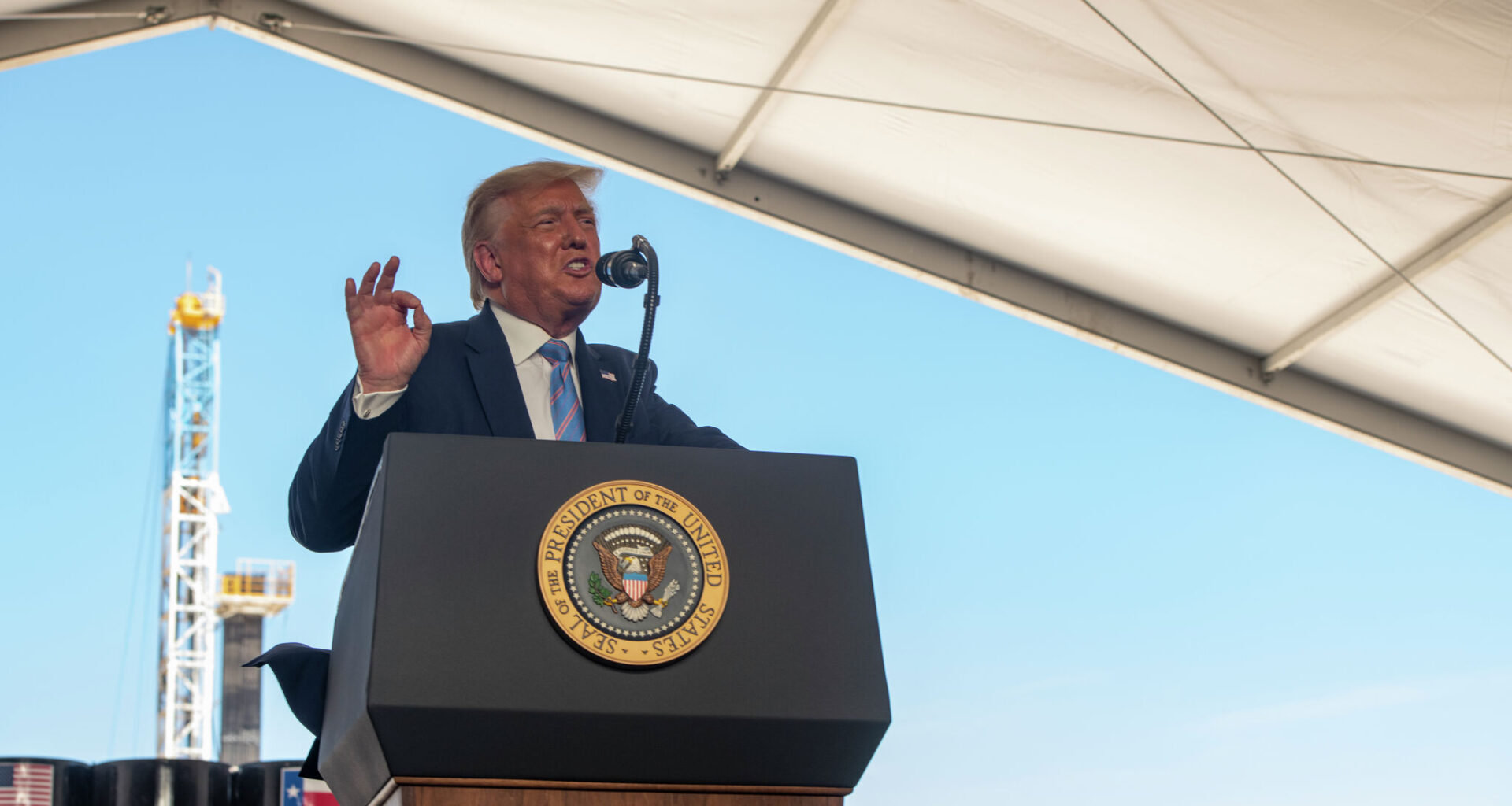
President Donald Trump talks to a crowd at a Double Eagle Energy oil and gas operation in front of Latshaw Rig No. 43 on Wednesday, July 29, 2020 in Midland County
Jacy Lewis/Midland Reporter-Telegram
Amid the chaos of President Donald Trump’s DOGE initiatives at home and foreign policy gambits abroad, it was easy to miss a sweep of actions that hurt the energy industry writ large. Namely, the Trump administration’s approach to energy policy is a patchwork quilt of unlawful decisions and illegal activities. This is bad news for Houston.
The turmoil began shortly after the inauguration. The numerous actions continue to reverberate.
In court documents, the Trump administration admitted to illegally canceling more than $7.5 billion in energy project funding to states based wholly on whether those states voted for Trump in the 2024 election. Though the goal might have been to target blue states, the energy industry is famous for its collaborations, and many big projects involve partners from other regions. So not only did the move violate the law, it also cut funding that would have ended up in Texas, whose electoral votes went to the president.
Article continues below this ad
In just one legal challenge in response to these actions — I expect there will be more — a group of plaintiffs organized by the American Institute of Chemical Engineers sued Energy Secretary Chris Wright after some projects related to critical minerals recovery and hydrogen production were canceled for political reasons. The plaintiffs’ filings noted that some project partners were in red states such as Texas and Oklahoma. The judge sided with the plaintiffs, vacating the cancellations so the projects could resume.
Or take my own situation as an example of this cross-state effect. As part of my job at the University of Texas at Austin, I was part of a three-year $25 million research project. Universities throughout the nation, Canada and Mexico were working together to analyze what a modernized grid might look like. Stanford University in California was the lead, and my team at the University of Texas at Austin was a subcontractor, alongside many other research institutions. When the grant to Stanford was cut — despite our progress on technical milestones — funding to Texas was also cut.
But the Trump administration isn’t just trying to target specific states to reward and punish. It also seems eager to use legally questionable levers to promote coal and stymie the development of wind and solar power.
Less than a month ago, a federal court ruled that Wright had overstepped his legal authority by ordering a coal-fired power plant to keep operating past the date its owners had planned to shut it down. The 64-year-old plant was expensive to operate, so keeping it on drove up costs for ratepayers by hundreds of millions of dollars.
Article continues below this ad
One week later, a judge ruled that the Environmental Protection Agency’s cancellation of a $7 billion program to provide solar power to lower-income Americans was illegal.
In August, a court ordered the Pentagon, which has to approve wind turbines over 200 feet tall, to resume issuing permits after it had stopped doing so with insufficient legal justification.
The Trump administration has also repeatedly targeted offshore wind. The courts had already found in early December 2025 that the federal government’s wholesale ban on new offshore wind energy permits was unlawful. Trump followed that decision a few weeks later with a stop-work order by the Department of the Interior for five offshore wind farms already under construction. Judges, unconvinced of the legality of the national security arguments that had been used to halt the energy projects, ruled in February 2026 that the offshore wind farms can proceed.
Trump quickly followed that decision with a questionable maneuver to provide billions of dollars of buyouts to offshore wind farm developers in exchange for canceling the projects and investing in fossil fuel projects instead. This approach has spurred a lot of legal blowback, with multiple states suing. Given how poorly the prior actions related to offshore wind hold up to judicial scrutiny, I expect these buyouts will also be found to rest on shaky legal ground.
It’s not just project development at risk. It’s also the process by which science is conducted to inform policy decisions. After the energy secretary hand-picked scientists to write a report in secret that would be used to undermine justifications for tackling climate change, a judge found that they violated long-standing transparency laws for policymaking bodies by not taking public input or keeping records of their meetings.
Article continues below this ad
The energy industry does best when rule of law prevails instead of corruption and political weaponization of government. These unlawful actions create uncertainty for the energy industry, which slows down development and raises costs. At a time when costs and uncertainty are already high, it’s time we return to a law-abiding policy environment.
Michael E. Webber is the Sid Richardson Chair in Public Affairs, Cockrell Family Chair No. 16 in Engineering and engineering academic director of the Senator Kay Bailey Hutchison Energy Center at the University of Texas at Austin. He is also a founding partner of IdeaSmiths, an engineering analysis firm.