
Dominic Anthony Walsh, HPM
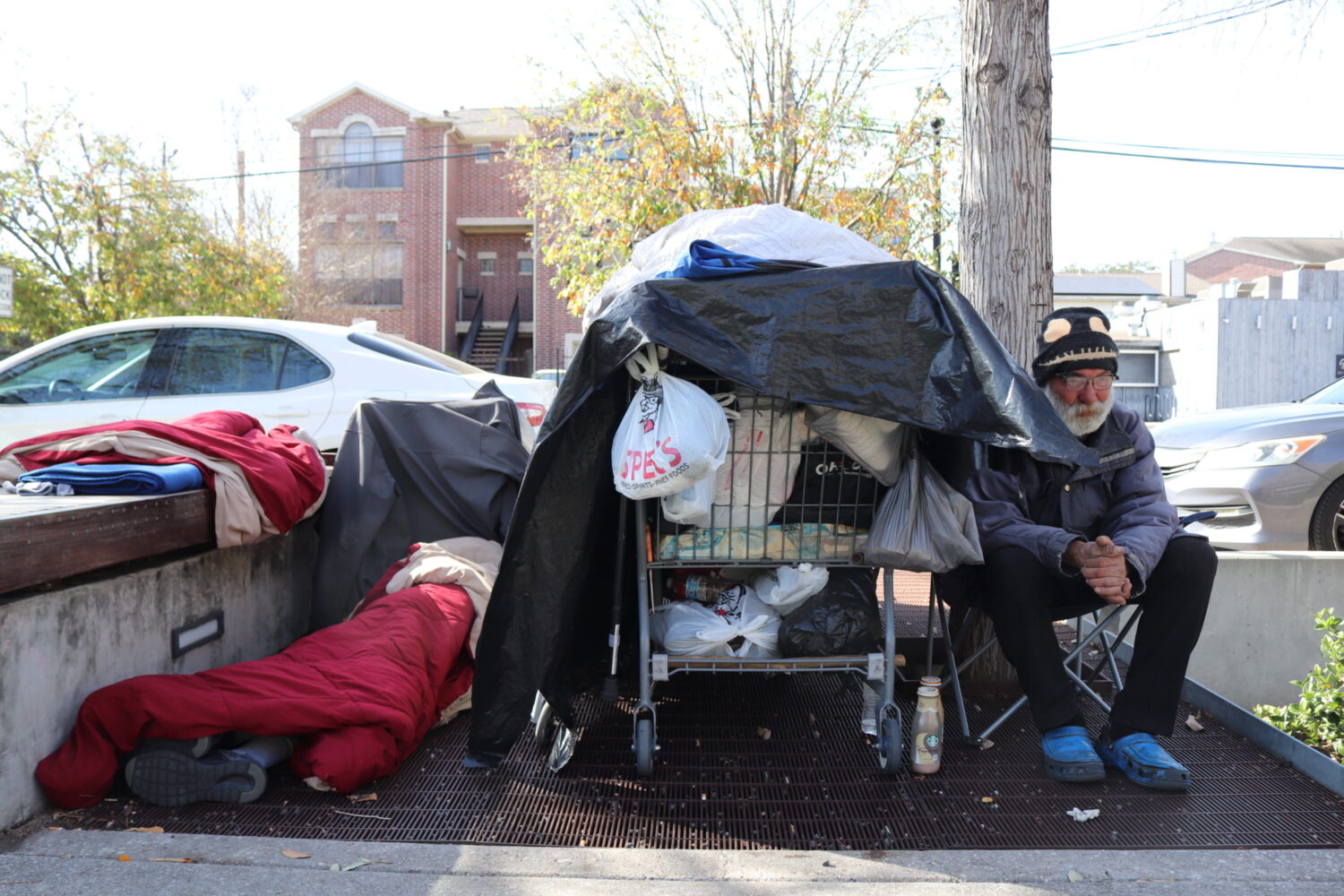
Dave sits on a chair next to a shopping cart full of his belongings on Bagby Street in Houston’s Midtown in March 2025.
At Houston City Hall on Wednesday, local officials unveiled a $48 million initiative to address homelessness across the region over the next three years.
The Coalition for the Homeless of Houston and Harris County will partner with the city and Harris County to provide “faster, more flexible interventions” to address chronic homelessness, defined as 90 days or longer without housing.
“We think we can solve homelessness — anybody’s homelessness, any reason for homelessness,” Kelly Young, president and CEO of the Coalition, told Houston Public Media ahead of the announcement.
Sign up for the Hello, Houston! daily newsletter to get local reports like this delivered directly to your inbox.
The Coalition oversees about $70 million in annual funding from the U.S. Department of Housing and Urban Development. According to the Coalition, the federally-funded program known as “The Way Home” has provided permanent housing and supportive services for more than 38,000 people since 2012, leading to a dramatic decline in the number of homeless people counted each year — from more than 8,000 15 years ago to less than 3,500 in recent years. Those federal dollars come with strings attached, dictating how they can be spent.
According to the Coalition, the new “Pathways 2 Independence” program has raised $34 million towards the three-year goal from a number of local philanthropies — including the Brown Foundation, Cullen Foundation, Houston Endowment, Kinder Foundation and Sarofim Foundation. Local organizations will have more freedom in how to spend those funds, and “flexible dollars allow you to have flexible intervention,” Young said.
After the three-year philanthropic funding runs out, the Coalition hopes local, state or federal funding sources will materialize to continue the program.
The Coalition reports about 5,700 people experiencing homelessness seek help in the Houston region every year. While 40% need “traditional housing interventions” or more intensive care, the other 60% “may regain stability sooner with faster, more flexible support.”
Young said the new program could address homelessness in a number of ways, like providing short-term housing assistance to ease the exit from jail for formerly incarcerated people.
The funds will be controlled by an executive committee of eleven people, including Young, representatives for the city and county, as well as leaders in the fields of mental health, medical care and business.
“The homeless population is one of our highest priorities,” Mayor John Whitmire said on Wednesday. “We still have so much work to do with the homeless population to get those individuals into the care and facilities they need, but also to protect our neighborhoods from individuals that need to be somewhere else.”
Dominic Anthony Walsh/Houston Public Media / Houston Public Media
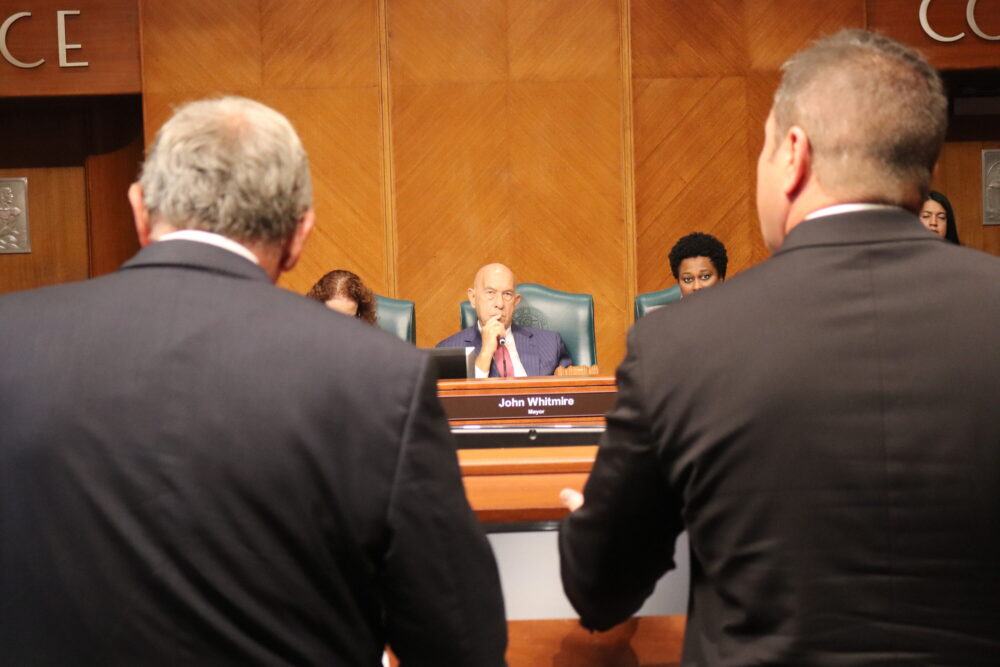
Houston director Mike Nichols and public safety director Larry Satterwhite speak to the Houston City Council and Mayor John Whitmire in Oct. 2025.
The city has its own homeless initiative. How does it fit into the new program?
The primary goal of the new program is to “end street homelessness.” Whitmire announced the same goal in 2024 — but the city fell short of its $70 million annual funding target, and city officials walked back the target to instead “reduce street homeless” earlier this year.
After the announcement, Houston Housing Director Mike Nichols told Houston Public Media the shared goal is “to make homelessness rare, brief and non-reoccurring.”
“It is not the city’s money, it is philanthropy’s money,” Nichols said. “They want to drive this funding to help people to get off the street — but be creative, to be flexible, which is different than we have with government money.”
In late May, the city opened a new homeless residential treatment center in East Downtown, serving as the lynchpin in Whitmire’s initiative. But so far, the center has struggled to quickly move people from the streets into housing.
Related: Homeless center in Houston’s East Downtown serves more than 420 people in first three months
According to the city’s housing department, more than 420 people have been served at the center since late May. About 110 of them have landed in “positive placements,” according to Nichols, while about 150 people had “unknown” outcomes, leaving the facility instead of entering a treatment program or getting on the path to permanent housing.
“When people come to [the center], it’s not a jail — they don’t have to stay there,” Nichols said. “We will continue to do a better job of finding where those people end up, but that’s going to take some time.”
On average, people stay at the facility for more than 60 days. Nichols said the city and its partners need to move people through the system more quickly, and the new program should help.