
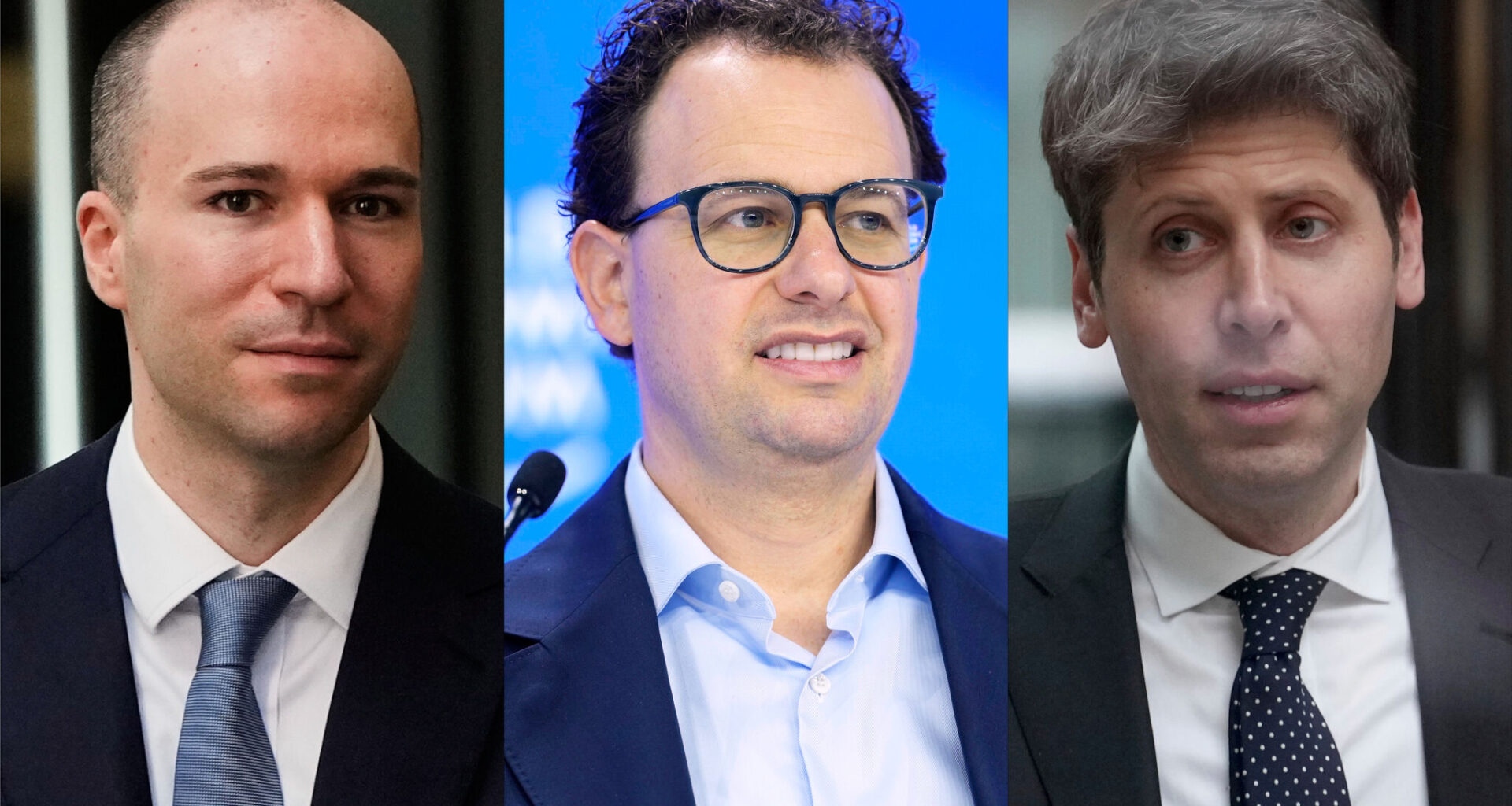
From left, OpenAI president Greg Brockman, Anthropic cofounder Dario Amodei, OpenAI CEO Sam Altman.
Godofredo A. Vásquez, Markus Schreiber and Aurelien Morissard/AP
A television commercial that ran in Texas this spring describing GOP congressional candidate Carlos De La Cruz as “Trump endorsed” and “strong on border security” looked like a standard-issue campaign ad.
But the fine print showed the ad was paid for by a super PAC connected to the artificial intelligence company Anthropic, part of a nationwide effort by artificial intelligence companies to elect candidates from both sides of the aisle they view as supportive of their efforts to grow the technology.
In Texas, groups connected to companies including Anthropic, OpenAI and Palantir spent more than $3.5 million supporting four federal candidates in the primaries this year, all of them Republicans, according to a review of federal campaign finance reports. The candidates were Jessica Hart Steinmann in the state’s 8th Congressional District, Alex Mealer in the 9th and Chris Gober in the 10th, along with De La Cruz in the 35th.
Article continues below this ad
The spending, which has since dropped off in the lead-up to the midterms, came amid increasing calls for Congress to regulate the burgeoning AI industry and the sprawling data centers that fuel it.
“They’re flooding the candidates with money,” Cathy Latham, Texas director at the non-profit Humans First, said of AI companies. “We need regulations. They’re not going to self-regulate.”
In the 10th Congressional District, which stretches from Austin to the Houston suburbs, a super PAC controlled by the political network Leading the Future spent almost $750,000 supporting Republican Chris Gober’s campaign to replace U.S. Rep. Michael McCaul. The group is backed by Greg Brockman, president of OpenAI, and Austin’s Joe Lonsdale, cofounder of Palantir, a software company that uses AI to develop software for businesses and the military.
In the March primary, Gober defeated Ben Bius, a Huntsville businessman who has been critical of the data center boom overtaking much of Texas.
Article continues below this ad
“They bought the seat and intended to from day one,” Bius said.
OpenAI and Palantir did not respond to a request for comment. Asked about the ads, Gober’s campaign said in a statement, “AI is moving fast and Americans are right to be worried.”
“While we need it to defend ourselves against enemies building their own systems, we also have to protect our kids, our electrical grid, our natural resources, and our way of life, and make sure it doesn’t destroy the human race, because too much is on the line.”
In the 8th district, a Leading the Future super PAC spent more than $500,000 on television ads and mailers supporting Hart Steinmann, an attorney with the America First Policy Institute and a former staffer to U.S. Sen. Ted Cruz. And in the 9th, Anthropic’s Public First Action network spent almost $750,000 to boost Mealer, an Army veteran who worked on energy deals at Wells Fargo. Both candidates won their nominations, as did De La Cruz.
None of the three responded to requests for comment.
Article continues below this ad
Texas has emerged as a battleground over the future of the industry, with the state Legislature expected to consider cracking down next year on the flood of data center projects and computer chip plants now under development.
The Chronicle limited its review to congressional candidates. Earlier this year it reported that a super PAC backed by Meta began running ads in Texas supporting candidates for the state Legislature and the comptroller’s office that it viewed as industry friendly – part of a $65 million national effort.
Of the four congressional candidates backed by the groups, only one – De La Cruz – is facing a competitive challenge ahead of Nov. 3. That may partly explain why the funding has appeared to dry up. But AI companies have also come under more intense scrutiny in recent weeks, amid reports of models going rogue and former employees warning that the technology could pose existential threats to humanity if it’s not reined in.
In a recent interview, OpenAI CEO Sam Altman questioned whether the political spending was hurting the industry’s image.
“I don’t think spending money on politics is what’s going to make people feel better about it,” he told Politico. “The industry needs to figure out a way to address what the actual concerns are, and right now, a lot of people in the industry are being quite tone deaf.”
Article continues below this ad
Last week Brockman announced he was not going ahead with a planned $25 million donation to OpenAI’s political network out of concern that it had become a “distraction.”
Usamah Andrabi, communications director at Justice Democrats, a political organization calling for greater oversight of AI, said it’s too soon to know whether the companies have backed off or just gotten smarter about hiding their financial support.
“We won’t know until after the dust settles from the midterms,” he said. “Early on, they clearly wanted to notch some easy wins in safe districts, to be able to hold their money over certain candidates and make sure they vote the right way.”
A spokesperson for Public First Action said their goal was to elect candidates “who back sound AI policy.” That has at times pitted the group against super PACs connected to OpenAI and Palantir, along with the Silicon Valley venture capital firm Andreessen Horowitz, which is heavily invested in AI technology.
“We exist because Americans in both parties overwhelmingly want guardrails on AI, and a handful of tech billionaires are spending more than $100 million to make sure Congress never writes any,” the spokesperson said in an email.
Article continues below this ad
Leading the Future, which runs those PACs, did not respond to a request for comment. OpenAI has said it supports “mandatory national AI safety requirements.”
Andrabi questioned the seriousness of Anthropic’s advocacy for safeguards, commenting, “There’s no good guy in this race.”
“The truth is neither of these corporations want to see real regulation,” he said. “Of course they want to pit themselves against each other. They’re the two largest competitors.”