
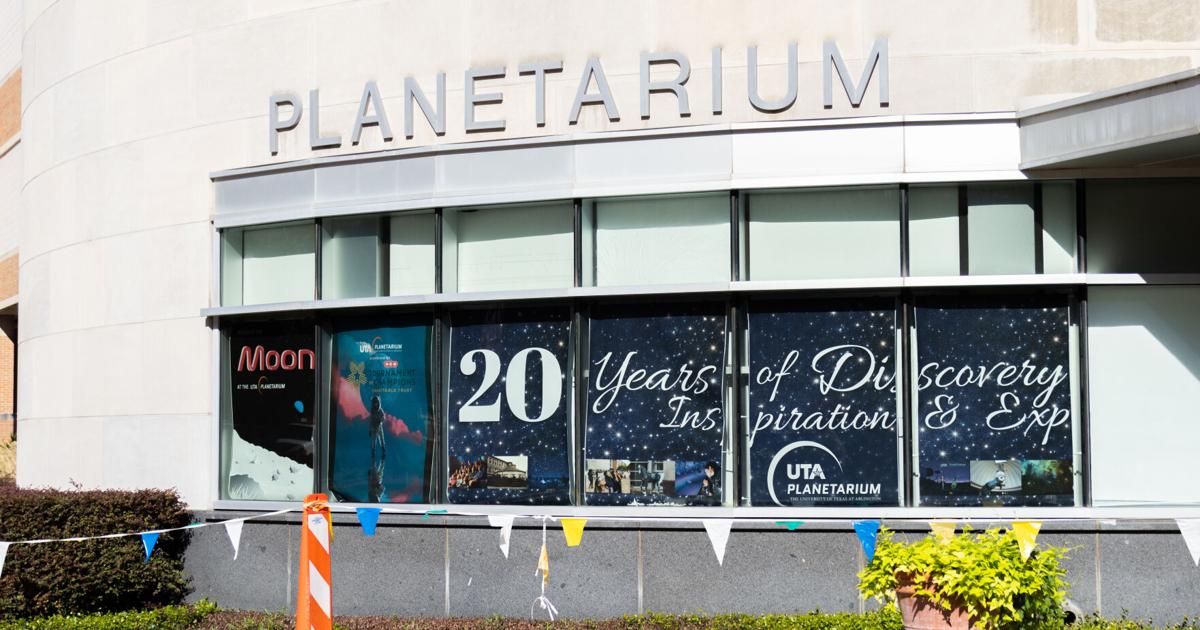

The Planetarium sits on campus Oct. 7. The planetarium is celebrating 20 years of providing immersive science education.
The H-E-B Tournament of Champions Charitable Trust has awarded the UTA Planetarium a $16,000 grant to aid in covering the cost of planetarium field trips.
The grant will go into the Stellar Funding initiative, a planetarium program that seeks to completely cover the cost of admission for public school students.
Planetarium director Levent Gurdemir said the planetarium has been receiving grant funding from the trust since the COVID-19 pandemic.
During the pandemic, the field trips were only virtual due to health and safety concerns. To help with funding, the planetarium started its partnership with the H-E-B Tournament of Champions and has received community grants each year since.
“Schools’ budgets, especially for extracurricular activities like field trips, were too low or none,” Gurdemir said. “We realized that we need to do something to help schools to restore and recover their field trips.”
To ensure it is giving financial advantage to schools in need of classroom support, the planetarium primarily seeks public schools that are under Title 1, a federal K-12 assistance program for schools with 40% or more students on reduced or free lunch, Gurdemir said.
The planetarium hosts nearly 30,000 K-12 students annually for their projection field trips, he said. Visiting schools come from districts in Dallas-Fort Worth.
A few times a year it also welcomes students from other districts, such as Austin, Texas.
The programs shown at the field trips are prepared in coordination with the teachers’ goals for their students, such as connecting astronomy to history or geology. Beyond astronomy, the planetarium dome can project concepts from subjects like architecture, biology and history.
With Digistar 7, an advanced projection software, the planetarium provides an immersive visual experience to help students grasp foundational concepts using real-time projections.
“We can even dive inside of planets, or we can look at the universe from different stars, star systems.” Gurdemir said. “It provides amazing virtual functionality for us to visualize the universe.”
Gurdemir said the planetarium staff members use these tools and experiences to share their passion for science and astronomy with young scientists and inspire them.
“I always vision the future great scientists and engineers when I see kids unloading and getting off the bus or getting on the bus after the field trips, especially when I see their excitement and their passion for science and engineering,” Gurdemir said.
Gurdemir said in the future he would like to reach more schools with field trips with more grant funding.
“My desire would be every kid in the Metroplex receives the planetarium experience or at least the field trip experience.”
@kh.kennedyharvey