
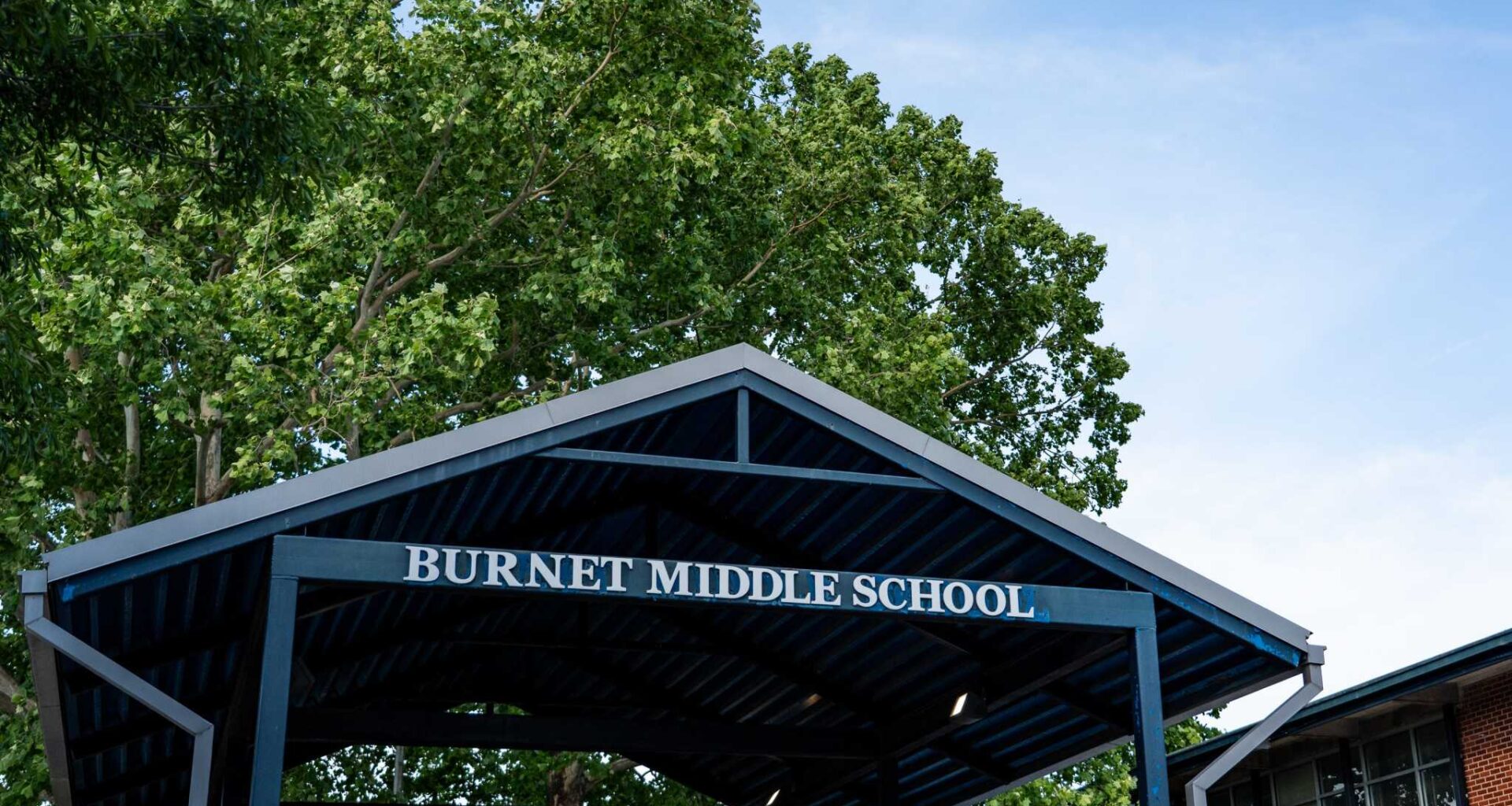
Burnet Middle School, May 13, 2025. Emails reveal how Austin ISD ended a partnership with the Texas Council for International Studies that would have let TCIS run daily operations at Burnet, Webb and Dobie middle schools.
Sara Diggins/American-Statesman
When the Austin Independent School District announced in late July that it would end a partnership with a nonprofit meant to improve academics at three schools and stave off state intervention, many in the community were disappointed.

Earlier this year, Austin ISD sought out a partnership with Texas Council for International Studies, a nonprofit that operates charter schools, to run three North Austin middle schools that had struggled on state tests for several years. The district asked TCIS to take over daily operations at the campuses to take advantage of a state law that would give the schools more money and a temporary pause on consequences tied to state letter grades.
Article continues below this ad
But in May, the Texas Education Agency denied the district’s bid for extra funding and the accountability pause at Dobie, Webb and Burnet middle schools, shifting the district closer to potential state intervention. TEA said the nonprofit did not have a sufficient track record of boosting student learning for Austin ISD to get the benefits of the state law.
Immediately following the agency’s decision, Austin ISD and the nonprofit committed to keep their partnership intact. But on July 20, the district announced the two had mutually agreed to end the collaboration, with Austin ISD officials saying the change would preserve continuity for students as the campuses sought to improve test scores. Ending the partnership relieved Austin ISD of a $600,000 contract as the district faced severe budget strains.
In mid-August, the state announced a new slate of state accountability scores, awarding Burnet and Webb middle schools their fifth consecutive F grades. The new grades put the entire school district at risk of a state takeover.
The Austin American-Statesman requested communications between the school district and TCIS in the week before the partnership dissolved to shed light on how the district came to its decision. The communications reveal that the process of untangling the partnership happened swiftly but methodically, and that the two parted largely on good terms.
Article continues below this ad
In the week before the groups’ breakup became public, TCIS and Austin ISD exchanged emails laying out a timeline to swiftly end the partnership.
On July 17, Joshua Jeon, Austin ISD’s executive director of governance, accountability and board services, wrote to TCIS CEO Margaret Davis that she had “been gracious every step of the way.”
Ending the partnership felt like the right thing to do, Davis said in an interview this week. TCIS had hoped to continue working with the schools, but she understood that TEA’s denial meant Austin ISD couldn’t access extra money that would have covered the costs of the partnership, she said.
“It limited the district in actions they could take, and it increased the already difficult budget situation,” Davis said. “Our position is we’re always going to do what’s best for the partnership.”
Article continues below this ad
TCIS specializes in International Baccalaureate education, which focuses on teaching globally-minded academic programming. IB is similar to Advanced Placement or other college preparation courses.
On Wednesday, Jeon said the district and TCIS ended the partnership amiably.
The partnership
The district and TCIS began emailing about a month after Austin ISD asked TEA to reverse its decision and allow the partnership to access the special funding and accountability benefits. In a June 11 letter to Education Commissioner Mike Morath, Austin ISD Superintendent Matias Segura said a majority of TCIS campuses have had academic success.
Article continues below this ad
“In the 2024-2025 school year, 11 out of 15 (historically 16) TCIS campuses were managed to academic success, that is, maintained or improved to Acceptable Performance or better — a supermajority,” Segura wrote. “Additionally, they have shown special success in managing middle school campuses to academic success.”
TEA’s denial in May had described TCIS’ academic performance as “uneven.” TEA never responded to the district’s June 11 appeal, Jeon said Wednesday.
Emails between district and TCIS staff show that officials moved quickly to wrap up the partnership upon not hearing from TEA. The district and TCIS began discussing the partnership’s dissolution the week of July 13, days after they hosted a July 9 joint career fair to hire teaching, special education and support staff for the three schools.
By July 17, the two partners had drafted a plan to communicate the partnership’s end and scheduled meetings with the affected middle school principals. TCIS also sent Austin ISD an invoice for $152,000 to cover the cost of services already provided and during the transition period, Jeon said.
Article continues below this ad
On July 18, Davis reached out to Allen Weeks, executive director of Austin Voices for Education and Youth, an organization that provides family support services at the middle schools, and Patrick Rosenthal, with the Bryker Woods Elementary School PTA. Bryker Woods has the only IB elementary program in Austin ISD and had agreed to help the three schools transition to an IB curriculum, according to the TCIS-Austin ISD contract.
Davis told Weeks and Rosenthal about the partnership ending and had conversations that were “supportive of the District,” she wrote in an email to Jeon.
Weeks was devastated to learn that the partnership ended, but realized it would have been another financial strain on Austin ISD, without additional funds from the state.
TCIS helped the schools hire staff over the summer and co-sponsored a reading and math summer camp with Austin Voices, Weeks said.
Article continues below this ad
“We got off to a good start in the summer,” Weeks said. “So, at least we got that out of it.”
Rosenthal was disappointed to learn that the partnership ended because he wants to see more IB options for students in the district, he said this week.
The Bryker Woods PTA would have provided support for fun events or tutoring, which the PTA still wants to do, he said.
“I still think all Austin ISD schools would benefit from an IB program, middle schools particularly,” Rosenthal said.
Article continues below this ad
Next steps
District and TCIS staff also discussed over email the role of Kevin Hilliard, who had been hired by TCIS as chief of schools for the three Austin ISD campuses where the organization would run daily operations. Davis told Jeon she would need to reduce salaries across TCIS because of the end of the contract with Austin ISD.
Officials discussed whether Hilliard could become an Austin ISD staff member or split time between the two partners.
“It is a difficult consideration to recommend to our leadership,” Jeon said.
Article continues below this ad
Davis agreed, adding that “we only want to be a blessing and help.”
Hilliard works for TCIS in San Antonio, according to the nonprofit.
This year, Austin ISD has continued to run the three campuses, and Segura told families that he expects academic improvement to continue.
Article continues below this ad
TEA has yet to announce how the agency will intervene in Austin ISD. State law requires TEA to either close campuses that score five consecutive failing grades on the state accountability system or take over the entire school district. Burnet and Webb middle schools triggered the law in August with their fifth F grades in a row.
Austin ISD has appealed its state scores and may not hear what form the intervention will take until mid-December, when the scores are finalized.