
Samantha Flores distinctly remembers seeing her own silhouette in a car’s headlights before it struck her during her bike ride home. She remembers the second car passing over her “like a spaceship.” She woke up from her coma with three questions: can I tell my boss that I am late for work, where am I and can I have a cup of coffee?
Eight years and eight reconstructive surgeries later, the 31-year-old walks with a cane, only has vision in one eye, occasionally stutters due to the brain damage, and manages chronic pain daily.
“I felt what it was like to bleed to death in the street. I got lucky. I woke up again,” she said.
San Antonio is among the deadliest large Texas cities for bikers, according to data from the Texas Department of Transportation. Though the number of severe injuries decreased in 2025, deaths still occur regularly. Since 2021, a cyclist has been killed about every two months on average.
San Antonio had just three and a half miles of protected bike lanes in July 2023, according to the city’s latest inventory report. Since then, the city unveiled a half-mile protected lane that connects The Pearl District to The Museum Reach, as well as a mile-long protected lane that connects River North to downtown.
Outside of those small corridors, the vast majority of cyclists share the street with cars, leaving them vulnerable to injury everywhere from bustling downtown roads to quiet country streets.
According to TxDOT data, most of the victims killed or injured were men and the majority were not wearing a helmet. The median age was 39 and about half of all accidents were at or near intersections. More than half of crashes occurred on roads with a speed limit less than 35 mph.
Police reported driver-related factors in just under half of crashes that resulted in cyclist injuries or deaths. Driver inattention killed two cyclists and severely injured 19 others; failure to yield severely injured six cyclists; speeding was linked to one death and three severe injuries; drug and alcohol use caused three severe injuries; and cell-phone use caused one severe injury.
Where do bike accidents happen?
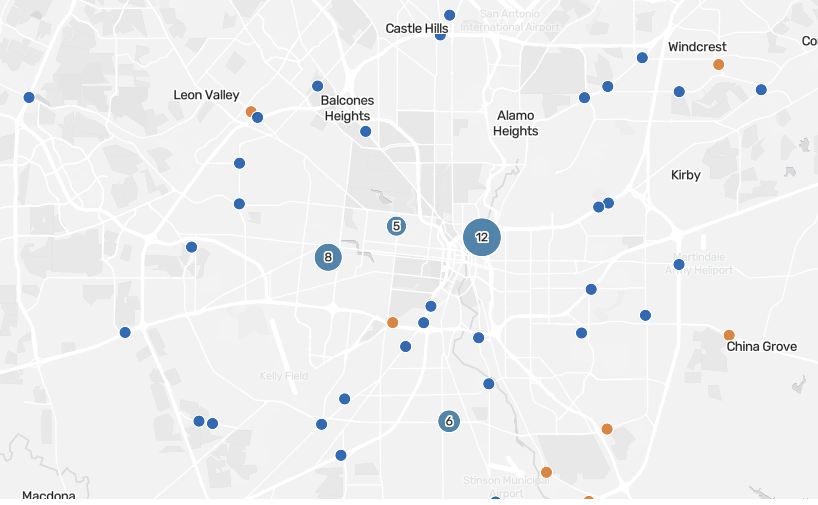
Both the city’s analysis and the Express-News analysis found that City Council District 5 — which covers the West Side and parts of Southtown — had more severe injuries and deaths for cyclists than any other district.
Where bicyclists are being killed and seriously injured in San Antonio
Drivers killed 13 cyclists and severely injured 70 others from January 2024 through September 2026.
Qualifying records were fatal or serious injury bicyclist crashes reported in San Antonio. Two severe injuries are not included in this map because they did not have location data.
Map: Eshaan Sarup • Source: Texas Department of Transportation Crash Records Information System
Catherine Hernandez, the director of San Antonio’s Department of Transportation, believes “part of it” is due to a higher percentage of residents in that district not having a car.
According to 2024 census data, 7.5% of San Antonio households do not have a car. In the Avenida Guadalupe neighborhood in District 5, one census tract — the smallest unit of measurement used by the Census Bureau — had 40% of households with no cars, more than any other tract in the city.
An official city report found that neighborhoods where 20% or more of households do not have a car experience five times as many severe or fatal bike and pedestrian crashes as areas with higher-than-average car ownership.
“If there’s not the right amount of sidewalks or bike lanes or infrastructure that will help them get there safely, then you are going to see that uptick because those are older parts of our city that were built a certain way,” said Hernandez.
In a statement sent to the Express-News, District 5 Councilwoman Teri Castillo said that “all residents deserve safe streets and safe, accessible ways to get around our neighborhoods” and mentioned upcoming infrastructure projects in her district, like the Zarzamora overpass and the widening of South Brazos.
Hernandez called cyclist safety a “shared responsibility” between the city and everyone who uses the roads, from cyclists to drivers to pedestrians.
Hernandez said her team focuses on proven safety measures — like midblock crosswalks, additional signage, pavement markings and bike lanes — on corridors that a city analysis labelled as high-injury for pedestrians and cyclists based on TxDOT data from 2019 to 2023. The department also strives to educate the community on best safety practices for drivers, bikers and pedestrians alike.
Pushback against bike lanes remains a blocker.
In 2023, the city removed several concrete barriers protecting a bike lane downtown after pressure from a private developer, though the lanes remain, according to reporting from KSAT. Last year, the city scrapped plans to add a bike lane on Goliad Road after the Highland Hills neighborhood association and San Antonio Independent School District argued that removing a traffic lane would increase congestion and cause more safety problems.
The department has goals for a 2,000 mile bike network, which includes bike lanes and shared-use paths, by 2050.
According to internal data shared with the Express-News, the city transportation department added six miles of bike lanes and shared paths in 2025, seven and a half miles in 2026, and plans to add nearly 20 more miles next year. From 2028 onwards, the city would need to add about 60 miles to the bike network each year on average to reach the 2,000 mile goal in time.
The department also plans to release a report next year based on 2021 to 2025 data to see if the safety measures on high-injury corridors have done their job.
“To push forward on our goal for zero fatalities, we know it’s going to be very difficult with a city that’s over 500 square miles and over a million people. But I mean, if we have an impact on just one life, that one life is valuable,” said Hernandez.
“They will not conquer me”
Growing up on the east side, Flores knew her neighborhood was not a good place to ride. She only learned how to ride a bike as an adult, since she did not have a car and believed cycling would be safer than riding the bus
Yet Flores enjoyed her rides so much that she would often add an extra stretch to her route home. She loved the sense of freedom, feeling the wind on her hair and smelling the wildflowers.
But she said the best part of cycling was the friends she made along the way. Though she never asked for it, the cycling community sold bicycles, auctioned off art, and ultimately raised enough money to keep Flores in her house for a year after the accident.
“For all that to just be a memory is disturbing. He should be here, you know,” she said.
But, Flores continues to find joy in cycling today. She started riding again just one year after her accident, something she sees as an act of resistance.
“They will not conquer me, they will not conquer this community, and we will not quietly go into the dark,” she said.