
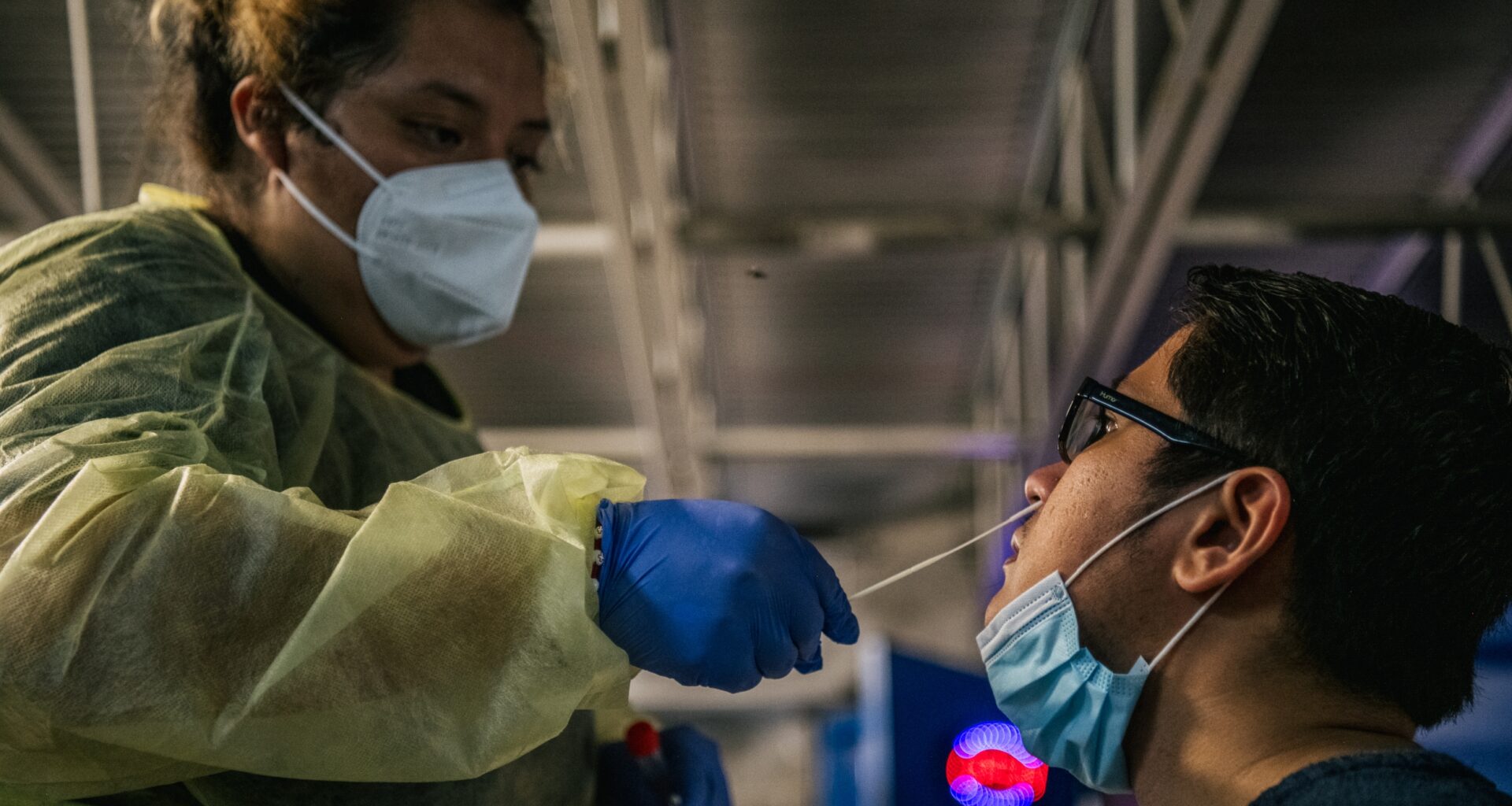
Two Plano, Texas, medical practices and their physician owner have agreed to pay $20 million to resolve allegations that they billed a federal program for uninsured patients for office visits when patients only received COVID-19 nasal swab tests, the U.S. Department of Justice announced Oct. 7.
Heal 360 Urgent Care PLLC, Heal 360 Primary Care PLLC, and owner Dr. Mohammed Amer Mohiuddin operated dozens of mostly walk-up and drive-through testing sites across Texas. The settlement resolves civil allegations only, and there has been no determination of liability.
The case shows how a pandemic program built to protect uninsured patients from medical bills also became a target for billing abuse. The money came from a limited fund that stopped accepting new testing claims in March 2022 because it ran short.
Swab Tests Allegedly Billed as Office Visits
From Jan. 1, 2021, through March 23, 2022, Heal 360 allegedly billed higher-level evaluation and management office-visit codes, including 99203, 99204, 99213 and 99214, for what was only specimen collection, according to the U.S. Attorney’s Office for the Northern District of Texas. Prosecutors say that work should have been billed as code 99211, which paid substantially less.
In plain terms, 99211 describes a brief encounter that may not require a physician, and CMS approved it for COVID-19 specimen collection during the pandemic. Codes such as 99214 describe more complex visits that typically involve a medical history, an examination, and decision-making by a clinician.
The government alleges that remote scribes overseas created templated medical records to make it look like office visits took place. Mohiuddin was listed as the rendering physician on most claims even though he did not see patients at the testing sites, the government says. The practices allegedly submitted hundreds of thousands of claims.
Settlement Terms and Whistleblower Share
The $20 million includes proceeds from the sale of certain real properties Mohiuddin bought, and the agreement also resolves a related federal forfeiture case involving property in Garland, Texas. The case began with two whistleblower lawsuits under the False Claims Act, and the whistleblowers will receive $3.4 million, or 17% of the settlement. Under that law, private citizens can sue on the government’s behalf and typically receive between 15% and 30% of any recovery, a structure designed to encourage insiders to report fraud.
“The Department is committed to rooting out fraud by healthcare providers who bill for services they did not provide,” said Assistant Attorney General Brett A. Shumate of the Justice Department’s Civil Division.
U.S. Attorney Ryan Raybould of the Northern District of Texas warned that his office “will find you, we will find the money and assets, and we will do everything within our power to hold you accountable.” Miranda L. Bennett, acting deputy inspector general for investigations at HHS-OIG, said billing for services never provided “undermines trust in the health care system.”
A Pattern of Uninsured Program Billing Cases in Texas
The HRSA COVID-19 Uninsured Program reimbursed providers for testing, treatment and vaccinations for people without insurance, and providers agreed not to bill patients for any balance. Because patients never saw a bill, they had little reason to notice what a clinic charged on their behalf.
HRSA stopped accepting testing and treatment claims after March 22, 2022, citing a lack of sufficient funds, and Congress rescinded the remaining money in 2023. A 2023 HHS-OIG audit of the program estimated nearly $784 million in improper payments for 2020 services alone.
Heal 360 is the latest of several North Texas cases. A Collin County physician agreed to pay $3.5 million in 2025 over similar allegations, according to HHS-OIG, and a Dallas clinic agreed in August 2026 to pay $7.5 million over alleged overbilling for COVID-19 testing of uninsured patients. In Houston this week, a physician was indicted on criminal charges in an alleged $30 million scheme billing a federal HRSA COVID-19 program. None of those cases is connected to Heal 360.
For Dallas-Fort Worth families who used drive-through testing sites, the case is a reminder that billing problems can surface years after care. People tested in Texas during 2021 and 2022 do not need to take action because of this settlement, which does not include refunds to patients. Insured patients who find charges for services they never received on an explanation-of-benefits statement can report them to the HHS-OIG fraud hotline at 1-800-HHS-TIPS. OIG notes that it rarely intervenes in personal billing disputes, and people seeking refunds must pursue other remedies.
The settlement resolves the civil whistleblower cases and the related forfeiture action, but it does not include any criminal charges. The Justice Department did not say whether the practices still operate or whether any further action is planned. Because the program no longer pays claims, the case is mainly about recovering money already spent. MedicalDaily will continue tracking federal enforcement tied to pandemic-era COVID-19 testing programs in Texas.
Key Questions Answered
Who agreed to the $20 million settlement? Heal 360 Urgent Care PLLC, Heal 360 Primary Care PLLC, and owner Dr. Mohammed Amer Mohiuddin of Plano, Texas.
What were the allegations? That nasal swab collection was billed as higher-level office visits to HRSA’s COVID-19 Uninsured Program from 2021 to 2022.
Did Heal 360 admit wrongdoing? No. The Justice Department said the claims are allegations only, with no determination of liability.
Who brought the case? Two whistleblowers filed lawsuits under the False Claims Act. They will receive $3.4 million.
Do patients get refunds? No. The settlement repays the federal government. Patients who spot false charges can report them to HHS-OIG.
Published by Medicaldaily.com